

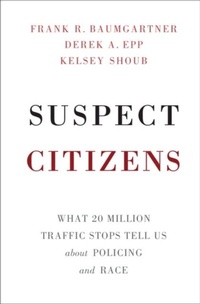
Suspect Citizens
What 20 Million Traffic Stops Tell Us About Policing and Race
Published on 11. July 2018
978-1-108-57599-7 (ISBN)
Description

Suspect Citizens offers the most comprehensive look to date at the most common form of police-citizen interactions, the routine traffic stop. Throughout the war on crime, police agencies have used traffic stops to search drivers suspected of carrying contraband. From the beginning, police agencies made it clear that very large numbers of police stops would have to occur before an officer might interdict a significant drug shipment. Unstated in that calculation was that many Americans would be subjected to police investigations so that a small number of high-level offenders might be found. The key element in this strategy, which kept it hidden from widespread public scrutiny, was that middle-class white Americans were largely exempt from its consequences. Tracking these police practices down to the officer level, Suspect Citizens documents the extreme rarity of drug busts and reveals sustained and troubling disparities in how racial groups are treated.
Reviews / Votes
'By focusing on every traffic stop in the state of North Carolina from 2002 to 2016, Suspect Citizens provides unassailable evidence of racial bias in routine police-citizen interactions. This book represents a monumental scholarly accomplishment that may also lead to important public policy reforms.' Vincent L. Hutchings, Hanes Walton, Jr, Collegiate Professor, University of Michigan 'For well over a decade North Carolina law enforcement agencies led the nation in collecting traffic stop data as directed by state legislation. Unfortunately, neither state legislators nor law enforcement leaders understood how to interpret or use that data. Law enforcement leaders in North Carolina and across the nation can use this work to better enforce traffic safety laws while building a trusting, transparent relationship with their communities.' Harold E. Medlock, former Chief of Police, Fayetteville, North Carolina, Police Department 'Racialized policing is one of the most pressing civil rights issues of our day. Through a meticulous analysis and sweeping examination of North Carolina's multiyear data on traffic stops over time and across place, agency, and groups, Suspect Citizens is a deep dive into the causes and injurious consequences of racialized policing. Avoiding easy answers and delivering bold, actionable findings, Baumgartner, Epp, and Shoub capture an essential insight: that aggressive policing strategies exact a high price in community alienation but deliver precious few benefits in public safety. This book arrives at a time when our nation desperately calls out for policy solutions to racially targeted policing.' Vesla M. Weaver, Bloomberg Distinguished Associate Professor, The Johns Hopkins University 'Baumgartner, Epp, and Shoub highlight the different reality of driving in North Carolina faced by black, white, and Hispanic drivers. This book is a must-read for scholars and policymakers who are interested in fairer outcomes in criminal justice and in improving relations between communities of color and the officers who serve them.' Traci Burch, Northwestern University, Illinois 'The most complete picture we have of who the police interact with and how. Suspect Citizens combines 'big data, 'careful thought, and meticulous and accessible analysis to offer critical insights into police behavior.' Peter K. Enns, author of Incarceration Nation: How the United States Became the Most Punitive Democracy in the World and Cornell University, New York 'The authors, all scholars of criminal justice or government, provide a thorough examination of traffic stops that adds to the breadth of research already in existence, combining a literature review with their own groundbreaking work studying routine traffic stops in North Carolina. ... This informative and well-written book will be a valued addition to many library collections, especially those supporting sociology or criminal justice programs.' D. R. Kavish, Choice 'This book is an important primer for policy makers and advocates ... The authors ... do a good job of speaking to multiple audiences. They cite the relevant criminological, sociological, socialpsychology, and political science literature appropriately.' Doris Marie Provine, Perspectives on Politics 'Teachers of quantitative methods courses looking for data for class assignments will appreciate this, as will scholars, be they emerging or established, looking for high-quality data for new projects on the politics of policing, at least if their focus is on traffic stops, either as a dependent variable or as independent variables. In sum, I highly recommend Suspect Citizens.' Michael Leo Owens, Journal of Race, Ethnicity, and Politics 'Suspect Citizens, written by a distinguished team of political scientists, delivers on that promise by providing an extraordinary study of racial profiling in North Carolina using the state's mandated traffic stop database. In the era of big data policing, Baumgartner, Epp, and Shoub demonstrate the value of data mining police practices to reveal racial disparities in 20 million recorded traffic stops between 2002 and 2016 ... The book is an important historical and contemporary window into one state's experience with one of the so-called remedies advocated by social scientists, police practitioners, and politicians in the late 1990s to reduce racial profiling by the police.' Albert J. Meehan, American Journal of SociologyMore details
Language
English
Place of publication
Cambridge
United Kingdom
Target group
College/higher education
Professional and scholarly
Illustrations
Worked examples or Exercises; 40 Tables, black and white; 33 Line drawings, black and white
File size
21,52 MB
ISBN-13
978-1-108-57599-7 (9781108575997)
Copyright in bibliographic data and cover images is held by Nielsen Book Services Limited or by the publishers or by their respective licensors: all rights reserved.
Schweitzer Classification
Other editions
Additional editions
Frank R. Baumgartner | Derek A. Epp | Kelsey Shoub
Suspect Citizens
What 20 Million Traffic Stops Tell Us About Policing and Race
Book
07/2018
Cambridge University Press
€126.50
Shipment within 15-20 days
Frank R. Baumgartner | Derek A. Epp | Kelsey Shoub
Suspect Citizens
What 20 Million Traffic Stops Tell Us About Policing and Race
Book
07/2018
Cambridge University Press
€33.10
Shipment within 15-20 days
Persons
Content
1. Suspect citizens: fighting the war on crime with traffic stops; 2. A legislative mandate to address concerns about racial profiling; 3. Who gets stopped?; 4. What happens after a stop?; 5. Finding contraband; 6. Search and arrest patterns by officer and agency; 7. Profiling Hispanics, profiling blacks; 8. Black political power and disparities in policing; 9. Reforms that reduce alienation and enhance community safety; 10. Conclusions.
