

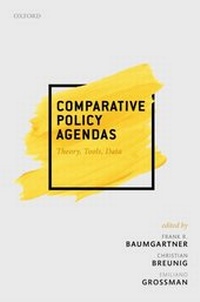
Comparative Policy Agendas
Theory, Tools, Data
1st Edition
Published on 14. March 2019
432 pages
978-0-19-257222-6 (ISBN)
Description

This is an open access title available under the terms of a CC BY-NC-ND 4.0 International licence. It is free to read at Oxford Scholarship Online and offered as a free PDF download from OUP and selected open access locations.
This book summarizes recent advances in the work on agenda-setting in a comparative perspective. The book first presents and explains the data-gathering effort undertaken within the Comparative Agendas Project over the past ten years. Individual country chapters then present the research undertaken within the many national projects. The third section illustrates the possibilities and directions for new research in comparative public policy using the data presented in this book. All the data used and discussed in the book is moreover publicly available.
The book represents a significant contribution to the study of comparative public policy. By introducing a unified research infrastructure it opens up new possibilities for both empirical and theoretical research in this area.
More details
Other editions
Additional editions
Frank R. Baumgartner | Christian Breunig | Emiliano Grossman
Comparative Policy Agendas
Theory, Tools, Data
Book
03/2019
Oxford University Press
€130.80
Shipment within 15-20 days
Persons
Frank R. Baumgartner started the US-based Policy Agendas Project with Bryan Jones over twenty-five years ago, and has been involved in its comparative extensions from the beginning. His research has variously focused on public policy processes, lobbying, agenda-setting, framing, race and criminal justice, and the death penalty. He has worked over the years in both American and comparative public policy issues.
Christian Breunig is professor of comparative politics at the Department of Politics and Public Administration at the University of Konstanz. He is interested in issues of representation and public policy, in particular law-making and budgetary politics, in advanced democracies. He directs the German Policy Agendas Project which is part of the Comparative Agendas Project.
Emiliano Grossman is professor of political science at Sciences Po. He teaches comparative politics and public policy at Sciences Po, where he is the convenor of the program in 'politics and public policy'. His research concentrates on political institutions, agenda-setting processes, and the role of media in politics. He is currently co-editor of the European Journal of Political Research. He has recently co-edited The Oxford Handbook of French Politics.
Content
- Cover
- Comparative Policy Agendas: Theory, Tools, Data
- Copyright
- Contents
- List of Figures
- List of Tables
- List of Contributors
- Part I: Roots, Foundations, and Evolution
- 1: The Comparative Agendas Project: Intellectual Roots and Current Developments
- 1.1 Roots and Goals of the Comparative Agendas Project
- 1.2 Using Agendas to Study Public Policy across and within Nations
- 1.3 Comparative Policy Agendas as a Field of Study
- 1.4 The Current State of the CAP Infrastructure
- 1.5 Structure of the Book
- References
- 2: Gone Fishing: The Creation of the Comparative Agendas Project Master Codebook
- 2.1 The Comparative Agendas Project: A Philosophy and a Beginning
- 2.1.1 But What Is CAP Data?
- 2.1.2 Coding Limited by Design
- 2.1.3 Policy Not Targets? Terrorism and the Economic Crisis
- 2.2 Coding through Compromise: The CAP Master Codebook
- 2.2.1 The Master Codebook Process
- 2.2.2 The Devil in the Details
- 2.2.3 A Cold War Mentality: Addressing the Country and Regional Subtopics
- 2.3 The Validity of Policy Differences
- 2.3.1 Defense Policy: The United States vs Switzerland
- 2.3.2 Culture: Something France Has and the United Kingdom Does Not?
- 2.3.3 Universal Health: Policy Attention
- 2.4 Conclusion
- Acknowledgements
- Notes
- References
- 3: The Comparative Agendas Project: The Evolving Research Interests and Designs of the CAP Scholarly Community
- 3.1 What CAP Scholars Are Interested in
- 3.2 Designs Used by CAP Scholars
- 3.3 Conclusion: Past and Future of the Comparative Agendas Project
- Note
- References
- Part II: Country Projects
- 4: The Australian Policy Agendas Project
- 4.1 The Australian Political System
- 4.2 Datasets of the Australian Policy Agendas Project
- 4.2.1 Legislation
- 4.2.2 Governor-General's Speeches (1945-2013)
- 4.2.3 Opposition Questions
- 4.2.4 The Media
- 4.2.5 Public Opinion
- 4.2.6 The High Court of Australia
- 4.3 An Example
- Notes
- References
- 5: The Belgian Agendas Project
- 5.1 The Belgian Agendas Project
- 5.2 The Belgian Political System
- 5.3 Belgian Datasets Description
- 5.4 Focus of the Belgian Project
- 5.5 Example: State Reform
- Notes
- References
- 6: The Canadian Agendas Project
- 6.1 The Canadian Political System
- 6.2 Canadian Political Agendas
- 6.3 Contributions of the Project and Perspectives
- References
- 7: Croatian Political Agendas
- 7.1 Introduction
- 7.2 The Croatian Political System
- 7.3 Datasets
- 7.4 Specificities
- 7.5 Automated Classification Procedure
- 7.6 Example: Government Confidentiality Policies
- References
- 8: The Danish Agendas Project
- 8.1 The Danish Political System
- 8.2 Datasets
- 8.3 Parliamentary Data Series
- 8.4 Local Government Agendas
- 8.5 Major Findings from the Danish Project
- Notes
- References
- 9: The French Agendas Project
- 9.1 The French Political System
- 9.2 Datasets
- 9.3 Specificities and Perspectives
- Note
- References
- 10: Political Agendas in Germany
- 10.1 The German Political System
- 10.2 German Political Agendas
- 10.3 Coding Procedure and Data Description
- 10.4 A First Look at the Database: Reunification in Political Agendas
- References
- 11: The Hungarian Agendas Project
- 11.1 The Hungarian Political System
- 11.2 Datasets
- 11.3 Specificities of the Hungarian Project
- 11.4 Perspectives: The Politics of Communism and Restitution
- Note
- References
- 12: The Israeli Agendas Project
- 12.1 Introduction
- 12.2 The Israeli Political System
- 12.3 Datasets
- 12.3.1 Laws and Regulations
- 12.3.2 Cabinet Decisions
- 12.4 An Example: The Arrangement Law (The Hesderim Law)
- 12.5 Unique Features of the Israeli Coding Procedure
- Reference
- 13: The Italian Agendas Project
- 13.1 The Italian Political System
- 13.2 Codebook and Datasets
- 13.3 Specificities and Perspectives
- Notes
- References
- 14: The Dutch Policy Agendas Project
- 14.1 The Dutch Political System and Agenda-Setting
- 14.2 Datasets and Coding Procedures
- 14.3 Description of Datasets
- 14.4 Example: The Policy Agenda of Safety Issues
- References
- 15: The New Zealand Policy Agendas Project
- 15.1 New Zealand's Political System
- 15.2 Datasets of the New Zealand Policy Agendas Project
- 15.2.1 New Zealand Supreme Court
- 15.2.2 Parliament-Oral Questions
- 15.3 An Example
- Notes
- References
- 16: The Portuguese Policy Agendas Project
- 16.1 The Portuguese Political System
- 16.2 Coding Issues and Data
- 16.3 Party Pledges: Exemplifying on a Specificity
- 16.4 Final Remarks
- Note
- References
- 17: Agenda Dynamics in Spain
- 17.1 The Spanish Political System
- 17.2 Databases
- 17.3 Specificities: Multilevel Governance
- 17.4 Conclusions
- Acknowledgements
- References
- 18: The Swiss Policy Agendas Project
- 18.1 The Swiss Political System
- 18.2 Datasets
- 18.3 Direct Democracy and Agenda-Setting
- Notes
- References
- 19: The Turkish Policy Agendas Project
- 19.1 Turkish Politics
- 19.2 Datasets
- 19.3 Empirical Applications
- 19.3.1 Measuring Public Preferences and Government Responsiveness
- 19.3.2 Public Budgeting in Authoritarian Regimes
- 19.4 Concluding Remarks
- References
- 20: The UK Policy Agendas Project
- 20.1 The UK Policy Agendas Project
- 20.2 The UK Political System and Agenda-Setting
- 20.3 Project and Data
- 20.3.1 The UK Coding System, Protocols, and Reliability
- 20.3.2 Comparing Cross-Nationally
- 20.3.3 Datasets
- 20.4 Insights from the UK Policy Agendas Project Data
- Note
- References
- 21: The US Policy Agendas Project
- 21.1 US Policy Agendas
- 21.2 US Political System
- 21.3 Datasets
- 21.4 A Look into the Data
- References
- 22: The EU Policy Agendas Project
- 22.1 The EU Political System
- 22.2 EU Policy Agendas Datasets
- 22.3 Specificities
- 22.4 An Example
- Note
- References
- 23: Agenda-Setting in the Florida Legislature
- 23.1 Florida
- 23.2 Extant Datasets
- 23.2.1 Bills
- 23.2.2 Biographical Data of Florida State Legislators
- 23.2.3 Newspaper Data-the Sayfie Review
- 23.3 Codebook
- 23.4 Coder Training
- 23.5 Data Example
- 23.6 Conclusion
- Notes
- References
- 24: Pennsylvania Policy Database Project
- 24.1 The Government and Politics of Pennsylvania
- 24.2 Datasets
- 24.3 Specificities and Perspectives
- 24.4 Data Analysis Example
- Notes
- References
- Part III: Comparative Perspectives
- 25: The Public Agenda: A Comparative Perspective
- 25.1 The Public Agenda and Theories of Agenda-Setting
- 25.2 Causes and Effects of the Public Agenda
- 25.3 Comparing the Public Agenda
- 25.4 Measuring the Public Agenda
- 25.5 Analysis
- 25.5.1 Comparing Public Agendas in United States, the United Kingdom, and Spain
- 25.5.2 Tracking the Public Agenda over Time
- 25.5.3 Stability and Instability in the Public Agenda
- 25.5.4 What Shapes the Public Agenda?
- 25.5.5 Representation via the Public and Policy Agenda
- 25.5.6 Public and Policy Agendas over Time
- 25.6 Conclusion
- Notes
- References
- 26: From Public to Publics: Assessing Group Variation in Issue Priorities in the United States and Israel
- 26.1 The Public Agenda and Issue Priorities
- 26.2 MIP Data
- 26.3 Issue Priorities in the United States
- 26.3.1 Macroeconomics
- 26.3.2 Macroeconomics-Minor Topics
- 26.4 Issue Priorities in Israel
- 26.5 Conclusion
- Notes
- References
- 27: Protest and Agenda-Setting
- 27.1 The Agenda Effect of Protest
- 27.2 Methods
- 27.3 Results
- 27.4 Conclusion
- References
- 28: The Media Agenda
- 28.1 Introduction
- 28.2 The Media Agenda: One of a Kind?
- 28.3 Political Agenda-Setting by the media
- 28.4 Empirical Example
- 28.4.1 Data
- 28.4.2 Results
- 28.5 Conclusion
- References
- 29: Parliamentary Questions
- 29.1 Oral Questions as Attention-Seeking Devices
- 29.2 Party Competition and the Increase in ParliamentaryQuestioning
- 29.3 Fragmentation of Issue Attention
- 29.4 Parliamentary Questions and Institutional Friction
- 29.5 Conclusion
- Notes
- References
- 30: Connecting Government Announcements and Public Policy
- 30.1 Expanding the "Program to Policy Link"
- 30.2 Institutional Features and the "Program to Policy Link"
- 30.3 Data and Methodology
- 30.4 Results and Discussion
- 30.5 Conclusion
- Note
- References
- 31: The Europeanization of Parliamentary Attention in and out of the European Union: France, Spain, the Netherlands, and Switzerland Compared
- 31.1 Introduction
- 31.2 The Europeanization of Parliamentary Activities
- 31.3 Coding of Parliamentary Questions (PQs)
- 31.4 The Scope and Triggers of Europeanized Questions
- 31.4.1 Evolution over Time and across Countries
- 31.4.2 Issue Attention
- 31.5 Conclusion
- Appendix
- Notes
- References
- 32: Horizontal and Vertical Attention Dynamics: Environmental Problems on Executive Policy Agendas in EU Member States
- 32.1 The Conditional Attention to Environmental Problems
- 32.2 Horizontal and Vertical Attention Dynamics
- 32.2.1 Horizontal Attention Dynamics: Issue Competition
- 32.2.2 Vertical Attention Dynamics: Multilevel Agenda-Setting
- 32.3 Data and Method of Analysis
- 32.4 Empirical Patterns in Four Member States and the European Union
- 32.4.1 Vertical Attention Dynamics: Multilevel Agenda-Setting
- 32.4.2 Horizontal Attention Dynamics: Issue Competition
- 32.5 Conclusion
- Acknowledgements
- Appendix 32.A.1: Subtopics included in the data
- Appendix 32.B.1: Summary of attention to environment in four countries
- Notes
- References
- 33: Using CAP Data for Qualitative Policy Research
- 33.1 Introduction
- 33.2 CAP as a Tool for Identifying Relevant Population of Cases
- 33.2.1 Drift in the United States
- 33.2.2 Drift in Spain
- 33.2.3 Limitations
- 33.3 CAP as a Tool for Familiarization with the Case of Interest
- 33.3.1 Childcare Policy in Spain
- 33.4 CAP as a Tool for Gathering Evidence
- 33.4.1 Lock-in Effect in Childcare Policy in the United States
- 33.4.2 Limitations
- 33.5 Conclusion
- Note
- References
- 34: Issue Attention in West European Party Politics: CAP and CMP Coding Compared
- 34.1 Introduction
- 34.2 The CMP and CAP Datasets and the Discussions around them
- 34.3 CMP and CAP Compared
- 34.4 Conclusions
- Acknowledgements
- Notes
- References
- 35: Advancing the Study of Comparative Public Policy
- 35.1 A Vast Infrastructure for the Study of Comparative Public Policy
- 35.2 Setting Standards for Collecting and Assembling Comparative Policy Data
- 35.3 The Future of Comparative Public Policy Studies
- References
- Index
