

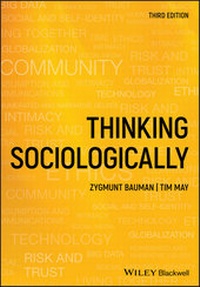
Thinking Sociologically
Description

Now in its third edition, Thinking Sociologically continues to offer a stimulating exploration of the underlying assumptions and tacit expectations which structure our view of the world. This best-seller has been translated into 12 languages to bring key sociological concepts to students and general readers around the globe. The authors review recent developments in society and examine the applicability of sociology to everyday life.
The world has changed a great deal since the second edition's publication. Issues of climate change, sustainability, inequality, social justice, inclusion and the role of social media have risen to prominence, and we are collectively challenging our ways of thinking about intimacy, community, consumption, ethics, social identity, and more. This new third edition has been revised to reflect these and other transformations in our lives, helping us to think sociologically about the consequences of these burgeoning issues, how we organize our societies, understand ourselves and lead our lives. This dynamic book:
* Applies sociology to everyday life in the context of current issues
* Contains contributions from major theorists that introduce central sociological concepts with modern relevance
* Features a highly engaging and stimulating style that promotes critical thought and independent study
Written for undergraduates, postgraduates, practicing sociologists and social scientists, this book also holds a broad appeal to a general audience. The third edition of Thinking Sociologically offers a compelling survey of sociological issues, recent changes in society and their influence on our day-to-day lives and identities.
Learn more about Thinking Sociologically in co-author Tim May's recent piece for the British Sociological Association.
More details
Other editions
Additional editions
Persons
ZYGMUNT BAUMAN was a world-renowned sociologist known for his ground-breaking work in social theory. His most recent publications included: Does the Richness of the Few Benefit Us All? (2013); Strangers at our Door (2016); Retrotopia (2017); and A Chronicle of Crisis: 2011-2016 (2017).
TIM MAY is Professor of Social Science Methodology at the University of Sheffield, UK. His recent publications include: Reflexivity: The Essential Guide (2017); Cities and the Knowledge Economy: Promise, Politics and Possibilities (2018); and Social Research: Issues, Methods and Process (5th edition, 2019).
Content
Preface to the Second Edition ix
Preface to the Third Edition xi
Acknowledgments xiii
Introduction: Crafting Sociological Lenses 1
Part I Action and Understanding in Everyday Life 13
1 Understanding Ourselves with and through Others 15
2 Sustaining Our Lives 27
3 Social Bonds: Speaking of "You" and "We" 41
Part II Choices, Contexts, and Challenges 55
4 Values, Power, and Choice 57
5 Gifts, Exchange, and Intimacy 77
6 Body, Sexuality, and Health 91
7 Space, Time, and Social Dynamics 105
8 Culture, Nature, and Territory 123
9 Consumption, Technology, and Lifestyle 143
Part III Retrospect and Prospect 159
10 Sociological Lenses: Retrospect and Prospect 161
Questions for Reflection and Further Reading 177
Index 187
