

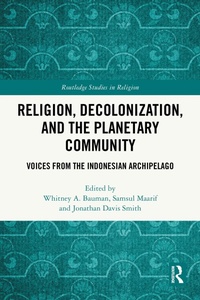
Religion, Decolonization, and the Planetary Community
Voices from the Indonesian Archipelago
1st Edition
Published on 22. January 2026
302 pages
978-1-040-53580-6 (ISBN)
Description

In light of the two great phenomena that define the era of the Anthropocene, globalization and climate change, what does it mean to be a human subject or person in the world today? One response to these phenomena in the world has been some sort of return to nationalism (usually on the political right) or localism/bioregionalism (usually on the political left). A second response has been a continuation of the spread of neo-liberal capitalism without any apparent regard for the problems it is causing (on the political right) or with social and environmental protections tagged on (on the political left).
This volume provides what is needed: new and multiple stories and ideas about the many different ways of being human in the world, and what this might mean for the planetary future. The volume brings together 17 scholars (14 Indonesians and 3 Global North scholars) working from or deeply influenced by the Indonesian archipelago. Each contributor examines the interconnected themes of religion, decolonization, and the planetary from their distinctive disciplinary and geographic locations.
This volume is divided into four parts, each with four chapters that share a thematic focus. "Thinking about Decolonization and the Planetary" provides the philosophical and theoretical groundwork for decolonizing religion and planetary thinking from an Indonesian context. "Decolonizing Human-Nature Relations" presents case studies that demonstrate how some Indigenous Peoples and local communities live in subjective relationships with nature, opening up new possibilities for caring for and with the natural environment. "Decolonizing Religion, Nature, and Gender Studies" presents case studies of religious, gender, and ecological binaries that both disadvantage some groups and provide spaces for hybridity, resistance, and embodied practices of human-nature relations by women, LGBTQ+, and other minoritized communities. "Decolonizing Legal and Rights Frameworks for Indigenous Peoples" offers analyses of
the top-down frameworks of law and human rights that perpetuate (post)colonial marginalization and erasure of Indigenous Peoples and local communities, and they propose ways of decolonizing these frameworks to better respect and integrate lived religion for a better planetary future.
This cutting-edge volume will be of interest to those within religion and critical theories, religion and Southeast Asia, religion and ecology, and religion and nature. In addition, it would be a valuable read for anyone who studies the broader humanities within the context of Indonesia or environmental humanities.
This volume provides what is needed: new and multiple stories and ideas about the many different ways of being human in the world, and what this might mean for the planetary future. The volume brings together 17 scholars (14 Indonesians and 3 Global North scholars) working from or deeply influenced by the Indonesian archipelago. Each contributor examines the interconnected themes of religion, decolonization, and the planetary from their distinctive disciplinary and geographic locations.
This volume is divided into four parts, each with four chapters that share a thematic focus. "Thinking about Decolonization and the Planetary" provides the philosophical and theoretical groundwork for decolonizing religion and planetary thinking from an Indonesian context. "Decolonizing Human-Nature Relations" presents case studies that demonstrate how some Indigenous Peoples and local communities live in subjective relationships with nature, opening up new possibilities for caring for and with the natural environment. "Decolonizing Religion, Nature, and Gender Studies" presents case studies of religious, gender, and ecological binaries that both disadvantage some groups and provide spaces for hybridity, resistance, and embodied practices of human-nature relations by women, LGBTQ+, and other minoritized communities. "Decolonizing Legal and Rights Frameworks for Indigenous Peoples" offers analyses of
the top-down frameworks of law and human rights that perpetuate (post)colonial marginalization and erasure of Indigenous Peoples and local communities, and they propose ways of decolonizing these frameworks to better respect and integrate lived religion for a better planetary future.
This cutting-edge volume will be of interest to those within religion and critical theories, religion and Southeast Asia, religion and ecology, and religion and nature. In addition, it would be a valuable read for anyone who studies the broader humanities within the context of Indonesia or environmental humanities.
More details
Series
Edition
1. Auflage
Language
English
Place of publication
London
United Kingdom
Publishing group
Taylor & Francis Ltd
Target group
College/higher education
Illustrations
2 Tables, black and white; 40 Halftones, black and white; 40 Illustrations, black and white
File size
41,63 MB
ISBN-13
978-1-040-53580-6 (9781040535806)
Copyright in bibliographic data and cover images is held by Nielsen Book Services Limited or by the publishers or by their respective licensors: all rights reserved.
Schweitzer Classification
Other editions
Additional editions
Whitney A. Bauman | Samsul Maarif | Jonathan Davis Smith
Religion, Decolonization, and the Planetary Community
Voices from the Indonesian Archipelago
Book
approx. 01/2026
1st Edition
Routledge
€211.70
Not yet published
Persons
Whitney A. Bauman is Professor of Religious Studies at Florida International University (FIU) in Miami, FL. He is also co-founder and co-director of Counterpoint: Navigating Knowledge, a non-profit based in Berlin, Germany that holds public discussions over social and ecological issues related to globalization and climate change.
Samsul Maarif is Director of the MA Program of the Center for Religious and Cross-Cultural Studies (CRCS), Graduate School, Universitas Gadjah Mada. His research interests include religions of Indigenous Peoples, ecology, community development and advocacy. He is the coordinator of the research-advocacy coalition for Indigenous Peoples "Rumah Bersama" (shared home).
Jonathan Davis Smith is a Visiting Research Fellow at the Centre for Religion and Public Life, University of Leeds, UK. He is also a Visiting Lecturer at the Center for Religious and Cross-Cultural Studies, Universitas Gadjah Mada, Indonesia. His research focuses on religion/culture, social movements and environmental activism.
Samsul Maarif is Director of the MA Program of the Center for Religious and Cross-Cultural Studies (CRCS), Graduate School, Universitas Gadjah Mada. His research interests include religions of Indigenous Peoples, ecology, community development and advocacy. He is the coordinator of the research-advocacy coalition for Indigenous Peoples "Rumah Bersama" (shared home).
Jonathan Davis Smith is a Visiting Research Fellow at the Centre for Religion and Public Life, University of Leeds, UK. He is also a Visiting Lecturer at the Center for Religious and Cross-Cultural Studies, Universitas Gadjah Mada, Indonesia. His research focuses on religion/culture, social movements and environmental activism.
Content
Introduction Part 1: Thinking about Decolonization and the Planetary 1. Decolonization and Planetary Thinking 2. Decolonizing Religion: toward an Engaged "Religious" Methodology 3. Decolonizing the Decolonization Discourse: The Dutch and the Making of Religion in Indonesia 4. Towards Decolonial Blue Ecotheology: Voices from the Archipelago Part 2: Decolonizing Human-Nature Relations 5. Bengawan Solo Riwayatmu Kini: Reading River Pollutants through Women's Eyes as a Decolonizing Act 6. Decolonizing Human-Animal Relations in Indonesia: Insights from Bara, Cindakko, and Tobalo Indigenous Communities in Sulawesi 7. Marapu Indigenous Economy: Ritual Agriculture in between Modern Disenchantment and Religious Ecology in Sumba, East Nusa Tenggara, Indonesia 8. Rethinking Human-Nature Relations in the Religious Education Curriculum on Indigenous Religions in Indonesia Part 3: Decolonizing Religion, Nature and Gender Studies 9. [Re]constructing [An]other Space: Ritual as a Site of Resistance for the Bissu Community in South Sulawesi, Indonesia 10. Waria Battling Everyday Life: From Identity Cards to Climate Disaster in Semarang, Indonesia 11. Daur Resik as an Ecofeminist Recycling Initiative: Living Well with Waste in Five Indonesian Cities for a Better Planetary Life 12. Decolonizing Human-Nature Relations: Ecofeminist Climate Activism in East Kalimantan, Indonesia Part 4: Decolonizing Legal and Rights Frameworks for Indigenous Peoples 13. Indigenous Rights Violations in Indonesia's Capital Relocation: Green Criminology and The Voice of Indigenous Peoples in East Kalimantan, Indonesia 14. Ibu Bumi Dilarani: How Environmental Law Conflicts with a Relational Approach to Nature in The North Kendeng Highlands, Central Java, Indonesia 15. Separative Conservation and Forest-Integrated Communities: The Manusela National Park Dilemma in Seram Island, Maluku, Indonesia 16. The Use of Ritual in Mediating Customary Land Disputes by the Dayak Kantuk Community in West Kalimantan, Indonesia
