

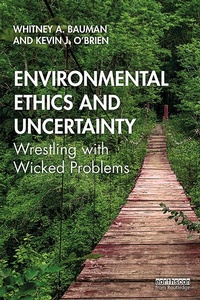
Environmental Ethics and Uncertainty
Wrestling with Wicked Problems
1st Edition
Published on 6. August 2019
160 pages
978-1-000-48756-5 (ISBN)
Description

This book offers a multidisciplinary environmental approach to ethics in response to the contemporary challenge of climate change caused by globalized economics and consumption. This book synthesizes the incredible complexity of the problem and the necessity of action in response, highlighting the unambiguous problem facing humanity in the 21st century, but arguing that it is essential to develop an ethics housed in ambiguity in response.
Environmental Ethics and Uncertainty is divided into theoretical and applied chapters, with the theoretical sections engaging in dialogue with scholars from a variety of disciplines, while the applied chapters offer insight from 20th century activists who demonstrate and/or illuminate the theory, including Martin Luther King, Rachel Carson, and Frank Lloyd Wright.
This book is written for scholars and students in the interdisciplinary field of environmental studies and the environmental humanities, and will appeal to courses in religion, philosophy, ethics, politics, and social theory.
Environmental Ethics and Uncertainty is divided into theoretical and applied chapters, with the theoretical sections engaging in dialogue with scholars from a variety of disciplines, while the applied chapters offer insight from 20th century activists who demonstrate and/or illuminate the theory, including Martin Luther King, Rachel Carson, and Frank Lloyd Wright.
This book is written for scholars and students in the interdisciplinary field of environmental studies and the environmental humanities, and will appeal to courses in religion, philosophy, ethics, politics, and social theory.
Reviews / Votes
"This welcome collaboration between two key scholars of environmental culture explains why embracing complexity, pluralism, difficulty, and uncertainty leads to better, deeper responses to environmental troubles. In clear prose with wide intellectual reference, Bauman and O'Brien argue that 'radical change is possible only at the pace of ambiguity.'"Willis Jenkins, Professor of Religious Studies & Environmental Humanities at the University of Virginia, USA
"Environmental Ethics and Uncertainty is original, engaging, and important. It offers students and other readers an entry into some of the very complex and challenging moral and theoretical issues related to climate change in a way that is smart and well-grounded without being overly dry, dense, or inaccessible. It does so by focusing on exactly the themes we need to be discussing in regards to environmental ethics and climate change today: ambiguity, uncertainty, pluralism, and hope. The authors show how uncertainty is not only theoretically but also practically helpful, as they think through concrete ethical problems such as fracking and pipeline protests. Further, their use of eclectic sources and thinkers both shows the wide range of issues and ideas we need to address in thinking about climate change and invites conversation with readers outside the field."
Anna Peterson, Professor, Department of Religion, University of Florida, USA
"Environmental Ethics and Uncertainty offers a timely intervention in polarized debates surrounding issues like climate change or fracking, and who or what we should believe. Drawing on the wisdom of activists and thinkers ranging from Rachel Carson to Martin Luther King, Jr., the book underscores the value of questioning. Bauman and O'Brien show us that excessive certainty and willful ignorance-both prominent stances in modern American culture-fail to capture the complexity of knowledge and its relationship to moral action."
Professor Lisa Sideris, Department of Religious Studies, Indiana University, USA
"The distinctiveness of Bauman and O'Brien's text comes through its unique combination of theoretical and applied chapters, drawing upon an impressive array of interdisciplinary sources and examples ... Employing the familiar frame of 'wicked problems', Bauman and O'Brien argue that approaches to environmental issues must inevitably appreciate complexity and uncertainty while emphasising the multiple positions and perspectives surrounding specific ... Bauman and O'Brien's work offers an important perspective to be considered by any scholars and activists interested in applied environmental ethics in the twenty-first century."
Joseph D. Witt, Mississippi State University in 'Environmental Values', 2020
More details
Edition
1. Auflage
Language
English
Place of publication
London
United Kingdom
Publishing group
Taylor & Francis Ltd
Target group
College/higher education
Illustrations
2 Line drawings, black and white
ISBN-13
978-1-000-48756-5 (9781000487565)
Copyright in bibliographic data and cover images is held by Nielsen Book Services Limited or by the publishers or by their respective licensors: all rights reserved.
Schweitzer Classification
Other editions
Additional editions
Book
08/2019
1st Edition
Routledge
€59.70
Shipment within 15-20 days
Book
08/2019
1st Edition
Routledge
€205.80
Shipment within 15-20 days
Persons
Whitney A. Bauman is Associate Professor of Religious Studies at Florida International University, USA. His books include Religion and Ecology: Developing a Planetary Ethic (2014) and, with Kevin O'Brien and Richard Bohannon, Grounding Religion: A Field Guide to the Study of Religion and Ecology, 2nd Revised Edition (2018).
Kevin J. O'Brien is Professor of Religion and Dean of Humanities at Pacific Lutheran University, USA. His books include The Violence of Climate Change: Lessons of Resistance from Nonviolent Activists and, with Whitney Bauman and Richard Bohannon, Inherited Land: The Changing Grounds of Religion and Ecology.
Kevin J. O'Brien is Professor of Religion and Dean of Humanities at Pacific Lutheran University, USA. His books include The Violence of Climate Change: Lessons of Resistance from Nonviolent Activists and, with Whitney Bauman and Richard Bohannon, Inherited Land: The Changing Grounds of Religion and Ecology.
Content
Introduction
The problem with knowing the answer
Chapter 1
Ethical action in an ambiguous world
Chapter 2
The depths of ambiguity: Ethical pluralism and wonder in Marjory Stoneman Douglas and Rachel Carson
Chapter 3
Good and evil without progress
Chapter 4
Complexity in action: The challenging uncertainties of Martin Luther King, Jr. and Malcolm X
Chapter 5
Loving the world without certainty
Chapter 6
The dangers of building without ambiguity: Spirituality and utopianism in Frank Lloyd Wright
Chapter 7
Concluding ideas on ambiguous time
Chapter 8
Concluding practices for an uncertain stand: Fracking, Protesting, and engineering the climate
The problem with knowing the answer
Chapter 1
Ethical action in an ambiguous world
Chapter 2
The depths of ambiguity: Ethical pluralism and wonder in Marjory Stoneman Douglas and Rachel Carson
Chapter 3
Good and evil without progress
Chapter 4
Complexity in action: The challenging uncertainties of Martin Luther King, Jr. and Malcolm X
Chapter 5
Loving the world without certainty
Chapter 6
The dangers of building without ambiguity: Spirituality and utopianism in Frank Lloyd Wright
Chapter 7
Concluding ideas on ambiguous time
Chapter 8
Concluding practices for an uncertain stand: Fracking, Protesting, and engineering the climate
