

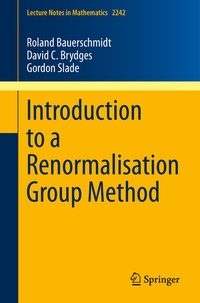
Introduction to a Renormalisation Group Method
Description

This is a primer on a mathematically rigorous renormalisation group theory, presenting mathematical techniques fundamental to renormalisation group analysis such as Gaussian integration, perturbative renormalisation and the stable manifold theorem. It also provides an overview of fundamental models in statistical mechanics with critical behaviour, including the Ising and f 4 models and the self-avoiding walk.
The book begins with critical behaviour and its basic discussion in statistical mechanics models, and subsequently explores perturbative and non-perturbative analysis in the renormalisation group. Lastly it discusses the relation of these topics to the self-avoiding walk and supersymmetry.
Including exercises in each chapter to help readers deepen their understanding, it is a valuable resource for mathematicians and mathematical physicists wanting to learn renormalisation group theory.
More details
Other editions
Additional editions
Persons
Roland Bauerschmidt is a University Lecturer in the Department of Pure Mathematics and Mathematical Statistics at the University of Cambridge. His work mainly focuses on the applications of probability theory and analysis to topics in statistical mechanics. He received his Ph.D. in Mathematics from the University of British Columbia in 2013, and was a member of the Institute for Advanced Study in Princeton at the School of Mathematics, and a postdoctoral researcher at Harvard University. He received the IUPAP Young Scientist Prize in 2015.
David C. Brydg es is a Professor Emeritus of Mathematics at the University of British Columbia. He works on quantum field theory and statistical mechanics, with an interest in functional integration and probability. He received his Ph.D. from the University of Michigan, and was a Professor at the University of Virginia. He served as the President of the International Association of Mathematics Physics in 2003-2005, and was elected a Fellow of the Royal Society of Canada in 2007.
Gordon Slade is a Professor in the department of Mathematics at the University of British Columbia. He works on probability theory and statistical mechanics. He received his Ph.D. in Mathematics from the University of British Columbia, and was a Lecturer at the University of Virginia. He was also an Assistant Professor, Associate Professor and Professor at McMaster University. He has been honored with various prizes, e.g., Jeffery-Williams Prize, CRM-Fields-PIMS Prize, Coxeter-James Prize, and was elected a Fellow of the Royal Society (London), the American Mathematical Society, the Institute of Mathematical Statistics, the Fields Institute and the Royal Society of Canada.
