

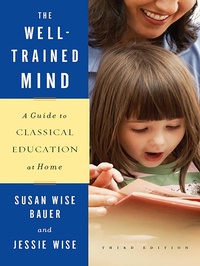
The Well-Trained Mind
A Guide to Classical Education at Home
3rd Edition
Published on 4. May 2009
864 pages
978-0-393-07090-3 (ISBN)
Description

"If you're a parent who has decided to educate your children yourself, this book is the first you should buy."—?Washington Times
The Well-Trained Mind will instruct you, step by step, on how to give your child an academically rigorous, comprehensive education from preschool through high school—one that will train him or her to read, to think, to ?understand?, to be well-rounded and curious about learning. Veteran home educators Jessie Wise and Susan Wise Bauer outline the classical pattern of education called the trivium, which organizes learning around the maturing capacity of the child's mind and comprises three stages: the elementary school "grammar stage," the middle school "logic stage," and the high school "rhetoric stage." Using this theory as your model, you'll be able to instruct your child in all levels of reading, writing, history, geography, mathematics, science, foreign languages, rhetoric, logic, art, and music, regardless of your own aptitude in those subjects.This newly revised edition contains completely updated ordering information for all curricula and books, new and expanded curricula recommendations, new material on using computers and distance-learning resources, answers to common questions about home education, information about educational support groups, and advice on practical matters such as working with your local school board, preparing a high school transcript, and applying to colleges.
More details
Other editions
New editions
E-Book
08/2016
4th Edition
W. W. Norton & Company
€36.99
Available for download
Additional editions
Book
05/2009
3rd Edition
WW Norton & Co
€54.66
Article exhausted; check for reprint
Previous edition
E-Book
04/2024
W. W. Norton & Company
€36.99
Available for download
Persons
Susan Wise Bauer is a writer, educator, and historian. Her previous books include the Writing With Ease, Writing With Skill, and Story of the World series from Well-Trained Mind Press, as well as The Well-Trained Mind: A Guide to Classical Education at Home, The Well-Educated Mind: A Guide to the Classical Education You Never Had, Rethinking School, The Story of Western Science: From the Writings of Aristotle to the Big Bang Theory, and the History of the World series, all from W. W. Norton. She has a Ph.D. in American Studies from the College of William & Mary in Virginia, as well as an M.A. in seventeenth-century literature and a Master of Divinity in Ancient Near Eastern Languages and Literature. For fifteen years, she taught literature and composition at the College of William and Mary.
Content
- Intro
- ALSO BY SUSAN WISE BAUER
- Title Page
- Copyright
- Dedication
- CONTENTS
- Acknowledgments for the First Edition
- Acknowledgments for the Revised Edition
- Acknowledgments for the Third Edition
- What The Well-Trained Mind Does: An Overview
- Practical Considerations: Using The Well-Trained Mind without Losing Your Own
- Supplementing Your Child's Education: The Well-Trained Mind and Full-Time School
- Epigraph
- PROLOGUE: THE STORY OF A CLASSICAL HOME EDUCATION
- 1. Uncharted Territory: Jessie
- 2. A Personal Look at Classical Education: Susan
- PART I. THE GRAMMAR STAGE: KINDERGARTEN THROUGH FOURTH GRADE
- 3. The Parrot Years
- Now or Never
- How to Teach the Poll-Parrot Stage
- Priorities
- 4. Unlocking the Doors: The Preschool Years
- Preschool: Birth to Three
- Kindergarten Years: Four and Five
- RESOURCES
- 5. Words, Words, Words: Spelling, Grammar, Reading, and Writing
- How to Do It
- General Instructions for Grades 1 through 4
- Overview of Language Work
- RESOURCES
- 6. The Joy of Numbers: Math
- The Way Children Think
- Math Tables: A Defense
- How to Do It
- Choosing Programs
- Schedules
- RESOURCES
- 7. Seventy Centuries in Four Years: History and Geography
- Seventy Centuries in Four Years
- What If You're Starting in the Middle?
- How to Do It
- RESOURCES
- 8. Making Sense of the World: Science
- Priorities
- Textbooks
- How to Do It
- RESOURCES
- 9. Dead Languages for Live Kids: Latin (and Other Languages Still Living)
- Why Latin?
- How Does Latin Work?
- How to Do It
- Schedules
- What about Other Languages?
- RESOURCES
- 10. Electronic Teachers: Using Computers and Videos
- 11. Matters of Faith: Religion
- RESOURCES
- 12. Finer Things: Art and Music
- Art
- Music
- RESOURCES
- Part I Epilogue Epilogue
- The Grammar Stage at a Glance
- Notebook Summary, Grades 1 through 4
- Whole Language and Phonics: Whole to Parts versus Parts to Whole
- PART II. THE LOGIC STAGE: FIFTH GRADE THROUGH EIGHTH GRADE
- 13. The Argumentative Child
- Building on the Foundation
- Logic and the Trivium
- Logic in the Curriculum
- How to Teach the Logic Stage
- Priorities
- 14. Snow White Was Irrational: Logic for the Intuitive
- How to Do It
- For the Logically Challenged
- RESOURCES
- 15. The Language of Reason: Math
- How to Do It: Fifth and Sixth Grades
- The Shift to Upper-Level Math
- RESOURCES
- 16. Why 1492? History and Geography
- Organizing the Material
- Starting in the Middle (or with More than One)
- How to Do It
- RESOURCES
- 17. Thinking Straight: Spelling, Grammar, Reading, and Writing
- How to Do It
- Spelling and Word Study
- Grammar
- Reading
- Writing
- Schedules
- RESOURCES
- 18. Making Deductions: Science
- Your Goals
- Texts
- Schedule
- The Notebook
- How to Do It
- RESOURCES
- 19. Looking into Other Worlds: Latin and Languages
- Teaching Options
- Which Languages?
- Which Texts?
- When Do I Do It?
- Schedules
- RESOURCES
- 20. Away with Abusive Fallacies! Religion
- RESOURCES
- 21. The History of Creativity: Art and Music
- Art
- Music
- Schedules
- RESOURCES
- 22. Magic Boxes: Using Computers and Videos
- Software
- The Internet
- DVDs
- RESOURCES
- 23. Moving toward Independence: Logic for Life
- Part II Epilogue Epilogue
- The Logic Stage at a Glance
- PART III. THE RHETORIC STAGE: NINTH GRADE THROUGH TWELFTH GRADE
- 24. Speaking Your Mind: The Rhetoric Stage
- A General Guide to the Rhetoric Stage
- The Study of Rhetoric
- How to Do It
- Debate
- Schedules
- RESOURCES
- 25. Skill with Words: Grammar and Writing
- How to Do It
- Schedules
- RESOURCES
- 26. Great Books: History and Reading
- How to Do It
- How to Talk about the Great Books
- Writing Projects
- What about American Government?
- Starting in the Middle
- University Sources for Great-Books Curricula
- Schedules
- RESOURCES
- 27. Comfort with Numbers: Math
- Possible Sequences
- Outside Help
- Advanced Placement
- Schedules
- RESOURCES
- 28. Principles and Laws: Science
- AN OVERVIEW OF RHETORIC-STAGE SCIENCE
- How to Do It
- Outside Help
- Sample Schedules
- RESOURCES
- 29. Learning Other Worlds: Foreign Languages
- Which Languages?
- Texts and Courses
- Schedules
- RESOURCES
- 30. Mastering the Magic Box: Computer Skills
- Generally Speaking
- Practically Speaking
- Schedule
- RESOURCES
- 31. Apologizing for Faith: Religion
- RESOURCES
- 32. Appreciating the Arts: Art and Music
- Art
- Music
- Schedules
- RESOURCES
- 33. The Specialist
- General Guidelines
- Flexibility
- Specific Guidelines
- Evaluation
- Schedule
- RESOURCE
- 34. Some People Hate Homer
- Part III Epilogue Epilogue
- The Rhetoric Stage at a Glance
- PART IV. COMING HOME: HOW TO EDUCATE YOUR CHILD AT HOME
- 35. The Kitchen-Table School: Why Home-Educate?
- Why Should You Home-School?
- Encouragement for Parents
- First Steps
- Taking Your Child Out of School
- Learning Challenges
- The Realities of Home Schooling
- A Personal Word from Jessie
- RESOURCES
- 36. The Confident Child: Socialization
- RESOURCE
- 37. The Character Issue: Parents as Teachers
- RESOURCES
- 38. And Just When Do I Do All This? Schedules for Home Schoolers
- How Much Time Does It Take?
- Yearly Planning
- Weekly Planning
- Daily Planning
- Jessie's Method of Organizing: A Personal Account
- Good Use of Time
- Home Schooling with Babies and Toddlers
- Schedules for Home Schoolers
- RESOURCES
- 39. Paper Proof: Grades and Record Keeping
- Notification
- Elementary School and Middle School: Portfolios
- High School: Transcripts
- Diploma
- RESOURCES
- 40. The Yardstick: Standardized Testing
- Yearly Testing
- AP and CLEP Exams
- PSAT, SAT, and ACT
- RESOURCES
- 41. Where's the Team? Athletics at Home
- RESOURCES
- 42. The Local School: Dealing with Your School System
- RESOURCE
- 43. Yelling for Help: Tutors, Online Resources, Correspondence Schools, Cooperative Classes, and Colleges and Universities
- Tutors
- Online Resources
- Correspondence Schools
- Cooperative Classes
- Community Colleges and Local Universities
- RESOURCES
- 44. Going to College: Applications for Home Schoolers
- Planning for College
- Choosing a College
- The Application Process
- The Portfolio
- One Successful Application
- Transcript Help
- A Word about Early Admissions
- RESOURCES
- 45. Working: Apprenticeships and Other Jobs
- RESOURCES
- 46. More Stuff: The Annotated Catalog List
- General
- Elementary Grades
- History
- Classics, Latin, Logic
- Shakespeare
- Language: Reading, Writing, Grammar, and So Forth
- Science
- Mathematics
- Used-Curricula and -Book Vendors
- 47. The Final Word: Starting in the Middle
- APPENDICES
- 1. Taking an Oral History
- 2. Home-Education Organizations
- 3. National Science Competitions
- 4. Sources
- 5. Previous Recommendations
- Selected Bibliography
