

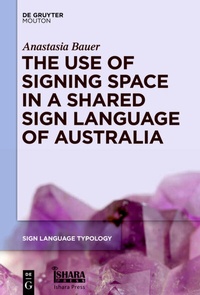
The Use of Signing Space in a Shared Sign Language of Australia
Description

Editorial board: Sam Lutalo-Kiingi, Ronice Müller de Quadros, Roland Pfau, Adam Schembri, Gladys Tang, Erin Wilkinson, Jun Hui Yang
The series is dedicated to the comparative study of sign languages around the world. Individual or collective works that systematically explore typological variation across sign languages are the focus of this series, with particular emphasis on undocumented, underdescribed and endangered sign languages. The scope of the series primarily includes cross-linguistic studies of grammatical domains across a larger or smaller sample of sign languages, but also encompasses the study of individual sign languages from a typological perspective and comparison between signed and spoken languages in terms of language modality, as well as theoretical and methodological contributions to sign language typology.
More details
Other editions
Additional editions
Person
Content
2 - List of figures [Seite 13]
3 - List of tables [Seite 17]
4 - Abbreviations [Seite 18]
5 - Sign language acronyms [Seite 19]
6 - Glossary [Seite 21]
7 - Notational conventions [Seite 22]
8 - Part I: Introduction [Seite 25]
8.1 - 1 Introduction [Seite 27]
8.1.1 - 1.1 Research aims and objectives [Seite 29]
8.1.2 - 1.2 Outline of the book [Seite 31]
8.2 - 2 Sign language types [Seite 34]
8.2.1 - 2.1 Deaf community sign languages [Seite 36]
8.2.2 - 2.2 Emerging sign languages [Seite 37]
8.2.3 - 2.3 Village sign languages [Seite 39]
8.2.3.1 - 2.3.1 Socioeconomic and demographic settings [Seite 39]
8.2.3.2 - 2.3.2 Social homogeneity [Seite 40]
8.2.3.3 - 2.3.3 (Socio-)Linguistic context [Seite 41]
8.2.3.4 - 2.3.4 Degree of endangerment [Seite 42]
8.2.4 - 2.4 Alternate sign languages [Seite 43]
8.2.4.1 - 2.4.1 Sawmill Sign Language [Seite 44]
8.2.4.2 - 2.4.2 Monastic sign languages [Seite 45]
8.2.4.3 - 2.4.3 Plains Indian Sign Language [Seite 46]
8.2.4.4 - 2.4.4 Keresan Pueblo Indian Sign Language [Seite 47]
8.2.4.5 - 2.4.5 Australian Aboriginal sign languages [Seite 47]
8.2.5 - 2.5 Shared sign languages [Seite 52]
8.2.6 - 2.6 Summary [Seite 54]
9 - Part II: Sociolinguistic Background & Methodology [Seite 57]
9.1 - 3 Cultural and sociolinguistic context [Seite 59]
9.1.1 - 3.1 Previous studies [Seite 59]
9.1.2 - 3.2 Historic & demographic background [Seite 61]
9.1.3 - 3.3 Cultural background [Seite 64]
9.1.4 - 3.4 Linguistic context [Seite 65]
9.1.5 - 3.5 The use of YSL in Yolngu communities [Seite 70]
9.1.5.1 - 3.5.1 Communication with deaf Yolngu [Seite 71]
9.1.5.2 - 3.5.2 Interaction over distance [Seite 74]
9.1.5.3 - 3.5.3 Further aspects of YSL origin and use [Seite 74]
9.2 - 4 Data collection [Seite 78]
9.2.1 - 4.1 Fieldwork [Seite 78]
9.2.1.1 - 4.1.1 Fieldwork sites [Seite 78]
9.2.1.2 - 4.1.2 Cultural issue [Seite 81]
9.2.2 - 4.2 Stimulus materials [Seite 82]
9.2.2.1 - 4.2.1 Spontaneous signing [Seite 83]
9.2.2.2 - 4.2.2 Elicited signing [Seite 83]
9.2.2.2.1 - 4.2.2.1 Visual materials [Seite 83]
9.2.2.2.2 - 4.2.2.2 Questionnaires and games [Seite 86]
9.2.2.2.3 - 4.2.2.3 Translation from English and Djambarrpuy?u [Seite 87]
9.2.3 - 4.3 Participants [Seite 88]
9.2.4 - 4.4 Data annotation [Seite 91]
10 - Part III: Selected Aspects of YSL Grammar [Seite 97]
10.1 - 5 Phonological aspects [Seite 99]
10.1.1 - 5.1 Handshapes [Seite 99]
10.1.1.1 - 5.1.1 Basic handshapes [Seite 102]
10.1.1.1.1 - 5.1.1.1 Token frequency [Seite 103]
10.1.1.1.2 - 5.1.1.2 Type frequency [Seite 104]
10.1.1.1.3 - 5.1.1.3 Non-dominant hand frequency [Seite 104]
10.1.1.2 - 5.1.2 Marginal handshapes [Seite 106]
10.1.2 - 5.2 Sign types: preference for one-handedness [Seite 108]
10.1.3 - 5.3 Nonmanual markers [Seite 114]
10.1.3.1 - 5.3.1 Mouth gestures [Seite 114]
10.1.3.2 - 5.3.2 Mouthings [Seite 118]
10.1.3.3 - 5.3.3 Head movements [Seite 120]
10.1.3.3.1 - 5.3.3.1 sleep vs. exist [Seite 120]
10.1.3.3.2 - 5.3.3.2 bäy?u vs. yaka [Seite 122]
10.1.4 - 5.4 Summary [Seite 124]
10.2 - 6 Syntactic aspects [Seite 125]
10.2.1 - 6.1 Negation [Seite 125]
10.2.1.1 - 6.1.1 Negation in Djambarrpuy?u [Seite 125]
10.2.1.2 - 6.1.2 Negation in YSL [Seite 126]
10.2.1.3 - 6.1.3 Summary [Seite 130]
10.2.2 - 6.2 Interrogatives [Seite 130]
10.2.2.1 - 6.2.1 Content questions [Seite 131]
10.2.2.1.1 - 6.2.1.1 Question word paradigm [Seite 131]
10.2.2.1.2 - 6.2.1.2 Syntactic position of question signs [Seite 135]
10.2.2.2 - 6.2.2 Polar questions [Seite 138]
10.2.2.3 - 6.2.3 Nonmanual marking [Seite 141]
10.2.2.4 - 6.2.4 Summary [Seite 142]
11 - Part IV: Use of Space [Seite 145]
11.1 - 7 The size of signing space [Seite 147]
11.2 - 8 Pronominal reference [Seite 151]
11.2.1 - 8.1 Pronouns in spoken languages [Seite 151]
11.2.2 - 8.2 Pronouns in sign languages [Seite 152]
11.2.2.1 - 8.2.1 Metaphorical pointing [Seite 158]
11.2.2.2 - 8.2.2 Cross-linguistic variation in metaphorical pointing [Seite 160]
11.2.3 - 8.3 Pronouns in Djambarrpuy?u [Seite 161]
11.2.4 - 8.4 Pronouns in YSL [Seite 163]
11.2.4.1 - 8.4.1 Person [Seite 163]
11.2.4.2 - 8.4.2 Number [Seite 166]
11.2.4.3 - 8.4.3 Clusivity [Seite 168]
11.2.4.4 - 8.4.4 Case [Seite 169]
11.2.4.5 - 8.4.5 Summary & comparison to NCDSLs [Seite 171]
11.2.4.6 - 8.4.6 Pointing to a house: the use of metonymic pointing in YSL [Seite 171]
11.2.5 - 8.5 Summary [Seite 178]
11.3 - 9 Verb directionality [Seite 180]
11.3.1 - 9.1 Verb agreement in spoken languages [Seite 180]
11.3.2 - 9.2 Verb directionality in sign languages [Seite 183]
11.3.2.1 - 9.2.1 Sign language verb classes [Seite 183]
11.3.2.2 - 9.2.2 Disagreements on agreement [Seite 187]
11.3.3 - 9.3 Verb directionality in YSL [Seite 190]
11.3.3.1 - 9.3.1 YSL verb classes: plain vs. non-plain [Seite 190]
11.3.3.1.1 - 9.3.1.1 Frequency of spatial modification in non-plain verbs [Seite 193]
11.3.3.1.2 - 9.3.1.2 Directional verbs [Seite 199]
11.3.3.1.3 - 9.3.1.3 Absence of number marking [Seite 202]
11.3.3.1.4 - 9.3.1.4 Optional object or location marking on YSL verbs [Seite 203]
11.3.4 - 9.4 Constituent order in transitive clauses [Seite 203]
11.3.4.1 - 9.4.1 YSL constituent order [Seite 204]
11.3.4.2 - 9.4.2 Djambarrpuy?u constituent order [Seite 206]
11.3.4.3 - 9.4.3 Disscussion [Seite 207]
11.3.5 - 9.5 Summary [Seite 208]
11.4 - 10 Expression of motion [Seite 210]
11.4.1 - 10.1 Classifiers in spoken languages [Seite 210]
11.4.2 - 10.2 Classifiers in sign languages [Seite 212]
11.4.2.1 - 10.2.1 Entity classifiers [Seite 213]
11.4.2.2 - 10.2.2 Handling classifiers [Seite 215]
11.4.3 - 10.3 Expression of motion in YSL [Seite 217]
11.4.3.1 - 10.3.1 YSL Directionals [Seite 217]
11.4.3.2 - 10.3.2 YSL Classifiers [Seite 220]
11.4.3.2.1 - 10.3.2.1 Entity classifiers in YSL [Seite 221]
11.4.3.2.1.1 - 10.3.2.1.1 The Ë handshape [Seite 222]
11.4.3.2.1.2 - 10.3.2.1.2 The handshape [Seite 224]
11.4.3.2.1.3 - 10.3.2.1.3 The handshape [Seite 226]
11.4.3.2.1.4 - 10.3.2.2 Handling classifiers in YSL [Seite 228]
11.4.4 - 10.4 Summary [Seite 231]
11.5 - 11 Expression of size and shape [Seite 233]
11.5.1 - 11.1 Size and Shape Specifiers in sign languages [Seite 233]
11.5.2 - 11.2 Size and Shape Specifiers in YSL [Seite 234]
11.5.3 - 11.3 Summary [Seite 238]
12 - Part V: Discussion & Conclusion [Seite 239]
12.1 - 12 YSL in cross-linguistic perspective [Seite 241]
12.1.1 - 12.1 The use of space in shared sign languages [Seite 242]
12.1.1.1 - 12.1.1 The lack of metaphorical pointing [Seite 242]
12.1.1.2 - 12.1.2 Limited use of spatial modification in transitive verbs [Seite 242]
12.1.1.3 - 12.1.3 Restricted use of entity classifiers [Seite 243]
12.1.2 - 12.2 Language-external factors and sign language structure [Seite 244]
12.1.2.1 - 12.2.1 Age of language [Seite 245]
12.1.2.2 - 12.2.2 Frame of reference [Seite 247]
12.1.2.3 - 12.2.3 Size of community and context-dependency [Seite 249]
12.1.2.4 - 12.2.4 Proportion of hearing signers [Seite 250]
12.2 - 13 Concluding remarks [Seite 253]
13 - Appendix I: List of YSL handshapes [Seite 255]
14 - Appendix II: Figures [Seite 257]
15 - Appendix III: Data [Seite 258]
16 - Notes [Seite 259]
17 - References [Seite 271]
18 - Index [Seite 299]
19 - Curriculum vitae [Seite 303]
