

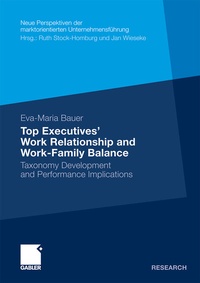
Top Executives' Work Relationship and Work-Family Balance
Taxonomy Development and Performance Implications
1st Edition
Published on 30. May 2010
XIX, 202 pages
978-3-8349-8548-4 (ISBN)
Description

Top executives are confronted with extremely high demands. As a result of these challenges, some top executives risk derailing soon after having reached the top. Because of their important position in the organization, a decline in top executives' performance or their sudden absence is especially harmful to the success of their organizations. Eva-Maria Bauer presents two theoretically grounded taxonomies which describe the different ways how top executives manage their work relationship and work-family balance. Her empirical analysis comprises qualitative interviews with top executives as well as a survey of top executives and their life partners. The results show significant differences between the executives' types concerning for example their well-being, satisfaction, and performance.
More details
Series
Language
German
Place of publication
Wiesbaden
Germany
Publishing group
Betriebswirtschaftlicher Verlag Gabler
Target group
Professional and scholarly
Illustrations
XIX, 202 S. 14 Abb.
File size
1,30 MB
ISBN-13
978-3-8349-8548-4 (9783834985484)
DOI
10.1007/978-3-8349-8548-4
Schweitzer Classification
Other editions
Additional editions
Eva-Maria Bauer
Top Executives' Work Relationship and Work-Family Balance
Taxonomy Development and Performance Implications
Book
11/2009
1st Edition
Springer Gabler
€59.99
Shipment within 7-9 days
Person
Dr. Eva-Maria Bauer completed her doctoral thesis under the supervision of Prof. Dr. Ruth Stock-Homburg at the department Department of Marketing & Human Resource Management at the Technische Universität Darmstadt.
Content
Conceptual Background.- Basics of the Empirical Studies.- Investigation of Top Executives' Work Relationship.- Investigation of Top Executives' Work-Family Balance.- Discussion.
3 Basics of the Empirical Studies (S. 71-72)
As outlined before, the empirical part of the taxonomy development procedure consists of a qualitative and a quantitative study. The basics of these studies, concerning both taxonomies, namely the data collection procedures, the samples and the analysis techniques will be outlined in the following. First, in chapter 3.1 the basics of the qualitative study will be outlined, followed by the basics of the quantitative studying in chapter 3.2.
3.1 Qualitative Study
The purpose of the qualitative study within the empirical portion of our taxonomy development process focuses on enriching and elaborating the theory-based frameworks of our taxonomies. The content-related issues concerning top executives' work relationship and workfamily balance will be outlined in later sections of this thesis (see chapter 3.2.4 and 5). In the following the basics of the qualitative study will be presented, that is to say the data collection and sample (see section 3.1.1) and the content analysis technique used to evaluate and interpret the qualitative data (see section 3.1.2).
3.1.1 Data Collection and Sample
For participant acquisition, we contacted 44 top executives by an initial letter and then telephone solicitations and asked them to give us a personal interview on their work-life balance situation. These top executives were members of the top management, "including CEOs and their immediate subordinates" (Eisenhardt/Bourgeois 1988, p. 739). Thus, in addition to CEOs, our sample includes "the heads of major functions such as sales, engineering, and finance" (Eisenhardt/Bourgeois 1988, p. 739). As an incentive, we offered a detailed personalized report of their personal resources compared with those of other top executives, as well as recommendations for ways they could handle job-related demands and ameliorate their worklife balance situation.
As a result, 42 top executives accepted to participate, whereas only two did not participate because of time constraints. The top executives in the sample were 88 percent men, 95 percent married or close-partnered and 90 percent had children. They had an average age of 50.8 years and an average of 17 years of work experience as top executive. The companies were located in a wide array of industrial sectors (e.g., automotive industry, building and construction industry, chemical and pharmaceutical industry, consulting, and publicshing industry). With this heterogeneous sample regarding age, tenure, and industries, we intended to generate a wide array of top executives' perceived work relationship and work-family balance situation. In order to approve the theoretically derived facets and constructs of top executives' work relationship and work-family balance, we collected data through semistructured interviews with individual respondents.
As outlined before, the empirical part of the taxonomy development procedure consists of a qualitative and a quantitative study. The basics of these studies, concerning both taxonomies, namely the data collection procedures, the samples and the analysis techniques will be outlined in the following. First, in chapter 3.1 the basics of the qualitative study will be outlined, followed by the basics of the quantitative studying in chapter 3.2.
3.1 Qualitative Study
The purpose of the qualitative study within the empirical portion of our taxonomy development process focuses on enriching and elaborating the theory-based frameworks of our taxonomies. The content-related issues concerning top executives' work relationship and workfamily balance will be outlined in later sections of this thesis (see chapter 3.2.4 and 5). In the following the basics of the qualitative study will be presented, that is to say the data collection and sample (see section 3.1.1) and the content analysis technique used to evaluate and interpret the qualitative data (see section 3.1.2).
3.1.1 Data Collection and Sample
For participant acquisition, we contacted 44 top executives by an initial letter and then telephone solicitations and asked them to give us a personal interview on their work-life balance situation. These top executives were members of the top management, "including CEOs and their immediate subordinates" (Eisenhardt/Bourgeois 1988, p. 739). Thus, in addition to CEOs, our sample includes "the heads of major functions such as sales, engineering, and finance" (Eisenhardt/Bourgeois 1988, p. 739). As an incentive, we offered a detailed personalized report of their personal resources compared with those of other top executives, as well as recommendations for ways they could handle job-related demands and ameliorate their worklife balance situation.
As a result, 42 top executives accepted to participate, whereas only two did not participate because of time constraints. The top executives in the sample were 88 percent men, 95 percent married or close-partnered and 90 percent had children. They had an average age of 50.8 years and an average of 17 years of work experience as top executive. The companies were located in a wide array of industrial sectors (e.g., automotive industry, building and construction industry, chemical and pharmaceutical industry, consulting, and publicshing industry). With this heterogeneous sample regarding age, tenure, and industries, we intended to generate a wide array of top executives' perceived work relationship and work-family balance situation. In order to approve the theoretically derived facets and constructs of top executives' work relationship and work-family balance, we collected data through semistructured interviews with individual respondents.
