
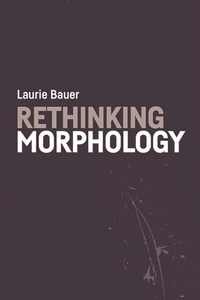
Rethinking Morphology
Description
Alles über E-Books | Antworten auf Fragen rund um E-Books, Kopierschutz und Dateiformate finden Sie in unserem Info- & Hilfebereich.
Different theoretical positions can lead to conflicting restrictions on our understanding of what morphology is about. In this textbook, Laurie Bauer presents a new way of thinking about morphological structure - one that will maximise our benefits from the existing disparate approaches available. Presenting a clear and critical overview, this book equips students with the tools to discuss morphological phenomena and to do so in relation to other linguistic contexts, including semantics, psycholinguistics and language change.
Structured around the core areas of morphemic theory, word morphology, word syntax, the boundaries of morphology, and exemplars and resonances, each chapter discusses the limits, strengths and wider implications of existing theories and issues surrounding these facets of morphology.
More details
Other editions
Additional editions
Content
- Cover
- Rethinking Morphology
- Copyrihgt
- Contents
- Acknowledgements
- Abbreviations and notational conventions
- 1 Introduction
- 2 Morpheme-based morphology
- 3 Word-based morphology
- 4 Word syntax
- 5 The phonological correlates of concatenation
- 6 The borders of morphology
- 7 Exemplars and resonances
- Glossary
- References
- Index

System requirements
File format: PDF
Copy-Protection: Adobe-DRM (Digital Rights Management)
System requirements:
- Computer (Windows; MacOS X; Linux): Install the free reader Adobe Digital Editions prior to download (see eBook Help).
- Tablet/smartphone (Android; iOS): Install the free app Adobe Digital Editions or the app PocketBook before downloading (see eBook Help).
- E-reader: Bookeen, Kobo, Pocketbook, Sony, Tolino and many more (only limited: Kindle).
The file format PDF always displays a book page identically on any hardware. This makes PDF suitable for complex layouts such as those used in textbooks and reference books (images, tables, columns, footnotes). Unfortunately, on the small screens of e-readers or smartphones, PDFs are rather annoying, requiring too much scrolling.
This eBook uses Adobe-DRM, a „hard” copy protection. If the necessary requirements are not met, unfortunately you will not be able to open the eBook. You will therefore need to prepare your reading hardware before downloading.
Please note: We strongly recommend that you authorise using your personal Adobe ID after installation of any reading software.
For more information, see our eBook Help page.