

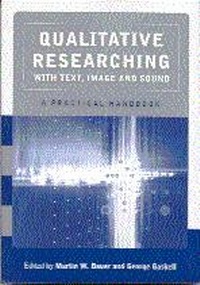
Qualitative Researching with Text, Image and Sound
A Practical Handbook for Social Research
1st Edition
Published on 16. May 2000
384 pages
978-1-4462-0538-9 (ISBN)
Description

`This excellent text will introduce advanced students - and remind senior researchers - of the availability of a broad range of techniques available for the systematic analysis of social data that is not numeric. It makes the key point that neither quantitative nor qualitative methods are interpretive and at the same time demonstrates once and for all that neither a constructivist perspective nor a qualitative approach needs to imply abandonment of rigor. That the chapters are written by different authors makes possible a depth of expertise within each that is unusually strong' - Susanna Hornig Priest, Texas A&M University; Author of `Doing Media Research'
Qualitative Researching with Text, Image and Sound offers a unique resource for today's social researcher. This practical handbook provides a comprehensive and accessible introduction to a broad range of research methods with the objective of clarifying procedures, good practice and public accountability.
Following an introduction which discusses quality and quantity, and how these relate to issues of representation and knowledge interests in social research, the book is organized into four parts:
? Part I covers different ways of collecting data and different types of data relating to text, image and sound: corpus construction, individual and group interviewing, narrative and episodic interviewing, video and film, and bemetology.
? Part II introduces the main analytic approaches for text, image and sound: classical content analysis, argumentation, discourse, conversation analysis, rhetoric, semiotics, analysis of moving images, and of noise and music - each includes an introduction with examples and step-by-step advice on how to do it.
? Part III covers computer-assisted analysis - including computer-assisted qualitative data analysis and key-word-in-context analysis.
? Part IV addresses issues of good practice, looking at problems and fallacies in interpretation and develops quality criteria for qualitative research.
This book provides researchers with the skills and knowledge to make the appropriate choices between different methods, types of data, and analytic procedures, and gives examples and criteria of good practice for each one. It will be essential reading for students and researchers across the social sciences.
Qualitative Researching with Text, Image and Sound offers a unique resource for today's social researcher. This practical handbook provides a comprehensive and accessible introduction to a broad range of research methods with the objective of clarifying procedures, good practice and public accountability.
Following an introduction which discusses quality and quantity, and how these relate to issues of representation and knowledge interests in social research, the book is organized into four parts:
? Part I covers different ways of collecting data and different types of data relating to text, image and sound: corpus construction, individual and group interviewing, narrative and episodic interviewing, video and film, and bemetology.
? Part II introduces the main analytic approaches for text, image and sound: classical content analysis, argumentation, discourse, conversation analysis, rhetoric, semiotics, analysis of moving images, and of noise and music - each includes an introduction with examples and step-by-step advice on how to do it.
? Part III covers computer-assisted analysis - including computer-assisted qualitative data analysis and key-word-in-context analysis.
? Part IV addresses issues of good practice, looking at problems and fallacies in interpretation and develops quality criteria for qualitative research.
This book provides researchers with the skills and knowledge to make the appropriate choices between different methods, types of data, and analytic procedures, and gives examples and criteria of good practice for each one. It will be essential reading for students and researchers across the social sciences.
Reviews / Votes
`This excellent text will introduce advanced students - and remind senior researchers - of the availability of a broad range of techniques available for the systematic analysis of social data that is not numeric. It makes the key point that neither quantitative nor qualitative methods are interpretive and at the same time demonstrates once and for all that neither a constructivist perspective nor a qualitative approach needs to imply abandonment of rigor. That the chapters are written by different authors makes possible a depth of expertise within each that is unusually strong' - Susanna Hornig Priest, Texas A&M University; Author of `Doing Media Research' "This excellent text will introduce advanced students-and remind senior researchers-of the availability of a broad range of techniques available for the systematic analysis of social data that is not numeric. It makes the key point that neither quantitative nor qualitative methods are interpretive and at the same time demonstrates once and for all that neither a constructivist perspective nor a qualitative approach needs to imply abandonment of rigor. That the chapters are written by different authors makes possible a depth of expertise within each that is unusually stong." -- Susanna Horning PriestAll prices
More details
Edition
First Edition
Language
English
Place of publication
London
United Kingdom
Target group
College/higher education
ISBN-13
978-1-4462-0538-9 (9781446205389)
Copyright in bibliographic data and cover images is held by Nielsen Book Services Limited or by the publishers or by their respective licensors: all rights reserved.
Schweitzer Classification
Other editions
Additional editions
Martin W. Bauer | George D. Gaskell
Qualitative Researching with Text, Image and Sound
A Practical Handbook for Social Research
Book
05/2000
1st Edition
SAGE Publications Inc
€268.60
Shipment within 15-20 days
Martin W. Bauer | George D. Gaskell
Qualitative Researching with Text, Image and Sound
A Practical Handbook for Social Research
Book
05/2000
1st Edition
SAGE Publications Inc
€114.40
Shipment within 15-20 days
Persons
Educated in Switzerland (Psychology and Economic History), and the UK (LSE, Social Psychology) and is currently Professor in Social Psychology and Research Methodology at the London School of Economics and Political Science, and a Research Fellow at the Science Museum in London. He taught internationally in France, Sweden, Switzerland, Brazil and Bulgaria, and advised national and international bodies on the public understanding of science.
Expert and lay representations of risk; social and ethical implications of biotechnology; qualitative research methods; risk and trust; science in society and society in science; beliefs and attitudes
Expert and lay representations of risk; social and ethical implications of biotechnology; qualitative research methods; risk and trust; science in society and society in science; beliefs and attitudes
Content
Quality, Quantity and Knowledge Interests - Martin W Bauer, George Gaskell and N C Allum
Avoiding Confusions
PART ONE: CONSTRUCTING A RESEARCH CORPUS
Corpus Construction - Martin W Bauer and Bas Aarts
A Principle for Qualitative Data Collection
Individual and Group Interviewing - George Gaskell
Narrative Interviewing - Sandra Jovchelovitch and Martin W Bauer
Episodic Interviewing - Uwe Flick
Video, Film and Photographs as Research Documents - Peter Loizos
Betemology - G Fassnacht
Towards Continous (Self) Observation and Personality Assessment
PART TWO: ANALYTIC APPROACHES FOR TEXT, IMAGE AND SOUND
Classical Content Analysis - Martin W Bauer
A Review
Argumentation Analysis - M Liakopoulos
Discourse Analysis - Rosalind Gill
Analysis of Conversation and Talk - Greg Myers
Rhetorical Analysis - Joan Leach
Semiotic Analysis of Still Images - Gemma Penn
Analysis of Moving Images - Diana Rose
Analyzing Noise and Music as Social Data - Martin W Bauer
PART THREE: COMPUTER ASSISTANCE
Computer-Assisted Analysis - Udo Kelle
Coding and Indexing
Keyword-in-Context - Nicole Kronberger and Wolfgang Wagner
Statistical Analysis of Text Features
PART FOUR: ISSUES OF GOOD PRACTICE
Fallacies in Interpretating Historical and Social Data - Robert W D Boyce
Towards Public Accountability - George Gaskell and Martin W Bauer
Beyond Sampling, Reliability and Validity
Avoiding Confusions
PART ONE: CONSTRUCTING A RESEARCH CORPUS
Corpus Construction - Martin W Bauer and Bas Aarts
A Principle for Qualitative Data Collection
Individual and Group Interviewing - George Gaskell
Narrative Interviewing - Sandra Jovchelovitch and Martin W Bauer
Episodic Interviewing - Uwe Flick
Video, Film and Photographs as Research Documents - Peter Loizos
Betemology - G Fassnacht
Towards Continous (Self) Observation and Personality Assessment
PART TWO: ANALYTIC APPROACHES FOR TEXT, IMAGE AND SOUND
Classical Content Analysis - Martin W Bauer
A Review
Argumentation Analysis - M Liakopoulos
Discourse Analysis - Rosalind Gill
Analysis of Conversation and Talk - Greg Myers
Rhetorical Analysis - Joan Leach
Semiotic Analysis of Still Images - Gemma Penn
Analysis of Moving Images - Diana Rose
Analyzing Noise and Music as Social Data - Martin W Bauer
PART THREE: COMPUTER ASSISTANCE
Computer-Assisted Analysis - Udo Kelle
Coding and Indexing
Keyword-in-Context - Nicole Kronberger and Wolfgang Wagner
Statistical Analysis of Text Features
PART FOUR: ISSUES OF GOOD PRACTICE
Fallacies in Interpretating Historical and Social Data - Robert W D Boyce
Towards Public Accountability - George Gaskell and Martin W Bauer
Beyond Sampling, Reliability and Validity
