

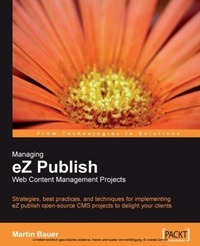
Managing eZ Publish Web Content Management Projects
Strategies, best practices, and techniques for implementing eZ publish open-source CMS projects to delight your clients
1st Edition
Published on 13. January 2025
320 pages
978-1-84719-173-1 (ISBN)
Description

Strategies, best practices, and techniques for implementing eZ publish open-source CMS projects to delight your clientsKey Features - Tips and expert advice for the whole eZ publish web CMS project lifecycle
- Learn about the requirements and success factors of an eZ project
- Implement eZ publish projects successfully, efficiently, and effectively
Book Descriptionopen-source CMS (content management system) and development framework with functionality for web publishing, intranets, e-commerce, extranets, and web portals. In this book, Martin Bauer of designit.com.au an eZ publish Silver partner, teaches you how to successfully manage and implement an eZ publish web content management project. He shows you how to produce quality results in a repeatable manner with the minimum of effort, and end up with eZ publish solutions that will delight your clients. The book presents strategies, best practices, and techniques for all steps of your eZ publish project, starting from client requirements, through planning, information architecture and content modeling, design considerations, and right up to deployment, client training, maintenance, support, and upgrades.What you will learn - Key differences between traditional web development and web content management projects
- How to write specifications for your eZ publish project
- Content modeling in an eZ publish project
- Planning your eZ publish project and approach its pricing
- Configuring your eZ publish development environment
- Risk management and how to apply it to eZ publish projects
- Content population in eZ publish projects
- Different types of testing required for eZ publish projects
- Maintaining and supporting your eZ publish projects
- Chapter 1 examines the differences between traditional software development and content management and how that affects the way we approach content management as a discipline. We cover some of the myths that exist when it comes to web development and content management as well as the types of solutions implemented using content management systems. Finally, we look at the different types of websites and web applications to gain an understanding of the common types of websites and applications that have emerged over the past 10 years.
- Chapter 2 provides an overview of information architecture and design in relation to content management systems.
- Chapter 3 gives you an overview of how ez publish is structured and the key elements that are used in most projects.
- Chapter 4 first helps you understand the requirements of an eZ project and then shows you how to plan your project through a project brief and planning workshop. It also covers how to deal with estimations and the issues that arise at this point of the project.
- Chapter 5 covers how to specify the functionality of a website that is to be implemented in eZ Publish. The chapter covers the overall content model that identifies the key classes and their relationships to each other.
- Chapter 6 explains the importance and purpose of a content model in eZ publish projects.
- Chapter 7 helps you with planning a project (standard and staged approach) and teaches you the approach for pricing your project.
- Chapter 8 covers in detail what s involved in risk management and how to apply it to eZ publish projects.
- Chapter 9 provides a series of management techniques that are straightforward to apply and will go a long way to keeping your eZ project on track.
- Chapter 10 helps you set up and configure your environments for eZ projects. It provides you with information on content population (automated and manual).
- Chapter 11 helps you understand the different types of testing that are required for eZ publish projects.
- Chapter 12 provides guidance on how to train users of the end solution including how to draft training manuals and run training sessions.
- Chapter 13 outlines the most common areas of maintenance and support for an eZ project.
- Appendix A provides a full sample specification of a project that brings together the elements outlined in Chapter 5.
Who this book is forThis book is for people responsible for the implementation and management of eZ publish projects, and is ideal for people building sites for "medium to large clients". If you're a project manager running an eZ publish web content management project and you want to learn how to run your projects more efficiently, or you want a better understanding of all the elements involved in eZ publish web content management projects this book is for you. This is not an implementation guide or a book to learn eZ publish from - you will not be able to build a site by following this book. It is for people who have experienced eZ publish projects, or are considering them. Web developers new to eZ publish should read http://www.packtpub.com/ezpublish/book
- Learn about the requirements and success factors of an eZ project
- Implement eZ publish projects successfully, efficiently, and effectively
Book Descriptionopen-source CMS (content management system) and development framework with functionality for web publishing, intranets, e-commerce, extranets, and web portals. In this book, Martin Bauer of designit.com.au an eZ publish Silver partner, teaches you how to successfully manage and implement an eZ publish web content management project. He shows you how to produce quality results in a repeatable manner with the minimum of effort, and end up with eZ publish solutions that will delight your clients. The book presents strategies, best practices, and techniques for all steps of your eZ publish project, starting from client requirements, through planning, information architecture and content modeling, design considerations, and right up to deployment, client training, maintenance, support, and upgrades.What you will learn - Key differences between traditional web development and web content management projects
- How to write specifications for your eZ publish project
- Content modeling in an eZ publish project
- Planning your eZ publish project and approach its pricing
- Configuring your eZ publish development environment
- Risk management and how to apply it to eZ publish projects
- Content population in eZ publish projects
- Different types of testing required for eZ publish projects
- Maintaining and supporting your eZ publish projects
- Chapter 1 examines the differences between traditional software development and content management and how that affects the way we approach content management as a discipline. We cover some of the myths that exist when it comes to web development and content management as well as the types of solutions implemented using content management systems. Finally, we look at the different types of websites and web applications to gain an understanding of the common types of websites and applications that have emerged over the past 10 years.
- Chapter 2 provides an overview of information architecture and design in relation to content management systems.
- Chapter 3 gives you an overview of how ez publish is structured and the key elements that are used in most projects.
- Chapter 4 first helps you understand the requirements of an eZ project and then shows you how to plan your project through a project brief and planning workshop. It also covers how to deal with estimations and the issues that arise at this point of the project.
- Chapter 5 covers how to specify the functionality of a website that is to be implemented in eZ Publish. The chapter covers the overall content model that identifies the key classes and their relationships to each other.
- Chapter 6 explains the importance and purpose of a content model in eZ publish projects.
- Chapter 7 helps you with planning a project (standard and staged approach) and teaches you the approach for pricing your project.
- Chapter 8 covers in detail what s involved in risk management and how to apply it to eZ publish projects.
- Chapter 9 provides a series of management techniques that are straightforward to apply and will go a long way to keeping your eZ project on track.
- Chapter 10 helps you set up and configure your environments for eZ projects. It provides you with information on content population (automated and manual).
- Chapter 11 helps you understand the different types of testing that are required for eZ publish projects.
- Chapter 12 provides guidance on how to train users of the end solution including how to draft training manuals and run training sessions.
- Chapter 13 outlines the most common areas of maintenance and support for an eZ project.
- Appendix A provides a full sample specification of a project that brings together the elements outlined in Chapter 5.
Who this book is forThis book is for people responsible for the implementation and management of eZ publish projects, and is ideal for people building sites for "medium to large clients". If you're a project manager running an eZ publish web content management project and you want to learn how to run your projects more efficiently, or you want a better understanding of all the elements involved in eZ publish web content management projects this book is for you. This is not an implementation guide or a book to learn eZ publish from - you will not be able to build a site by following this book. It is for people who have experienced eZ publish projects, or are considering them. Web developers new to eZ publish should read http://www.packtpub.com/ezpublish/book
More details
Other editions
Additional editions
Martin Bauer
Managing EZ Publish Web Content Management Projects
Book
10/2007
Packt Publishing
€63.20
Shipment within 3-4 weeks
Content
- Intro
- Managing eZ Publish Web Content Management Projects
- Table of Contents
- Managing eZ Publish Web Content Management Projects
- Credits
- About the Author
- About the Reviewers
- Preface
- What This Book Covers
- Who is This Book For?
- Conventions
- Reader Feedback
- Customer Support
- Errata
- Questions
- 1. Understanding Web Content Management
- Why Use a Content Management System?
- Content Management versus Development
- Test Cricket
- 20 20 Cricket
- Key Differences
- Methodologies
- Stakeholders
- Experience Levels
- Project Scales
- Project Experience and Understanding
- Interfaces
- Myths
- Myth no. 1
- Myth no. 2
- Myth no. 3
- Myth no. 4
- Types of Websites and Web Applications
- Static Websites
- Objectives
- Content Requirements
- Information Architecture
- Information and Navigation Design
- Visual Design
- Web Applications
- Objectives
- Functional Specification
- Interaction Design
- Information and Interface Design
- Visual Design
- Static Websites versus Web Applications
- Web Solution Categories
- Interactive
- Transactional
- Workflow-Based
- Collaborative
- Knowledge-Based
- What does All This Mean for eZ Publish Projects?
- Summary
- 2. Information Architecture and Design
- Information Architecture
- Task Oriented
- Content Oriented
- Five Facets of Design
- Content Modeling
- Content Class
- Information and Navigation Design
- Information Design
- Navigation Design
- Interaction Design
- Technical Design
- Wish
- Visual Design
- Contrast
- Uniformity
- A Common Mistake
- Visual Design Issues
- Design by Default
- Design by Fiat
- Design by Committee
- The Average User
- The Right Questions
- If All Else Fails
- Summary
- 3. eZ Publish Overview
- What is eZ Publish?
- Separation of Layers
- Managing Content
- What is eZ Publish Good For?
- Internal Structure and Configuration
- Directory Structure
- Configuration Files
- The Lego Approach
- Content Blocks
- Display Blocks
- Functional Blocks
- Data Types, Content Classes, and Objects
- Datatype
- Content Class
- Object
- Versions
- Structuring Content
- Nodes and Locations
- Locations
- Visibility
- Sections
- Assigning Sections
- Managing Sections
- Templates
- Template Code
- View Templates
- Node Templates
- Custom Node Templates
- $node
- System Templates
- Custom System Templates
- pagelayout.tpl
- Cascading Style Sheets
- Module Result
- Template Override System
- Designs
- Default Design
- Design Structure
- /fonts
- /images
- /overrides
- /stylesheets
- /templates
- siteaccess
- Access Control
- Users
- User Account Datatype
- User Details
- User Groups
- Policies
- Functions
- Roles
- Workflow
- Events
- A Workflow
- Standard Triggers
- Standard Events
- Extensions
- Summary
- 4. Defining an eZ Publish Project
- Requirements
- Capturing the Vision
- Why Are We Doing This?
- Theory versus Reality
- Formats
- The Author
- Interpretation
- Knowing How Much Detail to Capture
- The Last Word
- Project Brief
- Organizational Purpose
- Project Purpose
- Project Objectives
- Target Market
- Project Brief-The White Angel Foundation
- The Organizational Purpose
- The Project Purpose
- The Project Objectives
- The Target Market
- Planning Workshop
- Success
- Success Factors
- Stakeholder Satisfaction
- Meeting Project Objectives
- Meeting an Agreed Budget
- Delivering On Time
- Adding Value
- Meeting Quality Requirements
- Team Satisfaction
- Success Sliders
- Project Scope and Objectives
- Project Scope
- Objectives, Outputs, and Outcomes
- Quality
- Quality Factors
- Measuring Quality
- Estimation
- Reality Check
- Estimation Errors
- Usual Situation
- The Developer's Estimate
- The Project Manager's Estimate
- Low Bid
- The Sales Manager's Estimate
- Management/Client Directive
- Common Language
- Guess
- Estimate
- Fixed Price Quote
- The Ideal Situation
- Summary
- 5. How to Write a Specification
- Content Model
- The Studies in Australia Model
- Users and Groups
- General Public (Anonymous)
- Registration
- Members
- Member Class
- Member Functions
- Login
- Forgot Password
- Change Password
- Manage Details
- Editors
- Administrators
- Features
- Good Company Feature Overview
- Community Group Registration and Administration
- Community Group Registration Wireframe
- Community Group Administration Wireframes
- Community Group Listing
- Community Acceptance Wireframe
- Functions
- Wish Searching
- Wish Search Results
- Wish Search Details
- Site Map
- Content Classes and Rules
- Content Analysis
- Content Modeling
- Relation to Site Structure
- Views
- Products Main Page
- Product Category View
- Product Details
- Custom Templates
- Deans Art Homepage
- Queen Victoria Women's Centre Homepage
- Screen and Performance Standards
- Browser Compatibility
- Screen Resolution
- Accessibility
- Performance
- Specification Process
- High-Level Specification Workshop
- Domain Walkthrough
- Users and Roles of the System
- Object Model
- Key Relationships between Objects
- Object Role Diagram
- Features
- Site Map
- Detailed Specification
- Creative Brief
- The Product or Communication Task
- What is the product that this client is selling?
- What information is the client communicating or receiving?
- The Type of Product
- What type of product does our client produce?
- Target Market & Audience
- Who is the client's market?
- Who buys their product?
- Who are they interacting/communicating with?
- Which segment of the Target Market is this execution aimed at?
- Which segment of the Target Market is going to be using this site the most?
- Is there a Primary Audience and a Secondary Audience?
- Demographic Profile
- What is their age?
- Where do they live?
- How much money do they earn?
- What is their level of schooling?
- Would they access the site from home or from work?
- What is their bandwidth?
- Are they "net-savvy'?
- Psychographic Profile
- How do they feel towards our client's brand?
- What is their perception of our client's brand?
- Do they spend money on a whim?
- Who makes the decision when it comes to online purchases of our client's product category?
- Marketing Objective
- What is our client's main business/communication objective in going online?
- Creative Strategy
- What are we going to try to achieve creatively, with our client's product or service?
- Competition
- Who else is selling/doing the same thing our client is?
- Competitor sites
- What are they doing?
- Other Points
- Existing Branding
- Do you have an existing Logo?
- Is there an existing branding style guide?
- If no, then do you require branding and logo creation?
- Is there a company slogan or tagline?
- Summary
- 6. Content Modeling
- The Purpose of a Content Model
- What Makes a Good Model?
- Defining a Content Model
- Step 1: Domain Walkthrough
- Step 2: Identify Users of the System
- Step 3: Identify the Key Classes
- Step 4: Identify Relationships between the Classes
- Step 5: Create a Relationship Diagram
- Step 6: Create a Glossary
- Summary
- 7. Planning and Pricing
- Project Planning
- Standard Approach
- Staged Approach
- Pricing Your Project
- Time-Based Pricing
- Value Pricing
- Summary
- 8. Risk Management
- Key Steps in Risk Management
- Case Note
- Risk Assessment
- Risk Evaluation
- Risk Reduction
- Risk Monitoring
- Risk Reporting
- Types of Risks
- Project Risk
- System Complexity
- Target Environment
- Team Environment
- Business Project Risk
- Business Risk
- Production System Risk
- Benefits Realization Risk
- Personal Risk
- Risk Management in Practice
- Risk Assessment Overview
- Risk Memos
- Risk Memo
- Shooting the Messenger
- Who is Responsible?
- Risk Reporting
- Risk Report
- Key Risks in eZ publish Projects
- Experience
- Content
- Summary
- 9. Open Project Management
- Manifesto for Agile Software Development
- Individuals and Interactions over Processes and Tools
- Working Software over Comprehensive Documentation
- Customer Collaboration over Contract Negotiation
- Responding to Change over Following a Plan
- Open Management Practices
- Team Dynamics
- Who's on the Team?
- Project Sponsor/Client
- Project Manager
- Designer
- Developer
- System Administrator
- Avoiding the "Us and Them" Syndrome
- Daily Meetings
- Communication
- Forms of Communication
- Progress Reports
- Achievements
- Dependencies
- Assumptions
- Issues and Risks
- Resolutions
- Sample Progress Report
- Achievements
- Assumptions
- Dependencies
- Issues and Risks
- Resolutions
- Project Extranet
- Meeting Notes
- Progress Reports
- Documentation
- Tasks
- Summary
- 10. Implementation
- Infrastructure
- Development
- Staging
- Production
- Version Control
- Setup
- Configuration and Development
- Content Classes
- Site Structure
- Sample Content
- Custom Templates
- Users and Groups
- Extensions and Workflow
- Styling
- core.css
- style.css
- homestyle.css
- section_name.css
- print.css
- Moving Code between Environments
- Content Gathering
- Content Population
- Manual Content Population
- Automated Content Population
- Summary
- 11. Testing
- Load Testing
- Page Views
- Sessions
- Web Server Connections
- Database Connections
- Running Load Tests
- Testing, Monitoring, and Reporting Tools
- eZ Debug
- Debug Output
- Template Debug
- Inline Template Debug
- List of Used Templates
- SQL Debug Output
- Nagios
- Cacti
- Mytop
- Sample Test Plan
- 1.0. Executive Summary
- 1.1. Background
- 1.2. Scope
- 2.0. Test Design
- 2.1. Test Strategy
- 2.2. Assumptions
- 2.3. Test Steps
- 2.3.1. Setup
- 2.3.2. Recording and Scripting
- 2.3.3. Data Population
- 2.3.4. Test Run
- 2.3.5. Reporting
- 2.3.6 Schedule
- 3.0 Special Test for TransNET Update
- 3.1. General Requirements for Performing the TransNET Update and Enquiry Tasks
- Sample Test Report
- Test Case No. 4
- Analysis
- Browser and User Acceptance Testing
- User Acceptance Testing
- Automated Testing with Selenium
- Accessibility Testing
- Summary
- 12. Training
- Standard User Training
- Custom Training
- User Manual
- Standard Manual
- Sorting Content (designIT User Manual)
- Custom Manual
- Managing Maps Custom Feature
- Network Maps
- How to Add a Network Map
- Attributes
- Route Maps
- How to Add a Network Map
- Attributes
- Technical Training
- Summary
- 13. Maintenance and Support
- Patches
- Upgrades
- Planning an Upgrade
- Backup
- Setup
- Upgrade
- Testing
- Enhancements
- Support
- Content Management
- Bug Fixes
- Summary
- A. Appendix A
- Index
