

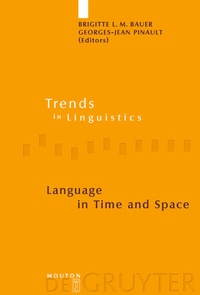
Language in Time and Space
Description

The honoree of this Festschrift has for many years now marked modern trends in diachronic and synchronic linguistics by his own publications and by stimulating those of numerous others. This collection of articles presents data-oriented studies that integrate modern and traditional approaches in the field, thus reflecting the honoree's contribution to contemporary linguistics. The articles relate to comparative data from (early) Indo-European languages and a variety of other languages and discuss the theoretical implications of phenomena such as linguistic universals, reconstruction, and language classification.
Reviews / Votes
"There is every sign that this Festschrift will also be referred to in twenty years time, not only for the articles on Indo-European by well-known Indo-Eurpeanistst, but also for some of the other topics covered here, which range from (im)politeness in Molière through witch reference in American Indian languages to Tibeto-Burman. The range and acuity of the contributions is an appropriate tribute to the work of the honorand."James Clackson in: Kratylos, 50, 2005More details
Other editions
Additional editions
Persons
Content
- Intro
- Werner Winter: Publications 1949-2003
- Introduction: Werner Winter, ad multos annos
- Patterns of stress and rhythm in Tocharian B prosody
- Old Irish masu 'if is' and similar forms
- On bifurcations and the Germanic consonant shifts
- A concept of truth for linguistic semantics
- Middle-passive and causative: valency-change in the Tocharian B -e- presents without initial palatalization
- Some thoughts on 'Universals'
- Latin static morphology and paradigm families
- Tibeto-Burman vs. Sino-Tibetan
- Some taboo-words in Iranian languages of Central Asia
- Apposition and word-order typology in Indo-European
- Reading Molière's The Learned Ladies - remarks on (im)politeness
- Did Indo-European linguistics prepare the ground for Nazism? Lessons from the past for the present and the future
- On the origin of Tocharian terms for GRAIN
- The Hittite reflexive construction in a typological perspective
- Praise and Honor (Gothic hazjan, Old English hergan, and Russian cest')
- The origin and nature of the linguistic parasite
- Realism in Indo-European Linguistics
- Turkic and Chinese loan words in Tocharian
- Categorizing the Japanese lexicon. A proposal with a background
- Notes on an ethnonym from East Nepal
- 'But' without switch-reference
- Fresh shoots from a vigourous stem: IE *u?ih1ró-
- On the tracks of the Tocharian Guru
- Eventide in Hatti-land
- An integrated view on ablaut and accent in Indo-European
- An early rule of syncope in Tocharian
- The Latin imperfect in -ba-, the Proto-Indo-European root *bhu?eh2- and full grade I forms from set?-roots with full grade II
- Conceptualization of agency in contemporary Polish
- Ouvrier, Arbeiter, workman, rabocij, obrero, operaio
- Classical Armenian HAGAG 'breath' and OGEM 'to speak'
- Index
- Index of examples
- Tabula Gratulatoria
