

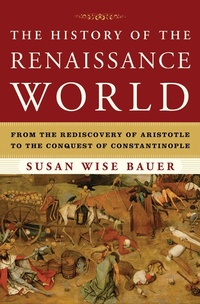
The History of the Renaissance World
Description

A lively and fascinating narrative history about the birth of the modern world.
Beginning in the heady days just after the First Crusade, this volume—the third in the series that began with The History of the Ancient World and The History of the Medieval World—chronicles the contradictions of a world in transition.Popes continue to preach crusade, but the hope of a Christian empire comes to a bloody end at the walls of Constantinople. Aristotelian logic and Greek rationality blossom while the Inquisition gathers strength. As kings and emperors continue to insist on their divine rights, ordinary people all over the world seize power: the lingayats of India, the Jacquerie of France, the Red Turbans of China, and the peasants of England.
New threats appear, as the Ottomans emerge from a tiny Turkish village and the Mongols ride out of the East to set the world on fire. New currencies are forged, new weapons invented, and world-changing catastrophes alter the landscape: the Little Ice Age and the Great Famine kill millions; the Black Death, millions more. In the chaos of these epoch-making events, our own world begins to take shape.
Impressively researched and brilliantly told, The History of the Renaissance World offers not just the names, dates, and facts but the memorable characters who illuminate the years between 1100 and 1453—years that marked a sea change in mankind's perception of the world.
More details
Other editions
Additional editions
Person
Content
- Intro
- Title Page
- Dedication
- Table of Contents
- List of Maps
- List of Illustrations
- Acknowledgments
- Preface
- Part One: RENAISSANCES
- One: Logic and Compromise England, Rome, and the Holy Roman Empire, 1100-1122
- Two: The Crusader Enemy Byzantium, Venice, and the Crusader kingdoms, 1100-1138
- Three: Anarchy England, Western Francia, and the Kingdom of Jerusalem, 1120-1139
- Four: The Lost Homeland China, Dai Viet, and Khmer, 1127-1150
- Five: Crusade Resurrected The Turkish and Crusader kingdoms, with visitations from Germany and France, 1128-1149
- Six: Reconquista and Rediscovery The Spanish peninsula, 1134-1146
- Seven: Questions of Authority France and Italy, 1135-1160
- Eight: The New Song China, 1141-1165
- Nine: The Heiji Disturbance Japan, 1142-1159
- Ten: Death of an Army Goryeo, 1146-1197
- Eleven: The First Plantagenet England and Western Francia, 1147-1154
- Twelve: Frederick Barbarossa Germany and Italy, 1147-1177
- Thirteen: The Almohads in Spain North Africa and Spain, 1147-1177
- Fourteen: "Many Nations" Africa, sometime in the twelfth century
- Fifteen: The Last Fatimid Caliph The Turkish and Crusader kingdoms, 1149-1171
- Sixteen: Monks and Brahmans South India, 1150-1189
- Seventeen: Conquest of the Willing Northern India, 1150-1202
- Eighteen: Death of a Priest England and France, 1154-1170
- Nineteen: Foreign Relations Byzantium, Hungary, and the Balkans, 1157-1168
- Twenty: The Venetian Problem Byzantium and Italy, 1171-1185
- Twenty-One: Resentments England, Ireland, and France, 1171-1186
- Twenty-Two: Saladin The Turkish and Crusader kingdoms, 1171-1188
- Twenty-Three: The Gempei War Japan, 1179-1185
- Twenty-Four: Kings' Crusade England, France, and the Turkish and Crusader kingdoms, 1188-1199
- Twenty-Five: The Sack of Constantinople Byzantium and Europe, 1195-1204
- Part Two: INVASIONS, HERESIES, AND UPRISINGS
- Twenty-Six: Westward Central and South America, 1200
- Twenty-Seven: The Mongol School of Warfare China, North and Central Asia, 1201-1215
- Twenty-Eight: John Softsword England and France, 1203-1213
- Twenty-Nine: Sundiata of the Mali Africa, 1203-1240
- Thirty: The Jokyu War Japan, 1203-1242
- Thirty-One: The Unwanted Throne The old Byzantine lands, 1204-1225
- Thirty-Two: The First Delhi Sultanate Northern and central India, 1206-1236
- Thirty-Three: Heresy France, 1209-1210
- Thirty-Four: Reconquest and Failure France and the Spanish peninsula, 1210-1213
- Thirty-Five: From Bouvines to Magna Carta France, England, and the Holy Roman Empire, 1213-1217
- Thirty-Six: The Birth of the Inquisition France, 1215-1229
- Thirty-Seven: Moving Westward China, North and Central Asia, and the Middle East, 1215-1229
- Thirty-Eight: South of India India and Sri Lanka, 1215-1283
- Thirty-Nine: The Fifth Crusade Egypt and the Crusader kingdoms, 1217-1221
- Forty: From the Golden Bull to the Baltic Crusade Hungary, Poland, and the lands of the Lithuanians, 1218-1233
- Forty-One: Lakeshores, Highlands, and Hilltops Africa, 1221-1290
- Forty-Two: The Sixth Crusade The Holy Roman Empire, the Crusader kingdoms, and the Ayyubid empire, 1223-1229
- Forty-Three: The Tran Dynasty Southeast Asia, 1224-1257
- Forty-Four: Young Kings England, France, and the kingdoms of Spain, 1227-1242
- Forty-Five: The Mongol Horde Most of Asia and Europe, 1229-1248 310
- Forty-Six: The Debt of Hatred The Holy Roman Empire, 1229-1250
- Forty-Seven: The Shadow of God India, 1236-1266
- Forty-Eight: The Seventh Crusade France, Egypt, and Syria, 1244-1250
- Forty-Nine: The Splintering Khanate The Mongol conquests, 1246-1264
- Fifty: The Mamluks of Egypt Egypt, Syria, and the Mongol lands, 1250-1268
- Fifty-One: Louis the Saint France and the Kingdom of Jerusalem, 1250-1267
- Fifty-Two: The Lion's Den Germany, Italy, Sicily, and England, 1252-1273
- Fifty-Three: The Recapture of Constantinople The Latin Empire and the empire of Nicaea, 1254-1261
- Fifty-Four: The Last Crusades North Africa, Egypt, France, Italy, and the Crusader kingdoms, 1270-1291
- Fifty-Five: Kublai Khan China, Japan, Goryeo, Champa, and the Dai Viet, 1273-1294
- Fifty-Six: The Sicilian Vespers Germany, Italy, Sicily, Aragon, and France, 1274-1288
- Fifty-Seven: The Wars of Edward I England, Scotland, Wales, and France, 1275-1299
- Fifty-Eight: The Second Sultanate of Delhi India, 1287-1300
- Fifty-Nine: The End of the Papal Monarchy France, Germany, and Italy, 1301-1317
- Sixty: The Appearance of the Ottomans Byzantium and the Turks of the Il-khanate, 1302-1347
- Sixty-One: The Fall of the Khilji India, 1303-1320
- Sixty-Two: The Triumph of the Bruce Scotland, England, and Ireland, 1304-1314
- Part Three: CATASTROPHES
- Sixty-Three: The Great Famine All of Europe, 1310-1321
- Sixty-Four: The Sultan and the Khan Egypt, the Il-khanate, and the Golden Horde, 1310-1335
- Sixty-Five: Mansa Musa of Mali West Africa, 1312-1360
- Sixty-Six: After the Famine France and England, 1318-1330
- Sixty-Seven: The Southern and Northern Courts Japan, 1318-1339
- Sixty-Eight: Rebellions India, 1320-1351
- Sixty-Nine: Naming the Renaissance Germany, Italy, and France, 1322-1341
- Seventy: The Cities in the Lake Central America, 1325-1375
- Seventy-One: A Hundred Years of War France and England, 1329-1347
- Seventy-Two: The End of the World Asia, Europe, and India, 1338-1353
- Part Four: REGROUPINGS
- Seventy-Three: The Will to War France, England, and the Spanish kingdoms, 1349-1369
- Seventy-Four: White Lotus, Red Turban China, 1351-1382
- Seventy-Five: After the Mongols Southeast Asia, 1351-1399
- Seventy-Six: The Turks and the Desperate Emperor Byzantium and the lands of the Turks, with side journeys to France and Italy
- Seventy-Seven: The Disintegration of Delhi India and Sri Lanka, 1352-1388
- Seventy-Eight: The Union of Krewo Poland, Hungary, and Lithuania, 1364-1399
- Seventy-Nine: The Rebirth of the Mongol Horde Central Asia, the Middle East, India, and the lands of the Rus', 1367-1399
- Eighty: Compromises and Settlements The Korean peninsula and Japan, 1368-1392
- Eighty-One: The House of Visconti and the Papal States France and Italy, 1368-1390
- Eighty-Two: Bad Beginnings France and England, 1369-1381
- Eighty-Three: Dislocation Africa, 1370-1399
- Eighty-Four: Madness and Usurpation Castile, Portugal, England, and France, 1383-1401
- Eighty-Five: The Battle of Nicopolis The Ottoman empire, Constantinople, and the lands of eastern Europe, 1385-1396
- Eighty-Six: The Union and Disunion of Kalmar Scandinavia, 1387-1449
- Eighty-Seven: The Hussite Uprising Germany, Italy, Hungary, and Bohemia, 1388-1419
- Eighty-Eight: The Taking of France France and England, 1401-1420
- Eighty-Nine: After Timurlane The north of India, the empire of Timur, the lands of the Ottoman Turks, Egypt, and Byzantium, 1401-1415
- Part Five: ENDINGS
- Ninety: The Withdrawal of the Ming China and the land of the Dai Viet, 1405-1455
- Ninety-One: Failure The old lands of the Holy Roman Empire and the remnants of Byzantium, 1412-1440
- Ninety-Two: Perpetual Slavery Portugal, Castile, and Africa, 1415-1455
- Ninety-Three: The Loss of France France and England, 1422-1453
- Ninety-Four: The Fall The Byzantine and Ottoman empires, along with Hungary, Germany, Wallachia, Bohemia, and Serbia, 1430-1453
- Notes
- Works Cited
- Permissions
- Index
- Copyright
- Also by Susan Wise Bauer
