

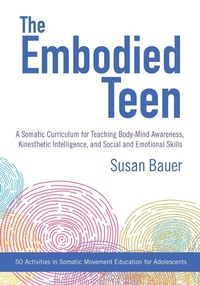
The Embodied Teen
A Somatic Curriculum for Teaching Body-Mind Awareness, Kinesthetic Intelligence,and Social and Emotional Skills--50 Activities in Somatic Movement Education
Published on 17. July 2018
376 pages
978-1-62317-189-6 (ISBN)
Description

The first book to offer a somatic movement education curriculum adapted to the unique needs of adolescents
Susan Bauer presents a groundbreaking curriculum for teaching teens how to integrate body and mind, enhance kinesthetic intelligence, and develop the inner resilience they need to thrive, now and into adulthood. Designed for educators, therapists, counselors, and movement practitioners, The Embodied Teen presents a pioneering introductory, student-centered program in somatic movement education. Using the student's own body as the lab through which to learn self-care, injury prevention, body awareness, and emotional resilience, Bauer teaches basic embodiment practices that establish the foundation for further skill development in sports, dance, and leisure activities. Students learn the basics of anatomy and physiology, and unlearn self-defeating habits that impact body image and self-esteem. By examining their cultural perceptions, they discover their body prejudices, helping them to both respect diversity and gain compassion for themselves and others. Concise and accessible, the lessons presented in this book will empower teens as they navigate the volatile physical and emotional challenges they face during this vibrant, powerful stage of life.
Susan Bauer presents a groundbreaking curriculum for teaching teens how to integrate body and mind, enhance kinesthetic intelligence, and develop the inner resilience they need to thrive, now and into adulthood. Designed for educators, therapists, counselors, and movement practitioners, The Embodied Teen presents a pioneering introductory, student-centered program in somatic movement education. Using the student's own body as the lab through which to learn self-care, injury prevention, body awareness, and emotional resilience, Bauer teaches basic embodiment practices that establish the foundation for further skill development in sports, dance, and leisure activities. Students learn the basics of anatomy and physiology, and unlearn self-defeating habits that impact body image and self-esteem. By examining their cultural perceptions, they discover their body prejudices, helping them to both respect diversity and gain compassion for themselves and others. Concise and accessible, the lessons presented in this book will empower teens as they navigate the volatile physical and emotional challenges they face during this vibrant, powerful stage of life.
More details
Other editions
Additional editions
Susan Bauer
The Embodied Teen
A Somatic Curriculum for Teaching Body-Mind Awareness, Kinesthetic Intelligence, and Social and Emotional Skills--50 Activities in Somatic Movement Education
Book
07/2018
North Atlantic Books,U.S.
€29.00
Shipment within 3-4 weeks
Person
SUSAN BAUER (MFA, RSME/T) is a teacher, dancer, author, Fulbright Scholar, and somatic educator and practitioner. In her thirty-year career she has taught in middle school and high school, college, and community contexts, and has led teacher trainings and given conference presentations both in the United States and abroad. Her pioneering teacher training program, Embodiment in Education, is now in its tenth year and has included guest faculty Bonnie Bainbridge Cohen, Deane Juhan, and Caryn McHose. Bauer served on the board of directors of the International Somatic Movement Education and Therapy Association (ISMETA) from 2012 to 2015. She is also a Registered Somatic Movement Educator and Therapist with a private practice in the San Francisco Bay Area. Bauer holds an MFA in dance from the Department of World Arts and Cultures at the University of California, Los Angeles and an MALS in Dance and Movement Studies from Wesleyan University. She is a contributor to the anthologies Embodied Lives and Dance, Somatics, and Spiritualities. For more information please visit susanbauer.com.
Content
- Intro
- Title Page
- Praise for The Embodied Teen
- Copyright
- Dedication
- Acknowledgments
- Introduction
- A Case Study of Embodiment: My Own Path in Somatic Practices
- Developing a Curriculum for Teens and a Training for Educators
- An Overview of This Book
- A Note on Origins and Crediting
- Who Can Use This Book?
- Part I: A Case for Somatic Movement Education for Teens
- 1: Why Teach Teens about Their Bodies?
- The Body in Education
- Using a Somatic Education Approach to Support Adolescent Development
- Adapting Somatic Movement Education Specifically for Teens
- 2: Somatic Education and Other Influences
- Somatic Movement Education
- Experiential Anatomy
- Related Fields and Movement Practices
- Part II: Getting Started: A Guide for Facilitators
- 3: Basics about the Curriculum
- Curriculum Design and Structure of the Book
- Pathways to Teaching Somatic Movement Education (SME)
- Introducing the Curriculum to Students
- 4: Eight Key Pedagogy Principles for Teaching SME with Teens
- Include Subjective Experience
- Use a Student-Driven Curriculum
- Balance Sensory and Motor Learning
- Teach about Proprioception
- Use a Layered Learning Approach
- Create a Safe Container and Sense of Community
- Provide Time for Integration
- Teach from Embodied Knowledge
- 5: The Language of Embodiment
- Inviting Student Participation
- Using Embodied Language
- Specialized Terminology
- 6: Touch and Other Touchy Subjects
- Working with Intentional Touch in Education
- Four Basic Guidelines for Teaching Intentional Touch
- Other Touchy Subjects: Teen Stress, Trauma, and Sexuality
- Part III: A Curriculum in SME: Embodied Anatomy for Teens Embodiment Basics-Level I
- 7: Body Listening
- What Is Body Listening?
- Orienting to Both Weight and Space
- Using Body Scanning, the Constructive Rest Position, and Visualizations
- Using a Movement Matrix
- 8: Body Systems
- Inside the Body
- The Cultural Body
- Movement Integration and Dedications
- 9: The Skeletal System
- Perceptions of the Skeleton
- The Nature of Bone
- Bone Tracing and Movement
- 10: Joints, Proprioception, and the Kinesthetic Sense
- Body Awareness
- Muscles and Movement
- 11: Organs
- Vitality and Rest
- Moving with Three-Dimensional Support
- 12: Fascia and Movement Qualities
- Layers of Tissue
- Types of Tissue, Movement Qualities, and Emotions
- Part IV: A Curriculum in SME: Embodied Anatomy for Teens Embodiment Fundamentals-Level II
- 13: Structure and Posture
- 14: The Dynamics of Balance
- Perceptions of Alignment
- Anatomy of the Spine
- Movement of the Spine
- 15: Breathing Basics
- Perceptions of Breathing
- The Anatomy of Breathing
- Breathing and Movement
- Breathing Our Earth Body
- 16: A Somatic "Warm-Up": A New Approach to an Everyday Practice
- Perceptions of Warm-Up
- A Somatic Warm-Up for Health and Vitality
- Full Body Integration: Structured Movement Sequences
- Practice with Using the Warm-Up Formula
- Using Additional Warm-Up Activities
- 17: Coming Full Circle
- Afterword: Envisioning the Future of Somatic Education
- Appendix A: Summary Sheet of the Eight Pedagogy Principles
- Appendix B: Summary Sheet of Four Guidelines for Teaching Intentional Touch
- Illustrations
- Photo Credits
- Endnotes
- Chapter 1
- Chapter 2
- Chapter 3
- Chapter 4
- Chapter 5
- Chapter 6
- Chapter 7
- Chapter 9
- Chapter 10
- Chapter 11
- Chapter 12
- Chapter 13
- Chapter 14
- Chapter 15
- Chapter 16
- Afterword
- Bibliography
- Index
- About the Author
