

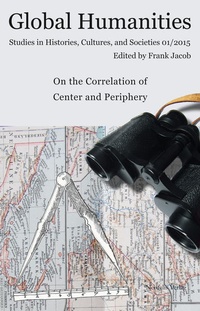
On the Correlation of Center and Periphery
Description

The analysis of the relationship between center and periphery is one of many theoretical approaches found in all fields of the Humanities. Looking at this special relationship from several disciplinary perspectives is an effective methodology for establishing connections between various fields of study. Consequently, the issue contains articles dealing with, among others, the Russian enterprise in Alaska, German polar exploration, gender in Islamic contexts in Europe, labor relations, 'economic securitization', cultural nationalism in Ghana, and Robert Rodriguez's movie Machete. The historical perspective of cultural reception, the economic relationship between central and peripheral areas as well as the development of stereotypes as a consequence of the exchange between both areas are also part of the discussion.
The first issue of Global Humanities therefore provides a broad outlook on the periphery-center relationship, giving the interested reader an insight into the different working fields of several disciplines within the Humanities. It furthermore can be considered an argument for strengthening interdisciplinary work in the future, highlighting the interconnectedness of history, literature, art, politics and many other disciplines.
More details
Other editions
Additional editions
Persons
Frank Jacob (Dr. phil.) ist Assistant Professor für Welt- und Globalgeschichte an der City University of New York (QCC). Er hat in Würzburg und Osaka Geschichte und Japanologie studiert und wurde 2012 mit einer Arbeit zu Geheimgesellschaften in Deutschland und Japan promoviert. Seitdem beschäftigt er sich mit verschiedenen komparativ-historischen Projekten, vor allem im Bereich der Kulturgeschichte. Zu seinen Forschungsschwerpunkten zählen die moderne Geschichte Japans, die deutsche Geschichte des 19. und 20. Jahrhunderts sowie Globalgeschichte in vergleichender Perspektive. Er ist unter anderem Herausgeber der Reihe Wissen über Waren - Historische Studien zu Nahrungs- und Genussmitteln (Nomos) und arbeitet aktuell an einer Untersuchung der Internationalisierung des Tabakhandels im 16. und 17. Jahrhundert.
Content
- Cover
- Half Title
- Title
- Colophon
- Table of Contents
- Editorial
- Receptions
- Kropp: Halfway around the World
- Löppenberg: Their Knowledge about Arctic Nature
- Mansour: Stirring the "Mix"
- Exchanges
- Schlenkrich / Mohamad-Klotzbach: Open and Closed Electoral Autocracies in the (Semi-)Periphery from 1996 to 2010
- Vasileios: Centers, Peripheries and Technical Progress
- Shaw: Self-Transcendence in Thomas Merton, Reza Ara steh, and Daisetz Suzuki
- Exploitation and Stereotypes
- Harnoncourt: Labor-Relations and the Periphery
- Bauer: Can German Nationalism after WWII Be Characterized by the Concept of 'Economic Securitization'?
- Botchway: Defiance, Rhetoric and Ideologies of Order, and the Rewriting of Colonial Historiography
- Constructions
- Hansen / Cronjäger: Transcending the Spatialized Other in and through Jeanette Winterson's The Stone Gods
- Wanberg: Disrupting the Center
- Brühne: A Revolutionary Myth
- Reviews
- Table of Figures
