

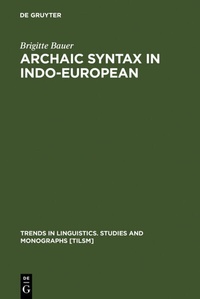
Archaic Syntax in Indo-European
The Spread of Transitivity in Latin and French
1st Edition
Published on 20. April 2011
XVIII, 394 pages
978-3-11-082599-2 (ISBN)
Description

No detailed description available for "Archaic Syntax in Indo-European".
Reviews / Votes
"Die mit reichhaltigem Material untermauerte, methodologisch wichtige Untersuchung stellt einen bemerkenswerten Beitrag zur Erforschung der ältesten idg. Syntax dar, der der zukünftigen Bearbeitung dieser schwierigen Frage nicht wenige Anregungen zu geben vermag." (Karl Horst Schmidt, Kratylos 48/2003)More details
Other editions
Additional editions
Book
07/2000
1st Edition
De Gruyter Mouton
€189.95
Shipment within 7-9 days
Book
01/2000
1st Edition
De Gruyter Mouton
€269.00
Article exhausted; check different version
Content
- Intro
- Preface
- Abbreviations referring to grammatical terms:
- Chapter 1 Introduction
- 1.1 Language typology: Arbitrariness and system
- 1.2 Indo-European linguistics and content-related typology
- 1.3 Language types
- 1.4 Proto-Indo-European and active typology
- 1.5 The aim of this study
- Chapter 2 The ergative and active hypotheses for Proto-Indo-European
- 2.1 Preliminary discussion: Uhlenbeck and Sapir
- 2.2 General characteristics of ergativity
- 2.3 Proto-Indo-European and the ergative hypothesis
- 2.4 Non-Transitive languages
- 2.5 Conclusion: The non-nominative stage of Proto-Indo-European
- Chapter 3 Impersonal verbs
- 3.1 The impersonal verb in Indo-European: General considerations
- 3.2 Impersonal verbs referring to weather conditions
- 3.3 Impersonal verbs in Latin not referring to weather conditions
- 3.4 The development of impersonal verbs in the shift from Latin to Romance
- 3.5 Impersonal verbs in non-Indo-European languages
- 3.6 Conclusion
- Chapter 4 Possessive mihi est constructions
- 4.1 Types of possession
- 4.2 Possession in Indo-European languages
- 4.3 The mihi est construction in Latin
- 4.4 Dative vs. genitive in possessive constructions
- 4.5 Conclusion
- Chapter 5 Nominal structures: Verbal mihi est constructions
- 5.1 Verbal mihi est constructions in the early daughter languages
- 5.2 Verbal mihi est constructions in Latin
- 5.3 Verbal mihi est constructions: conclusion
- Chapter 6 Nominal structures: Absolute constructions
- 6.1 Absolute constructions in the early daughter languages
- 6.2 Absolute constructions: An inherited characteristic?
- 6.3 Absolute constructions in Latin
- 6.4 The development of absolute constructions in Latin
- 6.5 Absolutes in Old and Middle French
- 6.6 Conclusion
- Chapter 7 Conclusion
- 7.1 Proto-Indo-European grammar
- 7.2 Syntactic residues in Proto-Indo-European
- 7.3 Grammatical characteristics and the development of syntactic residues
- 7.4 Parallels with other structures
- References
- Index
