

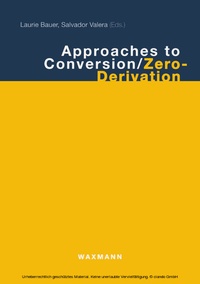
Approaches to Conversion / Zero-Derivation
1st Edition
Published on 1. December 2005
176 pages
978-3-8309-6456-8 (ISBN)
Description

This thematic publication contains papers presented by invited speakers at a symposium of Conversion / Zero-Derivation held in conjunction with the 10th International Morphology Conference in Szentendre, Hungary, in May 2002, and papers from scholars who could not attend that symposium but indicated their interest in contributing to this volume.
Conversion became an issue again in the nineties, probably as a result of the widespread renewed interest in morphology that is in full swing today. The papers contained in this book approach conversion from various perspectives and with different purposes in mind. They cover topics such as what it means to change category, how one can discover the directionality of conversion and the very vexed question of whether an analysis in terms of conversion is or is not to be preferred over one in terms of zero-derivation. All of these questions were canvassed at the symposium, but so were others: questions of typology, conversion in languages other than English, and the question of how far the meaning of conversion is predictable. The participants in the symposium were interested to find that with so many people discussing conversion there was remarkably little overlap in the areas addressed.
Conversion became an issue again in the nineties, probably as a result of the widespread renewed interest in morphology that is in full swing today. The papers contained in this book approach conversion from various perspectives and with different purposes in mind. They cover topics such as what it means to change category, how one can discover the directionality of conversion and the very vexed question of whether an analysis in terms of conversion is or is not to be preferred over one in terms of zero-derivation. All of these questions were canvassed at the symposium, but so were others: questions of typology, conversion in languages other than English, and the question of how far the meaning of conversion is predictable. The participants in the symposium were interested to find that with so many people discussing conversion there was remarkably little overlap in the areas addressed.
More details
Other editions
Additional editions
Laurie Bauer | Salvador Valera
Approaches to Conversion /Zero-Derivation
Book
11/2005
1st Edition
Waxmann
€19.90
Withdrawn from sale
