

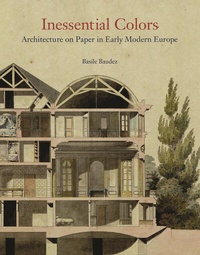
Inessential Colors
Architecture on Paper in Early Modern Europe
1st Edition
Published on 10. January 2022
288 pages
978-0-691-23315-4 (ISBN)
Description

The first comprehensive account of how and why architects learned to communicate through color
Architectural drawings of the Italian Renaissance were largely devoid of color, but from the seventeenth century through the nineteenth, polychromy in architectural representation grew and flourished. Basile Baudez argues that colors appeared on paper when architects adapted the pictorial tools of imitation, cartographers' natural signs, military engineers' conventions, and, finally, painters' affective goals in an attempt to communicate with a broad public.
Inessential Colors traces the use of color in European architectural drawings and prints, revealing how this phenomenon reflected the professional anxieties of an emerging professional practice that was simultaneously art and science. Traversing national borders, the book addresses color as a key player in the long history of rivalry and exchange between European traditions in architectural representation and practice.
Featuring a wealth of previously unpublished drawings, Inessential Colors challenges the long-standing misreading of architectural drawings as illustrations rather than representations, pointing instead to their inherent qualities as independent objects whose beauty paved the way for the visual system architects use today.
Architectural drawings of the Italian Renaissance were largely devoid of color, but from the seventeenth century through the nineteenth, polychromy in architectural representation grew and flourished. Basile Baudez argues that colors appeared on paper when architects adapted the pictorial tools of imitation, cartographers' natural signs, military engineers' conventions, and, finally, painters' affective goals in an attempt to communicate with a broad public.
Inessential Colors traces the use of color in European architectural drawings and prints, revealing how this phenomenon reflected the professional anxieties of an emerging professional practice that was simultaneously art and science. Traversing national borders, the book addresses color as a key player in the long history of rivalry and exchange between European traditions in architectural representation and practice.
Featuring a wealth of previously unpublished drawings, Inessential Colors challenges the long-standing misreading of architectural drawings as illustrations rather than representations, pointing instead to their inherent qualities as independent objects whose beauty paved the way for the visual system architects use today.
More details
Other editions
Additional editions

Book
12/2021
Princeton University Press
€76.88
Shipment within 10-20 days
Person
Basile Baudez is assistant professor of architectural history in the Department of Art and Archaeology at Princeton University. His books include Architecture et tradition académique and A Civic Utopia: Architecture and the City in France, 1765-1837.
Content
- Cover
- Contents
- Introduction
- Prologue. Architectures in Black and White
- Painters' Colors, Architects' Black and White
- Monochromy and Italian Europe
- Chapter One. Imitative Colors
- Painting Elevations
- Architectural Plans and Mapmaking
- Chapter Two. Conventional Colors
- Military Engineers as Cartographers and Builders
- The Architects' Conventional Colors
- The Convention of Pink for Masonry
- Chapter Three. Affective Colors
- A World in Color
- Architectural Paintings
- From Triumphant Polychromy to Sublime Monochromy
- Conclusion. The Anxiety of the Architect
- Appendix. The Draftsman's Tools
- Whiteness and the Nature of Drawing Paper
- Colored Chalks
- Tools and Mechanical Aids
- Drawing Curved Lines
- Quills, Pens, and Brushes
- Writing Inks: Brown, Black, and Red
- Artists' Pigments
- Acknowledgments
- Notes
- Bibliography
- Index
- Image Credits
