

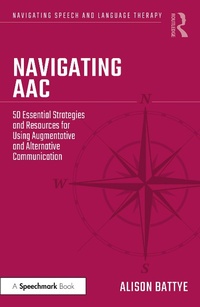
Navigating AAC
50 Essential Strategies and Resources for Using Augmentative and Alternative Communication
1st Edition
Published on 30. September 2022
252 pages
978-1-000-68891-7 (ISBN)
Description

Speech and Language Therapists are assumed to have a knowledge of AAC (Augmentative and Alternative Communication). The reality is that, unless they have had a student clinical placement in this field, they will qualify with very little experience in this area.
This book is an approachable guide to AAC and covers the various types, including paper-based and voice-output communication aids. There is guidance on how to assess a person who might need AAC, and how to work collaboratively with those who support the person on a daily basis. The author discusses the importance of core vocabulary alongside a personalised vocabulary. There are pointers for referring to specialised services, signposting families to alternative sources of funding, and making a business case for buying AAC equipment.
Written by an expert in the field, this book provides tips and strategies for SLTs who are brand new to AAC, as well as experienced clinicians wanting to gain further confidence in working with this varied client group.
This book is an approachable guide to AAC and covers the various types, including paper-based and voice-output communication aids. There is guidance on how to assess a person who might need AAC, and how to work collaboratively with those who support the person on a daily basis. The author discusses the importance of core vocabulary alongside a personalised vocabulary. There are pointers for referring to specialised services, signposting families to alternative sources of funding, and making a business case for buying AAC equipment.
Written by an expert in the field, this book provides tips and strategies for SLTs who are brand new to AAC, as well as experienced clinicians wanting to gain further confidence in working with this varied client group.
Reviews / Votes
"[I] learnt a lot of new information from this excellent book and would highly recommend it to SLTs whoare professionally interested in AAC." - Natalia Cavajdova, Specialist SLT, Specialist Children and Young People's Services, ELFT NHS (RCSLT Bulletin, Issue 839, Summer 2024)
More details
Series
Edition
1. Auflage
Language
English
Place of publication
London
United Kingdom
Publishing group
Taylor & Francis Ltd
Target group
Professional and scholarly
Illustrations
3 Tables, black and white; 5 Line drawings, black and white; 5 Illustrations, black and white
ISBN-13
978-1-000-68891-7 (9781000688917)
Copyright in bibliographic data and cover images is held by Nielsen Book Services Limited or by the publishers or by their respective licensors: all rights reserved.
Schweitzer Classification
Other editions
Additional editions
Alison Battye
Navigating AAC
50 Essential Strategies and Resources for Using Augmentative and Alternative Communication
Book
09/2022
1st Edition
Routledge
€36.60
Shipment within 10-20 days
Alison Battye
Navigating AAC
50 Essential Strategies and Resources for Using Augmentative and Alternative Communication
Book
09/2022
1st Edition
Routledge
€215.41
Shipment within 10-20 days
Person
Alison Battye is the author of Who's Afraid of AAC? (2017). She is also a Specialist SLT in AAC and manager of regional specialised AAC services.
Content
1. What is AAC?
Assessing for AAC
2. How to introduce the idea of AAC
3. Everyone on board
4. Get to know the person
5. Assess, don't guess!
6. The foundations for AAC
7. A consistent 'yes' or 'no'
8. Assessing for access method
Supporting the AAC user
9. Input before output
10. Multi-modal communication
11. Modelling AAC to a child
12. Communication partner training
AAC solutions
13. Makaton signs
14. Objects of reference
15. Introducing symbols for choice-making
16. Symbol sets
17. Communication boards
18. Communication books
19. PECS (Picture Exchange Communication System)
20. Visual supports
21. Alphabet charts
22. Partner-assisted auditory scanning
23. Eye-pointing and E-Tran frames
24. Single message VOCAs
25. Multiple message VOCAs
26. AAC apps
27. Computer and tablet VOCAs
28. Eye-gaze technology
29. Voice-banking and message-banking
30. Communication passports
Building language skills with AAC
31. Core and fringe vocabulary
32. Personalising the vocabulary
33. Building vocabulary skills
34. Building phrases and sentences
35. Communication functions
36. Conversation club
Literacy, learning and AAC
37. Symbols or text?
38. Assessing literacy
39. Teaching literacy
40. Access to the curriculum
Advocacy and AAC
41. Talking Mats
42. Mental capacity and making decisions
43. Safeguarding and AAC
AAC and access to the world
44. Multi-media and environmental controls
45. AAC competencies
46. Setting objectives
Funding for AAC
47. Specialist AAC assessment
48. Other funding streams
49. A business case for AAC resources
50. Continuing professional development
Assessing for AAC
2. How to introduce the idea of AAC
3. Everyone on board
4. Get to know the person
5. Assess, don't guess!
6. The foundations for AAC
7. A consistent 'yes' or 'no'
8. Assessing for access method
Supporting the AAC user
9. Input before output
10. Multi-modal communication
11. Modelling AAC to a child
12. Communication partner training
AAC solutions
13. Makaton signs
14. Objects of reference
15. Introducing symbols for choice-making
16. Symbol sets
17. Communication boards
18. Communication books
19. PECS (Picture Exchange Communication System)
20. Visual supports
21. Alphabet charts
22. Partner-assisted auditory scanning
23. Eye-pointing and E-Tran frames
24. Single message VOCAs
25. Multiple message VOCAs
26. AAC apps
27. Computer and tablet VOCAs
28. Eye-gaze technology
29. Voice-banking and message-banking
30. Communication passports
Building language skills with AAC
31. Core and fringe vocabulary
32. Personalising the vocabulary
33. Building vocabulary skills
34. Building phrases and sentences
35. Communication functions
36. Conversation club
Literacy, learning and AAC
37. Symbols or text?
38. Assessing literacy
39. Teaching literacy
40. Access to the curriculum
Advocacy and AAC
41. Talking Mats
42. Mental capacity and making decisions
43. Safeguarding and AAC
AAC and access to the world
44. Multi-media and environmental controls
45. AAC competencies
46. Setting objectives
Funding for AAC
47. Specialist AAC assessment
48. Other funding streams
49. A business case for AAC resources
50. Continuing professional development
