

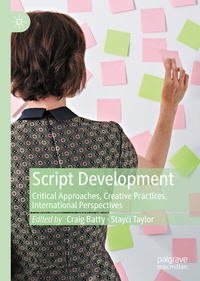
Script Development
Description

This book offers the first international look at how script development is theorised and practiced. Drawing on interviews, case studies, discourse analysis, creative practices and industry experiences, it brings together scholars and practitioners from around the world to offer critical insights into this core, but often hidden, aspect of screenwriting and screen production. Chapters speculate and reflect upon how creative, commercial and social practices - in which ideas, emotions, people and personalities combine, cohere and clash - are shaped by the practicalities, policies and rapid movements of the screen industry. Comprising two parts, the book first looks 'into' script development from a theoretical perspective, and second looks 'out from' the practice to form practitioner-led perspectives of script development. With a rising interest in screenwriting and production studies, and an increased appetite for practice-based research, the book offers a timely mapping of the terrainof script development, providing rich foundations for both study and practice.
Reviews / Votes
"a truly interesting and enlightening read, which provides fresh and insightful material and sharp analysis from numerous aspects of the complex script development process. This broad and multi-faceted book is more relevant than ever-it will most likely spur further research in the area of script development for years to come. In short, this is a book the screenwriting field has been waiting for."- Siri Senje, Professor and Program Director of Screenwriting, Kristiania University College
More details
Other editions
Additional editions
Persons
Craig Batty is Dean of Research at University of South Australia, Australia. He is author and editor of over 100 publications on screenwriting, script development and the screenwriting PhD.
Stayci Taylor is a Lecturer in Media at RMIT University, Australia. She is an award-winning screenwriter and researcher, published widely on screenwriting, web series and creative writing.
Content
Part 1: Looking into Script Development: Theories on Practice.- 1. Originality, and Development of the Screen Idea, Ian W. Macdonald.- 2. How Government Policy Defines Script Development: Comparative Case Studies of Screen Australia and the Danish Film Institute, Radha O'Meara and Cath Moore.- 3. Screenplay Development and the Post-Socialist Producer: A Small-Market Perspective, Petr Szczepanik.- 4. The Persistence of Cultural Vision: Australian Screenwriting 1994-2013, Glenda Hambly.- 5. Beyond Stereotype: Collaborative Script Development for Stories about Mental Illness and Suicide, Fincina Hopgood.- 6. Network Television Writers and the 'Race Problems' of 1968, Caryn Murphy.- 7. Telling Stories about Yesterday's Hero for Today's World: The Script Development of Chilean TV series Heroes (2006-2007), Carmen Sofia Brenes, Margaret McVeigh and Alejandro C. Reid.- 8. Author and Screenwriter Working Together on an Adapted Script: The Case of O quatrilho , Clarissa Mazon Miranda.- 9. Establishing a Shared Cultural Domain within European Co-Production: Nordic Noir as Boundary Object, Rosamund Davies.- Part 2: Looking out from Script Development: Practice into Theory.- 10. Holding Ground and Moving Targets: Scripting Urban Terror in East Africa, Joshua McNamara.- 11. Screenplay Development and Social Change in Papua New Guinea, Mark Eby.- 12. Uncertainty, Risk and Entering Unsafe Territory: Exploring the Writing Process of a New Zealand Indigenous Screenwriter, Christina Milligan.- 13. So Much Drama, So Little Time: Script Development in Australian Fast Turnaround Serial Drama, Philippa Burne and Noel Maloney.- 14. Finding the Beats in the TV Sitcom, D.T. Klika15. The Promiscuous Screenplay: Writing with Anything and Everything, Siobhan Jackson.- 16. Subjects of the Gaze: Script Development as Performance, Emma Bolland and Louise Sawtell.
