

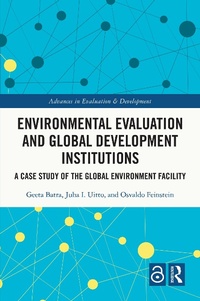
Environmental Evaluation and Global Development Institutions
A Case Study of the Global Environment Facility
1st Edition
Published on 10. October 2021
200 pages
978-1-000-48199-0 (ISBN)
Description

Evaluation is increasingly important for finding sustainable solutions for the people and the planet, based on a systematic analysis of what works, for whom, and under what circumstances, and to contribute to the achievement of the Sustainable Development Goals, as they pertain to the environment.
This book explores why the Global Environment Facility (GEF) invests in evaluation for accountability and learning to inform its decision-making on programming priorities, and how this leads to wiser funding decisions and better program performance on the ground. The book is based on real-life experiences of how to make evaluation count for international environmental action. Drawing upon comprehensive evaluations of the GEF, it provides unique insights from authors responsible for designing, implementing, and disseminating the findings of the evaluations. No other multilateral development or environment agency places evaluation fully at the center of their decision-making. The book outlines the trends in the global environment and the changing landscape of international environmental finance. It defines the role of the GEF and explains its institutional framework and the unique partnership that involves donor and recipient countries, multilateral development banks, UN agencies, nongovernmental organizations (NGOs), and national agencies in the developing countries. Further, it provides useful pointers to other organizations wishing to enhance evidence-based decision-making for improving their relevance, performance, and impact.
The book will be most suitable for graduate-level, specialized study in a variety of disciplines such as environmental and development economics, political science, international relations, geography, sociology, and social anthropology.
The Open Access version of this book, available at http://www.taylorfrancis.com, has been made available under a Creative Commons Attribution-Non Commercial-No Derivatives 4.0 license.
This book explores why the Global Environment Facility (GEF) invests in evaluation for accountability and learning to inform its decision-making on programming priorities, and how this leads to wiser funding decisions and better program performance on the ground. The book is based on real-life experiences of how to make evaluation count for international environmental action. Drawing upon comprehensive evaluations of the GEF, it provides unique insights from authors responsible for designing, implementing, and disseminating the findings of the evaluations. No other multilateral development or environment agency places evaluation fully at the center of their decision-making. The book outlines the trends in the global environment and the changing landscape of international environmental finance. It defines the role of the GEF and explains its institutional framework and the unique partnership that involves donor and recipient countries, multilateral development banks, UN agencies, nongovernmental organizations (NGOs), and national agencies in the developing countries. Further, it provides useful pointers to other organizations wishing to enhance evidence-based decision-making for improving their relevance, performance, and impact.
The book will be most suitable for graduate-level, specialized study in a variety of disciplines such as environmental and development economics, political science, international relations, geography, sociology, and social anthropology.
The Open Access version of this book, available at http://www.taylorfrancis.com, has been made available under a Creative Commons Attribution-Non Commercial-No Derivatives 4.0 license.
More details
Series
Edition
1. Auflage
Language
English
Place of publication
London
United Kingdom
Publishing group
Taylor & Francis Ltd
Target group
College/higher education
Product notice
Reflowable
Illustrations
5 Tables, black and white; 19 Line drawings, black and white; 6 Halftones, black and white; 25 Illustrations, black and white
File size
3,45 MB
ISBN-13
978-1-000-48199-0 (9781000481990)
Copyright in bibliographic data and cover images is held by Nielsen Book Services Limited or by the publishers or by their respective licensors: all rights reserved.
Schweitzer Classification
Other editions
Additional editions
Geeta Batra | Juha I. Uitto | Osvaldo N. Feinstein
Environmental Evaluation and Global Development Institutions
A Case Study of the Global Environment Facility
Book
05/2023
1st Edition
Routledge
€65.00
Shipment within 10-20 days
Geeta Batra | Juha I. Uitto | Osvaldo N. Feinstein
Environmental Evaluation and Global Development Institutions
A Case Study of the Global Environment Facility
Book
10/2021
1st Edition
Routledge
€206.10
Shipment within 10-20 days
Geeta Batra | Juha I. Uitto | Osvaldo N. Feinstein
Environmental Evaluation and Global Development Institutions
A Case Study of the Global Environment Facility
Book
10/2021
Routledge
Unfortunately, price unknown
Available (delivery time upon request)
Persons
Geeta Batra is Chief Evaluation Officer and Deputy Director of the Independent Evaluation Office (IEO) of the Global Environment Facility (GEF), Washington, DC, USA. Geeta has 24 years of experience in international development across the World Bank, International Finance Corporation, and the Global Environment Facility. She spent eight years in advisory and lending operations, and 16 years in evaluation. Geeta has applied a spectrum of evaluation methods to enhance quality and use of evaluations to improve program design, development outcomes, and sustainability.
Juha I. Uitto is Director of the Global Environment Facility (GEF) Independent Evaluation Office (IEO). He has worked as an evaluator with the GEF and the United Nations Development Programme (UNDP) for more than two decades focusing on evaluation at the nexus of environment and development. For five years, he served as Executive Coordinator of the UN Evaluation Group. He spent the 1990s as research manager at the United Nations University. Educated at the Universities of Helsinki and Lund, Juha holds a PhD in Social and Economic Geography. He has published widely on topics related to sustainable development, environmental hazards, and evaluation. He has held visiting positions with Rutgers University and Kyoto University.
Osvaldo Feinstein is Professor at the Universidad Complutense de Madrid's Master in the Evaluation of Programs and Public Policies and Member of the International Advisory Panel of UNDP's Independent Evaluation Office. He is an editor and author of books and articles on evaluation, development, and economics. He is the former manager and adviser at the World Bank's Evaluation Department and consultant with the IDB, AfDB, WBG, GEF, ILO, UNESCO, MOPAN, DFID, IDRC, ILPES, CEPAL, UNDP, IFAD, CGIAR, CLEAR-AA, AEVAL, BdF EIPA, and IEF. He has experience in Latin American and Caribbean countries, and in Asia and Africa, Eastern Europe, France, Italy, and Spain.
Juha I. Uitto is Director of the Global Environment Facility (GEF) Independent Evaluation Office (IEO). He has worked as an evaluator with the GEF and the United Nations Development Programme (UNDP) for more than two decades focusing on evaluation at the nexus of environment and development. For five years, he served as Executive Coordinator of the UN Evaluation Group. He spent the 1990s as research manager at the United Nations University. Educated at the Universities of Helsinki and Lund, Juha holds a PhD in Social and Economic Geography. He has published widely on topics related to sustainable development, environmental hazards, and evaluation. He has held visiting positions with Rutgers University and Kyoto University.
Osvaldo Feinstein is Professor at the Universidad Complutense de Madrid's Master in the Evaluation of Programs and Public Policies and Member of the International Advisory Panel of UNDP's Independent Evaluation Office. He is an editor and author of books and articles on evaluation, development, and economics. He is the former manager and adviser at the World Bank's Evaluation Department and consultant with the IDB, AfDB, WBG, GEF, ILO, UNESCO, MOPAN, DFID, IDRC, ILPES, CEPAL, UNDP, IFAD, CGIAR, CLEAR-AA, AEVAL, BdF EIPA, and IEF. He has experience in Latin American and Caribbean countries, and in Asia and Africa, Eastern Europe, France, Italy, and Spain.
Content
1. Introduction 2. Evaluation at the GEF 3. Evaluation and the replenishment process 4. Evaluation methods 5. Performance, effectiveness, and sustainability of GEF interventions 6. Toward transformational change 7. Boosting the benefits: Use of GEF IEO evaluations 8. Lessons from the GEF experience
