

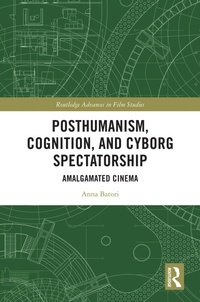
Posthumanism, Cognition and Cyborg Spectatorship
Amalgamated Cinema
Published on 30. March 2026
176 pages
978-1-040-49538-4 (ISBN)
Description

This book argues that contemporary digital blockbusters function as laboratories for posthuman cognition that transform spectatorship into a cyborg mode in which perception, memory, and agency are distributed across the cinematic canvas, the diegetic bodies of characters, the formal operations of film style, and the embodied cognition of the spectator.
Drawing on posthumanist theory and the framework of 4E cognition, it introduces four interlinked concepts - embodied and frozen module cognition, amalgamated aesthetics, and the cybokinetic frame - to explain how film form trains attention, sensorimotor coupling, and cognitive adaptation. Methodologically, the study combines close textual analysis with attention and perception research, incorporating formal measures (ASL, MSL, VAI) and advocating for experimental follow-ups using eye-tracking, pupillometry, and fMRI/EEG studies. Through case studies including Blonde, Nope, Inception, RoboCop, Pacific Rim, and Iron Man, the book traces how aesthetic strategies sustain or fracture embodied engagement under conditions of sensory and informational excess. Ultimately, it redefines the digital blockbuster as an active cognitive technology that both reflects and reconfigures twenty-first-century perception.
The book is aimed at film and media scholars, cognitive scientists exploring neurocinematics and enactive approaches, advanced students, and filmmakers who seek guidance on visual design.
Drawing on posthumanist theory and the framework of 4E cognition, it introduces four interlinked concepts - embodied and frozen module cognition, amalgamated aesthetics, and the cybokinetic frame - to explain how film form trains attention, sensorimotor coupling, and cognitive adaptation. Methodologically, the study combines close textual analysis with attention and perception research, incorporating formal measures (ASL, MSL, VAI) and advocating for experimental follow-ups using eye-tracking, pupillometry, and fMRI/EEG studies. Through case studies including Blonde, Nope, Inception, RoboCop, Pacific Rim, and Iron Man, the book traces how aesthetic strategies sustain or fracture embodied engagement under conditions of sensory and informational excess. Ultimately, it redefines the digital blockbuster as an active cognitive technology that both reflects and reconfigures twenty-first-century perception.
The book is aimed at film and media scholars, cognitive scientists exploring neurocinematics and enactive approaches, advanced students, and filmmakers who seek guidance on visual design.
More details
Series
Language
English
Place of publication
London
United Kingdom
Publishing group
Taylor & Francis Ltd
Target group
College/higher education
Professional and scholarly
Illustrations
21 Halftones, black and white; 21 Illustrations, black and white
File size
5,15 MB
ISBN-13
978-1-040-49538-4 (9781040495384)
Copyright in bibliographic data and cover images is held by Nielsen Book Services Limited or by the publishers or by their respective licensors: all rights reserved.
Schweitzer Classification
Other editions
Additional editions
Book
approx. 03/2026
1st Edition
Routledge
€213.20
Not yet published
Person
Anna Batori is an independent researcher with a PhD in Film and Television Studies (University of Glasgow/Screen, UK, 2017). She is the author of Space and Place in Romanian and Hungarian Cinema (2018) and Extreme Cinema in Eastern Europe (2024). Batori writes on world cinema, film theory and digitized narrative techniques.
Content
1. What Is Posthuman Cinema?
2. The Posthuman Feedback Loop and the Cybernetic Subject
3. Posthuman Cognitive Apparatus in Inception
4. Upgraded Human Vision: The Cyborg Subject
5. Amalgamated Aesthetics and Cybokinetic Perception
6. Frozen Module Cognition and Disembodied Simulation
7. Superhero Cognition and the Marvel Cinematic Universe
8. Conclusion: Amalgamated Cinema and the Digital
Index
2. The Posthuman Feedback Loop and the Cybernetic Subject
3. Posthuman Cognitive Apparatus in Inception
4. Upgraded Human Vision: The Cyborg Subject
5. Amalgamated Aesthetics and Cybokinetic Perception
6. Frozen Module Cognition and Disembodied Simulation
7. Superhero Cognition and the Marvel Cinematic Universe
8. Conclusion: Amalgamated Cinema and the Digital
Index
