

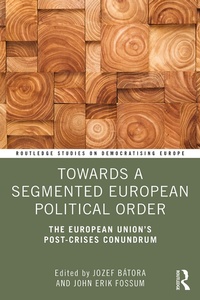
Towards a Segmented European Political Order
The European Union's Post-crises Conundrum
1st Edition
Published on 8. November 2019
312 pages
978-1-351-02433-4 (ISBN)
Description

This book makes a distinctive contribution to the crucial debate on the European Union (EU)'s present and future development.
It systematically examines how the range of crises and challenges over the last decade have transformed the EU and relates those findings to the discussion of an increasingly differentiated EU. It argues that the post-crises EU shows clear signs of becoming a segmented political order with in-built biases and constraints. The book spells out the key features of such an order in ideational and structural terms and shows how it more concretely manifests itself in the EU's institutional and constitutional make-up and in how member states constrain and condition EU action. Different states impose different types of constraints, as is underlined through paying explicit attention to the Visegrad countries.
This book will be of key interest to scholars and students of EU politics/studies, European integration and politics, East European politics and foreign policy.
It systematically examines how the range of crises and challenges over the last decade have transformed the EU and relates those findings to the discussion of an increasingly differentiated EU. It argues that the post-crises EU shows clear signs of becoming a segmented political order with in-built biases and constraints. The book spells out the key features of such an order in ideational and structural terms and shows how it more concretely manifests itself in the EU's institutional and constitutional make-up and in how member states constrain and condition EU action. Different states impose different types of constraints, as is underlined through paying explicit attention to the Visegrad countries.
This book will be of key interest to scholars and students of EU politics/studies, European integration and politics, East European politics and foreign policy.
Reviews / Votes
This collection foregrounds the institutional fault lines, ideas and ideologies that make today's EU a uniquely "segmented" political order. Its thought-provoking contributions help us see that different aspects of European governance are simultaneously moving in several different directions - and that this has major consequences for how we understand its whole system. - Craig Parsons, University of Oregon, USA.More details
Series
Edition
1. Auflage
Language
English
Place of publication
London
United Kingdom
Publishing group
Taylor & Francis Ltd
Target group
College/higher education
Illustrations
5 Tables, black and white; 195 Line drawings, black and white; 19 Illustrations, black and white
ISBN-13
978-1-351-02433-4 (9781351024334)
Copyright in bibliographic data and cover images is held by Nielsen Book Services Limited or by the publishers or by their respective licensors: all rights reserved.
Schweitzer Classification
Other editions
Additional editions
Jozef Batora | John Erik Fossum
Towards a Segmented European Political Order
The European Union's Post-crises Conundrum
Book
11/2019
1st Edition
Routledge
€193.13
Shipment within 10-20 days
Jozef Batora | John Erik Fossum
Towards a Segmented European Political Order
The European Union's Post-crises Conundrum
Book
11/2019
1st Edition
Routledge
€54.70
Shipment within 10-20 days
Persons
Jozef Batora is Professor at the Department of Political Science, Faculty of Arts, Comenius University in Bratislava, Slovakia, and at the International Relations Department, Webster Vienna Private University, Austria.
John Erik Fossum is Professor at the ARENA Centre for European Studies, University of Oslo, Norway.
John Erik Fossum is Professor at the ARENA Centre for European Studies, University of Oslo, Norway.
Content
1. Introduction
2. The Institutional Make-up of Europe's Segmented Political Order
3. Illusions of Convergence: The Persistent Simplification of a Wicked Crisis
4. Epistemic Worries about Economic Expertise
5. What Kind of Crisis and How to Deal with it? The Segmented Border Logic in the European Migration Crisis
6. Toxic Neoliberalism on the EU's Periphery: Slovakia, the Euro and the Migrant Crisis
7. European Solidarity in Times of Crisis: Towards Differentiated Integration
8. Interstitial Organisations and Segmented Integration in EU Governance
9. Undermining the Standards of Liberal Democracy within the European Union: The Polish Case and the Limits of Post-Enlargement Democratic Conditionality
10. Newspaper Portrayal of the EU in Crises in the Czech Republic, Slovakia and Hungary: The Union's Imagined Linearity
11. European Crises and Foreign Policy Attitudes in Europe
12. Integration through Differentiation and Segmentation: The Case of one Member State from 1950 to Brexit (and Beyond)
13. Conclusion: A Segmented Political Order and Future Options
2. The Institutional Make-up of Europe's Segmented Political Order
3. Illusions of Convergence: The Persistent Simplification of a Wicked Crisis
4. Epistemic Worries about Economic Expertise
5. What Kind of Crisis and How to Deal with it? The Segmented Border Logic in the European Migration Crisis
6. Toxic Neoliberalism on the EU's Periphery: Slovakia, the Euro and the Migrant Crisis
7. European Solidarity in Times of Crisis: Towards Differentiated Integration
8. Interstitial Organisations and Segmented Integration in EU Governance
9. Undermining the Standards of Liberal Democracy within the European Union: The Polish Case and the Limits of Post-Enlargement Democratic Conditionality
10. Newspaper Portrayal of the EU in Crises in the Czech Republic, Slovakia and Hungary: The Union's Imagined Linearity
11. European Crises and Foreign Policy Attitudes in Europe
12. Integration through Differentiation and Segmentation: The Case of one Member State from 1950 to Brexit (and Beyond)
13. Conclusion: A Segmented Political Order and Future Options
