

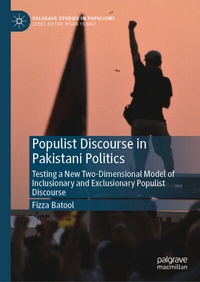
Populist Discourse in Pakistani Politics
Description

This book presents a new theoretical model for mapping how populist leaders construct "the people", using simultaneous processes of inclusion and exclusion. Applying this model to Pakistan's distinctive political landscape, the work analyzes the populist discourse of Zulfikar Ali Bhutto and Imran Khan, highlighting the key similarities and differences in their construct. The comparative analysis underlines how Pakistan's political history, including the role of religion, the military, and dynastic politics, shapes populist politics in the country.
By centering a non-Western case, this book challenges dominant frameworks and offers an accessible, comparative lens on populist discourse. It will be of interest to scholars and students of populism, Pakistani politics, and discourse analysis, as well as to those interested in the broader dynamics of democratization in hybrid political systems.
More details
Other editions
Additional editions
Person
Dr. Fizza Batool is a Pakistani academic specializing in populism, religious nationalism, and democratization. She serves as an Assistant Professor at SZABIST University, Karachi. Holding a Ph.D. in International Relations from the University of Karachi, she has worked in academia and policy think tanks for over a decade. Her recent co-authored publication with Dr. Ihsan Yilmaz, Populist Identification in Public Discourse , is recognized as the first comprehensive book on populism in Pakistan and the first work using Laclau's discourse theory to understand the demand side of populism. Dr. Batool has served as a Post-doctoral Fellow at the Central European University (CEU) Democracy Institute in Budapest, and a South Asian Voices (SAV) Visiting Fellow at the Stimson Center in Washington, D.C.
Content
Chapter 1: The Puzzle of Pakistani Populism.- Chapter 2: A New Model for Analyzing Populism.- Chapter 3: Populism and Pakistan: A Brief History.- Chapter 4: Between Socialism and Islam: Mapping Inclusion and Exclusion in Bhutto's Populism.- Chapter 5: Between Tradition and Change: Mapping Inclusion and Exclusion in Imran Khan's Populism.- Chapter 6: Conclusion.
