

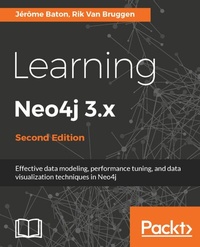
Learning Neo4j 3.x
Effective data modeling, performance tuning and data visualization techniques in Neo4j
2nd Edition
Published on 8. July 2025
316 pages
978-1-78646-008-0 (ISBN)
Description

No detailed description available for "Learning Neo4j 3.x".
All prices
More details
Edition
2nd Revised edition
Language
English
Place of publication
Birmingham
United Kingdom
Target group
Professional and scholarly
US School Grade: College Graduate Student
Edition type
Revised edition
Product notice
Reflowable
File size
24,71 MB
ISBN-13
978-1-78646-008-0 (9781786460080)
Copyright in bibliographic data and cover images is held by Nielsen Book Services Limited or by the publishers or by their respective licensors: all rights reserved.
Schweitzer Classification
Other editions
Additional editions
Jérôme Baton
Learning Neo4j 3.x -
Effective data modeling, performance tuning and data visualization techniques in Neo4j
Book
10/2017
2nd Edition
Packt Publishing
€63.20
Shipment within 3-4 weeks
Persons
Baton Jerome :
Jerome Baton started hacking computers at the age of skin problems, gaming first then continued his trip by self-learning Basic on Amstrad CPC, peaking on coding a full screen horizontal starfield, and messing the interlace of the video controller so that sprites appeared twice as high in horizontal beat'em up games. Disks were three inches for 178 Kb then. Then, for gaming reasons, he switched to Commodore Amiga and its fantastic AMOS Basic. Later caught by seriousness and studies, he wrote Turbo Pascal, C, COBOL, Visual C++, and Java on PCs and mainframes at university, and even Logo in high school. Then, Java happened and he became a consultant, mostly on backend code of websites in many different businesses. Jerome authored several articles in French on Neo4j, JBoss Forge, an Arduino workshop for Devoxx4Kids, and reviewed kilos of books on Android. He has a weakness for wordplay, puns, spoonerisms, and Neo4j that relieves him from join(t) pains. Jerome also has the joy to teach in French universities, currently at I.U.T de Paris, Universite Paris V - Rene Descartes (Neo4j, Android), and Universite de Troyes (Neo4j), where he does his best to enterTRain the students. When not programming, Jerome enjoys photography, doing electronics, everything DIY, understanding how things work, trying to be clever or funny on Twitter, and spends a lot of time trying to understand his kids and life in general.Van Bruggen Rik :
Rik Van Bruggen is the VP of Sales for Neo Technology for Benelux, UK, and the Nordic region. He has been working for startup companies for most of his career, including eCom Interactive Expertise, SilverStream Software, Imprivata, and Courion. While he has an interest in technology, his real passion is business and how to make technology work for a business. He lives in Antwerp, Belgium, with his wife and three lovely kids, and enjoys technology, orienteering, jogging, and Belgian beer.
Jerome Baton started hacking computers at the age of skin problems, gaming first then continued his trip by self-learning Basic on Amstrad CPC, peaking on coding a full screen horizontal starfield, and messing the interlace of the video controller so that sprites appeared twice as high in horizontal beat'em up games. Disks were three inches for 178 Kb then. Then, for gaming reasons, he switched to Commodore Amiga and its fantastic AMOS Basic. Later caught by seriousness and studies, he wrote Turbo Pascal, C, COBOL, Visual C++, and Java on PCs and mainframes at university, and even Logo in high school. Then, Java happened and he became a consultant, mostly on backend code of websites in many different businesses. Jerome authored several articles in French on Neo4j, JBoss Forge, an Arduino workshop for Devoxx4Kids, and reviewed kilos of books on Android. He has a weakness for wordplay, puns, spoonerisms, and Neo4j that relieves him from join(t) pains. Jerome also has the joy to teach in French universities, currently at I.U.T de Paris, Universite Paris V - Rene Descartes (Neo4j, Android), and Universite de Troyes (Neo4j), where he does his best to enterTRain the students. When not programming, Jerome enjoys photography, doing electronics, everything DIY, understanding how things work, trying to be clever or funny on Twitter, and spends a lot of time trying to understand his kids and life in general.Van Bruggen Rik :
Rik Van Bruggen is the VP of Sales for Neo Technology for Benelux, UK, and the Nordic region. He has been working for startup companies for most of his career, including eCom Interactive Expertise, SilverStream Software, Imprivata, and Courion. While he has an interest in technology, his real passion is business and how to make technology work for a business. He lives in Antwerp, Belgium, with his wife and three lovely kids, and enjoys technology, orienteering, jogging, and Belgian beer.
Content
- Intro
- Copyright
- Credits
- About the Authors
- Acknowledgement
- About the Reviewers
- www.PacktPub.com
- Customer Feedback
- Table of Contents
- Preface
- Chapter 1: Graph Theory and Databases
- Introducing Neo4j 3.x and a history of graphs
- Definition and usage of the graph theory
- Social studies
- Biological studies
- Computer science
- Flow problems
- Route problems
- Web search
- Background
- Navigational databases
- Relational databases
- NoSQL databases
- Key-value stores
- Column-family stores
- Document stores
- Graph databases
- The Property Graph model of graph databases
- Node labels
- Relationship types
- Why use graph databases, or not
- Why use a graph database?
- Complex queries
- In-the-clickstream queries on live data
- Pathfinding queries
- When not to use a graph database and what to use instead
- Large set-oriented queries
- Graph global operations
- Simple aggregate-oriented queries
- Test questions
- Summary
- Chapter 2: Getting Started with Neo4j
- Key concepts and characteristics of Neo4j
- Built for graphs from the ground up
- Transactional ACID-compliant database
- Made for online transaction processing
- Designed for scalability
- A declarative query language - Cypher
- Sweet spot use cases of Neo4j
- Complex join-intensive queries
- Pathfinding queries
- Committed to open source
- The features
- The support
- The license conditions
- Installing Neo4j
- Installing Neo4j on Windows
- Installing Neo4j on Mac or Linux
- Using Neo4j in a cloud environment
- Sandbox
- Using Neo4j in a Docker container
- Installing Docker
- Preparing the filesystem
- Running Neo4j in a Docker container
- Test questions
- Summary
- Chapter 3: Modeling Data for Neo4j
- The four fundamental data constructs
- How to start modeling for graph databases
- What we know - ER diagrams and relational schemas
- Introducing complexity through join tables
- A graph model - a simple, high-fidelity model of reality
- Graph modeling - best practices and pitfalls
- Graph modeling best practices
- Designing for query-ability
- Aligning relationships with use cases
- Looking for n-ary relationships
- Granulate nodes
- Using in-graph indexes when appropriate
- Graph database modeling pitfalls
- Using rich properties
- Node representing multiple concepts
- Unconnected graphs
- The dense node pattern
- Test questions
- Summary
- Chapter 4: Getting Started with Cypher
- Writing the Cypher syntax
- Key attributes of Cypher
- Being crude with the data
- Create data
- Read data
- Update data
- Delete data
- Key operative words in Cypher
- Syntax norms
- More that you need to know
- With a little help from my friends
- The Cypher refcard
- The openCypher project
- Summary
- Chapter 5: Awesome Procedures on Cypher - APOC
- Installing APOC
- On a hardware server
- On a Docker container
- Verifying APOC installation
- Functions and procedures
- My preferred usages
- A little help from a friend
- Graph overview
- Several key usages
- Setup
- Random graph generators
- PageRank
- Timeboxed execution of Cypher statements
- Linking of a collection of nodes
- There's more in APOC
- Test questions
- Summary
- Chapter 6: Extending Cypher
- Building an extension project
- Creating a function
- Creating a procedure
- Custom aggregators
- Unmanaged extensions
- HTTP and JAX-RS refreshers
- Registering
- Accessing
- Streaming JSON responses
- Summary
- Chapter 7: Query Performance Tuning
- Explain and profile instructions
- A query plan
- Operators
- Indexes
- Force index usage
- Force label usage
- Rules of thumb
- Explain all the queries
- Rows
- Do not overconsume
- Cartesian or not?
- Simplicity
- Summary
- Chapter 8: Importing Data into Neo4j
- LOAD CSV
- Scaling the import
- Importing from a JSON source
- Importing from a JDBC source
- Test setup
- Importing all the systems
- Importing from an XML source
- Summary
- Chapter 9: Going Spatial
- What is spatial?
- Refresher
- Not faulty towers
- What is so spatial then?
- Neo4j's spatial features
- APOC spatial features
- Geocoding
- Setting up OSM as provider
- Setting up Google as provider
- Neo4j spatial
- Online demo
- Features
- Importing OpenStreetMap data
- Large OSM Imports
- Easy way
- The tougher way to import data
- Restroom please
- Understanding WKT and BBOX
- Removing all the geo data
- Summary
- Chapter 10: Security
- Authentication and authorization
- Roles
- Other roles
- Users management
- Linking Neo4j to an LDAP directory
- Starting the directory
- Configuring Neo4j to use LDAP
- Test questions
- Summary
- Chapter 11: Visualizations for Neo4j
- The power of graph visualizations
- Why graph visualizations matter!
- Interacting with data visually
- Looking for patterns
- Spot what's important
- The basic principles of graph visualization
- Open source visualization libraries
- D3.js
- GraphViz
- Sigma.js
- Vivagraph.js
- yWorks
- Integrating visualization libraries in your application
- Visualization solutions
- Gephi
- Keylines
- Keylines graph visualization
- Linkurio.us
- Neo4j Browser
- Tom Sawyer Software for graph visualization
- Closing remarks on visualizations - pitfalls and issues
- The fireworks effect
- The loading effect
- Cytoscape example
- Source code
- Questions and answers
- Summary
- Chapter 12: Data Refactoring with Neo4j
- Preliminary step
- Simple changes
- Renaming
- Adding data
- Adding data with a default value
- Adding data with specific values
- Checking our values
- Removing data
- Great changes
- Know your model
- Refactoring tools
- Property to label
- Property to node
- Related node to label
- Merging nodes
- Relations
- Consequences
- Summary
- Chapter 13: Clustering
- Why set up a cluster?
- Concepts
- Core servers
- Read replica servers
- High throughput
- Data redundancy
- High availability
- Bolt
- Building a cluster
- The core servers
- The read replicas
- The bolt+routing protocol
- Disaster recovery
- Summary
- Chapter 14: Use Case Example - Recommendations
- Recommender systems dissected
- Using a graph model for recommendations
- Specific query examples for recommendations
- Recommendations based on product purchases
- Recommendations based on brand loyalty
- Recommendations based on social ties
- Bringing it all together - compound recommendations
- Business variations on recommendations
- Fraud detection systems
- Access control systems
- Social networking systems
- Questions and answers
- Summary
- Chapter 15: Use Case Example - Impact Analysis and Simulation
- Impact analysis systems dissected
- Impact analysis in business process management
- Modeling your business as a graph
- Which applications are used in which buildings?
- Which buildings are affected if something happens to Appl_9?
- What business processes with an RTO of 0-2 hours would be affected by a fire at location Loc_100?
- Impact simulation in a cost calculation environment
- Modeling your product hierarchy as a graph
- Working with a product hierarchy graph
- Calculating the price based on a full sweep of the tree
- Calculating the price based on intermediate pricing
- Impact simulation on product hierarchy
- Questions and answers
- Summary
- Appendix: Tips and Tricks
- Reset password
- Check for other hosts
- Getting the first line of a CSV file
- Enabling SSH on a Raspberry Pi
- Creating guides for the Neo4j browser
- Data backup and restore
- Community version
- Enterprise version
- Tools
- Cypher-shell
- Data integration tools
- Modeling tools
- Arrows
- OmniGraffle
- Community projects
- Online documentation
- Community
- More proverbs
- Index
