

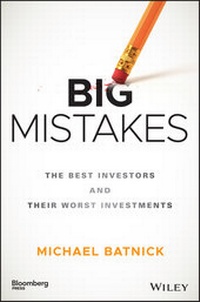
Big Mistakes
Description

Big Mistakes: The Best Investors and Their Worst Investments explores the ways in which the biggest names have failed, and reveals the lessons learned that shaped more successful strategies going forward. Investing can be a rollercoaster of highs and lows, and the investors detailed here show just how low it can go; stories from Warren Buffet, Bill Ackman, Chris Sacca, Jack Bogle, Mark Twain, John Maynard Keynes, and many more illustrate the simple but overlooked concept that investing is really hard, whether you're managing a few thousand dollars or a few billion, failures and losses are part of the game. Much more than just anecdotal diversion, these stories set the basis for the book's critical focus: learning from mistakes. These investors all recovered from their missteps, and moved forward armed with a wealth of knowledge than can only come from experience. Lessons learned through failure carry a weight that no textbook can convey, and in the case of these legendary investors, informed a set of skills and strategy that propelled them to the top.
Research-heavy and grounded in realism, this book is a must-read for any investor looking to maximize their chances of success.
* Learn the most common ways even successful investors fail
* Learn from the mistakes of the greats to avoid losing ground
* Anticipate challenges and obstacles, and develop an advance plan
* Exercise caution when warranted, and only take the smart risks
While learning from your mistakes is always a valuable experience, learning from the mistakes of others gives you the benefit of wisdom without the consequences of experience. Big Mistakes: The Best Investors and Their Worst Investments provides an incomparable, invaluable resource for investors of all stripes.
More details
Other editions
Additional editions
Person
MICHAEL BATNICK is the director of Research at Ritholtz Wealth Management. He develops and implements risk management and portfolio strategies for clients and leads internal research efforts. He educates people on investing at The Irrelevant Investor blog and co-produces the weekly podcast, Animal Spirits.
Content
Preface ix
CHAPTER 1 There Are No Iron-Clad Laws 1 Benjamin Graham
CHAPTER 2 Manage Your Risk 13 Jesse Livermore
CHAPTER 3 Don't Get Attached 25 Mark Twain
CHAPTER 4 Genius's Limits 35 John Meriwether
CHAPTER 5 Find What Works for You 45 Jack Bogle
CHAPTER 6 Stay in Your Lane 55 Michael Steinhardt
CHAPTER 7 You're Not as Smart as YouThink 65 Jerry Tsai
CHAPTER 8 Beware of Overconfidence 73 Warren Buffett
CHAPTER 9 Get Off Your Soapbox 85 Bill Ackman
CHAPTER 10 Hard Lessons Can Be Necessary 97 Stanley Druckenmiller
CHAPTER 11 The Risks of Concentrated Investing 107 Sequoia
CHAPTER 12 The Most Addictive Game 117 John Maynard Keynes
CHAPTER 13 You Only Need to Win Once 129 John Paulson
CHAPTER 14 Handling Big Losses 137 Charlie Munger
CHAPTER 15 Dealing with Regret 145 Chris Sacca
CHAPTER 16 Looking in the Mirror 155 Michael Batnick
About the Author 165
Index 167
