

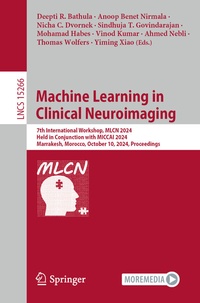
Machine Learning in Clinical Neuroimaging
Description

This book constitutes the refereed proceedings of the 7th International Workshop on Machine Learning in Clinical Neuroimaging, MLCN 2024, held in Conjunction with MICCAI 2024 in Marrakesh, Morocco, on 10th October 2024.
The 16 full papers presented in this volume were carefully reviewed and selected from 28 submissions.
They are grouped into the following topics: machine learning; clinical applications.
More details
Other editions
Additional editions
Content
.- Machine learning.
.- Parkinson's Disease Detection from Resting State EEG using Multi-Head Graph Structure Learning with Gradient Weighted Graph Attention Explanations.
.- ProxiMO: Proximal Multi-Operator Networks for Quantitative Susceptibility Mapping.
.- Brain-Cognition Fingerprinting via Graph-GCCA with Contrastive Learning.
.- HyperBrain: Anomaly Detection for Temporal Hypergraph Brain Networks.
.- SpaRG - Sparsely Reconstructed Graphs for Generalizable fMRI Analysis.
.- A Lightweight 3D Conditional Diffusion Model for Self-Explainable Brain Age Prediction in Adults and Children.
.- SOE: SO(3)-Equivariant 3D MRI Encoding.
.- Towards a foundation model for cortical folding.
.- Clinical Applications.
.- A Lesion-aware Edge-based Graph Neural Network for Predicting Language Ability in Patients with Post-stroke Aphasia.
.- DISARM: Disentangled Scanner-free Image Generation via Unsupervised Image2Image
Translation.
.- Segmenting Small Stroke Lesions with Novel Labeling Strategies.
.- A Progressive Single-Modality to Multi-Modality Classification Framework for Alzheimer's Disease Sub-type Diagnosis.
.- Surface-based parcellation and vertex-wise analysis of ultra high-resolution ex vivo 7 tesla MRI in Alzheimer's disease and related dementias.
.- Self-Supervised Pre-training Tasks for an fMRI Time-series Transformer in Autism Detection.
.- Is Your Style Transfer Doing Anything Useful? An Investigation Into Hippocampus Segmentation and the Role of Preprocessing.
.- GAMing the Brain: Investigating the Cross-modal Relationships between Functional Connectivity and Structural Features using Generalized Additive Models.
