

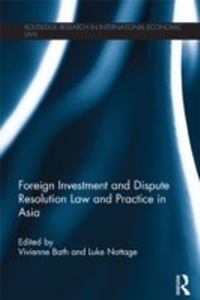
Foreign Investment and Dispute Resolution Law and Practice in Asia
1st Edition
Published on 12. March 2012
296 pages
978-1-136-58106-9 (ISBN)
Description

This book considers foreign investment flows in major Asian economies. It critically assesses the patterns and issues involved in the substantive law and policy environment which impact on investment flows, as well as the related dispute resolution law and practice. The book combines insights from international law and comparative study and is attentive to the socio-economic contexts and competing theories of the role of law in Asia. Contributions come from both academics with considerable practical expertise and legal practitioners with strong academic backgrounds. The chapters analyze the law and practice of investment treaties and FDI regimes in Asia looking specifically at developments in Japan, India, China, Indonesia, Malaysia, Korea and Vietnam. The book explores the impact of the Asian Financial Crisis in the late 1990s and the Global Financial Crisis a decade later, examining actual trends and policy debates relating to FDI and capital flows in Asia before and after those upheavals.
Foreign Investment and Dispute Resolution: Law and Practice in Asia is a valuable resource for practitioners, academics and students of International and Comparative Law, Business and Finance Law, Business, Finance and Asian Studies.
Foreign Investment and Dispute Resolution: Law and Practice in Asia is a valuable resource for practitioners, academics and students of International and Comparative Law, Business and Finance Law, Business, Finance and Asian Studies.
Reviews / Votes
"The overriding strength of this book lies in its exploratory and problem-solving focus. The contributing editors and authors well appreciate the divergent attitudes and practices towards investment law and practice in Asia. They are all experts in their fields. This book is a valuable tool for academics, students and practitioners engaged in Asian international investment law and practice. It provides incisive guidance to potential investors in Asia, suggesting whether, when and how they might invest in particular Asian countries, what kinds of support or resistance they may encounter and how they might plan their cross-border investments in light of that support or resistance. Viewed holistically, they provide a remarkably articulate assessment of divergent socioeconomic, political and cultural reasons for that divergence among Asian countries, including their impact upon FDI and ISA in particular."- LEON TRAKMAN, Professor of Law, University of New South Wales, Australia,
More details
Series
Edition
1. Auflage
Language
English
Place of publication
London
United Kingdom
Publishing group
Taylor & Francis Ltd
Target group
College/higher education
File size
3,81 MB
ISBN-13
978-1-136-58106-9 (9781136581069)
Copyright in bibliographic data and cover images is held by Nielsen Book Services Limited or by the publishers or by their respective licensors: all rights reserved.
Schweitzer Classification
Other editions
Additional editions
Vivienne Bath | Luke Nottage
Foreign Investment and Dispute Resolution Law and Practice in Asia
Book
05/2013
1st Edition
Routledge
€48.30
Shipment within 15-20 days
Vivienne Bath | Luke Nottage
Foreign Investment and Dispute Resolution Law and Practice in Asia
Book
11/2011
1st Edition
Routledge
€146.00
Shipment within 15-20 days
Persons
Vivienne Bath is Associate Professor in Law at the University of Sydney, and Director of the Centre for Asian and Pacific Law at the University of Sydney, Australia.
Luke Nottage is Associate Professor in Law at the University of Sydney, Australia, and founding Co-Director of the Australian Network for Japanese Law.
Luke Nottage is Associate Professor in Law at the University of Sydney, Australia, and founding Co-Director of the Australian Network for Japanese Law.
Content
Preface, Akira Kawamura
1. Foreign Investment and Dispute Resolution Law and Practice in Asia: An Overview, Vivienne Bath and Luke Nottage
2. Investment Arbitration in Asia: Five Perspectives on Law and Practice, Luke Nottage and J. Romesh Weeramantry
3. A Passive Player in International Investment Law: Typically Japanese?, Shotaro Hamamoto
4. The Quandary for Chinese Regulators: Controlling the Flow of Investment into and out of China, Vivienne Bath
5. China's Investment Treaties: A Procedural Perspective, Nils Eliasson
6. Foreign Investment in Indonesia: The Problem of Legal Uncertainty, Simon Butt
7. The Japan-Indonesia Economic Partnership Agreement:
An Energy Security Perspective, Sita Sitaresmi
8. Foreign Investment Laws and the Role of FDI in Malaysia's 'New' Economic Model, Salim Farrar
9. Treaty Definitions of 'Investment' and the Role of Economic Development: A Critical Analysis of the Malaysian Historical Salvors Cases, Govert Coppens
10. The 'Object and Purpose' of Indian Investment Agreements: Failing to Balance Investment Protection and Regulatory Power, Prabhash Ranjan
11. The Evolution of Korea's Investment Treaties and Investor-State Dispute Settlement Provisions, Joongi Kim
12. Legal Issues in Vietnam's FDI Law: Protections under Domestic Law, Bilateral Investment Treaties and Sovereign Guarantees, Hop Dang
13. Review of Asian Views on Foreign Investment Law, Muthucumaraswamy Sornarajah
1. Foreign Investment and Dispute Resolution Law and Practice in Asia: An Overview, Vivienne Bath and Luke Nottage
2. Investment Arbitration in Asia: Five Perspectives on Law and Practice, Luke Nottage and J. Romesh Weeramantry
3. A Passive Player in International Investment Law: Typically Japanese?, Shotaro Hamamoto
4. The Quandary for Chinese Regulators: Controlling the Flow of Investment into and out of China, Vivienne Bath
5. China's Investment Treaties: A Procedural Perspective, Nils Eliasson
6. Foreign Investment in Indonesia: The Problem of Legal Uncertainty, Simon Butt
7. The Japan-Indonesia Economic Partnership Agreement:
An Energy Security Perspective, Sita Sitaresmi
8. Foreign Investment Laws and the Role of FDI in Malaysia's 'New' Economic Model, Salim Farrar
9. Treaty Definitions of 'Investment' and the Role of Economic Development: A Critical Analysis of the Malaysian Historical Salvors Cases, Govert Coppens
10. The 'Object and Purpose' of Indian Investment Agreements: Failing to Balance Investment Protection and Regulatory Power, Prabhash Ranjan
11. The Evolution of Korea's Investment Treaties and Investor-State Dispute Settlement Provisions, Joongi Kim
12. Legal Issues in Vietnam's FDI Law: Protections under Domestic Law, Bilateral Investment Treaties and Sovereign Guarantees, Hop Dang
13. Review of Asian Views on Foreign Investment Law, Muthucumaraswamy Sornarajah
