

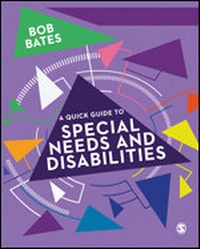
A Quick Guide to Special Needs and Disabilities
1st Edition
Published on 8. November 2016
256 pages
978-1-4739-9444-7 (ISBN)
Description

A Quick Guide to Special Needs is an easy go-to guide for busy teachers, SENCOs, practitioners and anyone else who is interested in pragmatic solutions to the challenges of teaching children and young people with additional needs.
Detailing over 60 conditions which cause people to have additional needs, Bob Bates helps you broaden your understanding of different physical, neurological, psychological, and developmental needs with accessible bite-sized explanations of the conditions, best practice approaches to working with these learners, and how to apply them to your everyday teaching.
Each individual need is explained over a 2-page spread and every entry includes:
Case studies encouraging you to reflect on real-life situations to understand the impact each condition has on people and how they and their parents deal with it.
Do it steps offering a simple step-by-step approach that you can follow in order to meet additional needs arising out of these conditions.
Important steps for the classroom specifically for teachers to use.
Recommended reading, suggesting books, articles and websites where further information on specific conditions are available.
Whether you're a newly qualified or experienced teacher, or simply want to further your understanding on the vast variety of individual needs, this guide is the ideal dip-in dip-out reference point for SEND.
Also from Bob Bates:
Educational Leadership Simplified
Learning Theories Simplified
Detailing over 60 conditions which cause people to have additional needs, Bob Bates helps you broaden your understanding of different physical, neurological, psychological, and developmental needs with accessible bite-sized explanations of the conditions, best practice approaches to working with these learners, and how to apply them to your everyday teaching.
Each individual need is explained over a 2-page spread and every entry includes:
Case studies encouraging you to reflect on real-life situations to understand the impact each condition has on people and how they and their parents deal with it.
Do it steps offering a simple step-by-step approach that you can follow in order to meet additional needs arising out of these conditions.
Important steps for the classroom specifically for teachers to use.
Recommended reading, suggesting books, articles and websites where further information on specific conditions are available.
Whether you're a newly qualified or experienced teacher, or simply want to further your understanding on the vast variety of individual needs, this guide is the ideal dip-in dip-out reference point for SEND.
Also from Bob Bates:
Educational Leadership Simplified
Learning Theories Simplified
Reviews / Votes
Bob Bates' latest book contains a wealth of information as well as practical ideas, with each one of the 60 or so entries being set out in a similar format, making it easy to dip into and to find what is most relevant to the reader at the time.Bob writes in a style that is easy to read and quickly catches the interest. I thought his idea of using mini-case studies, including some about people in the public eye not only added interest, but could help those with similar conditions to feel that there are role models who present a positive picture of what can be achieved and that no-one should be defined solely by the difficulties they strive to overcome.' -- Dr. Rona Tutt, OBE This is an extremely well researched text that covers detailed descriptions of a wide range of conditions and it would be of great value as a go-to overview of learning differences and interventions, with detailed links to resources. -- Mary Mountstephen The book is clearly aimed at teachers, but would also be useful to students and health and social care professionals working with children and young people. It is a valuable starting point for gaining quick and accessible general information in relation to the conditions and issues covered in this book, with a strong theme of inclusion throughout. -- Louise Cogher
More details
Edition
First Edition
Language
English
Place of publication
London
United Kingdom
Target group
Professional and scholarly
ISBN-13
978-1-4739-9444-7 (9781473994447)
Copyright in bibliographic data and cover images is held by Nielsen Book Services Limited or by the publishers or by their respective licensors: all rights reserved.
Schweitzer Classification
Other editions
Additional editions
Book
11/2016
1st Edition
SAGE Publications Ltd
€61.20
Shipment within 15-20 days
Book
11/2016
1st Edition
SAGE Publications Ltd
€120.60
Shipment within 15-20 days
Person
Bob Bates was a Senior Executive in the Civil Service for twenty years. During this time, he also worked as a staff trainer and coach and mentor to people with disabilities. He then set up his own Management & Training Consultancy (The Arundel Group), which celebrates its 25th anniversary next year. His work as a management consultant covered a number of local and central government projects as well as working as a trainer with major UK private sector companies.
In the late 1990s Bob started a lecturing career, during which time he gained two Masters Degrees in Management and Education and a PhD in Education. He has taught over 1000 teachers and trainers on graduate and post-graduate programmes at two universities. He currently manages and teaches on City & Guild Teaching Award, Certificate and Diploma courses in a Community College
The first edition of Learning Theories Simplified was Bob's third book. His first book, The Little Book of BIG Management Theories, written with Jim McGrath, was on W.H, Smiths' non-fiction best sellers list for nearly a year, is being translated into fifteen languages, including Japanese and Arabic, and was chosen by the Chartered Management Institute as the CMI's Practical Management Book of the Year for 2014. His second book, The Little Book of BIG Coaching Theories, published in February 2015, was also a best seller and has been translated into German and Thai. His fourth book, A Quick Guide to Special Needs and Disabilities, was published by SAGE in 2016 and his fifth book, Leadership Theories Simplified, was published by SAGE in 2017.
Bob shares his time these days between writing, working voluntarily for a charity that promotes health and education in the Gambia, researching into offender learning and homelessness and teaching Adult Education Teachers.
Bob can be contacted through his web site bobbates.co.uk (here you get an option to pick Research or Bad Bob Bates - please choose the former) or email saddlers9899@aol.com
In the late 1990s Bob started a lecturing career, during which time he gained two Masters Degrees in Management and Education and a PhD in Education. He has taught over 1000 teachers and trainers on graduate and post-graduate programmes at two universities. He currently manages and teaches on City & Guild Teaching Award, Certificate and Diploma courses in a Community College
The first edition of Learning Theories Simplified was Bob's third book. His first book, The Little Book of BIG Management Theories, written with Jim McGrath, was on W.H, Smiths' non-fiction best sellers list for nearly a year, is being translated into fifteen languages, including Japanese and Arabic, and was chosen by the Chartered Management Institute as the CMI's Practical Management Book of the Year for 2014. His second book, The Little Book of BIG Coaching Theories, published in February 2015, was also a best seller and has been translated into German and Thai. His fourth book, A Quick Guide to Special Needs and Disabilities, was published by SAGE in 2016 and his fifth book, Leadership Theories Simplified, was published by SAGE in 2017.
Bob shares his time these days between writing, working voluntarily for a charity that promotes health and education in the Gambia, researching into offender learning and homelessness and teaching Adult Education Teachers.
Bob can be contacted through his web site bobbates.co.uk (here you get an option to pick Research or Bad Bob Bates - please choose the former) or email saddlers9899@aol.com
Content
PART 1 : Physical Impairements
Allergies
Asthma
Brittle Bone Disease
Cerebral Palsy
Chronic Fatigue Syndrome
Cystic Fibrosis
Diabetes
Epilepsy
Foetal Alcohol Syndrome
Haemophilia
Hearing Impairment
Heart Disease
Hemiplegia
Hydrocephalus
Juvenile Rheumatoid Arthritis
Microcephalus
Motor Neurone Disease
Multiple Sclerosis
Multiple Sensory Deprivation
Muscular Dystrophy
Restricted Growth
Sickle-cell Anaemia
Skin Disease
Spina Bifida
Visual Impairment
Wheelchair Users
PART 2: Neurological and Psychological Disorders
Asperger's Syndrome
Ataxia
Attention Deficit Hyperactivity Disorder
Autism
Down Syndrome
Dyscalculia
Dyslexia
Dyspraxia
Sensory Processing Disorder
Speech and Language Impairments
Tourette's Syndrome
Williams Syndrome
Attachment Disorder
Bipolar Disorder
Depression
Eating Disorders
Emotional Behavioural Disorder
General Anxiety Disorder
Obsessive Compulsive Disorder
Personality Disorder
Phobias
Post-Traumatic Stress Disorder
Schizophrenia
Selective Mutism
PART 3: Other Additional Needs
Disengaged and Excluded
Emotional Distress (bullying)
English as an Additional Language
Gifted and Talented
Learning Difficulties
Munchausen by Proxy Syndrome
New Migrants
Obesity
Poor Conduct Disorder
Socio-Economic Difficulties (poverty)
Travellers and Gypsies
Victims of Abuse
Victims of Forced Marriages
Young Carers
Young Offenders
PART 4: Approaches for working with children and young people with additional needs
A Strategy for Children
A Strategy for Parents
A Strategy for Teachers
Cognitive Behavioural Therapy (CBT)
Fundatia Inima de Copil (Heart of a Child Foundation)
Heuristic Play
Jolly Phonics
Makaton
Mentalisation-Based Therapy (MBT)
Mentoring and Critical Friendship
Mindfulness
Neurodiversity
Neuro-Linguistic Programming (NLP)
Portage Home Learning
CERTS (Social Communication Emotional Regulation Transactional Support for Children)
Solihull Approach
SENCOs (Special Educational Needs Coordinators)
Transactional Analysis
TEACCH (Treatment and Education of Autistic and Communication Handicapped Children)
Understanding Intelligence
Yoga and Tai chi
Allergies
Asthma
Brittle Bone Disease
Cerebral Palsy
Chronic Fatigue Syndrome
Cystic Fibrosis
Diabetes
Epilepsy
Foetal Alcohol Syndrome
Haemophilia
Hearing Impairment
Heart Disease
Hemiplegia
Hydrocephalus
Juvenile Rheumatoid Arthritis
Microcephalus
Motor Neurone Disease
Multiple Sclerosis
Multiple Sensory Deprivation
Muscular Dystrophy
Restricted Growth
Sickle-cell Anaemia
Skin Disease
Spina Bifida
Visual Impairment
Wheelchair Users
PART 2: Neurological and Psychological Disorders
Asperger's Syndrome
Ataxia
Attention Deficit Hyperactivity Disorder
Autism
Down Syndrome
Dyscalculia
Dyslexia
Dyspraxia
Sensory Processing Disorder
Speech and Language Impairments
Tourette's Syndrome
Williams Syndrome
Attachment Disorder
Bipolar Disorder
Depression
Eating Disorders
Emotional Behavioural Disorder
General Anxiety Disorder
Obsessive Compulsive Disorder
Personality Disorder
Phobias
Post-Traumatic Stress Disorder
Schizophrenia
Selective Mutism
PART 3: Other Additional Needs
Disengaged and Excluded
Emotional Distress (bullying)
English as an Additional Language
Gifted and Talented
Learning Difficulties
Munchausen by Proxy Syndrome
New Migrants
Obesity
Poor Conduct Disorder
Socio-Economic Difficulties (poverty)
Travellers and Gypsies
Victims of Abuse
Victims of Forced Marriages
Young Carers
Young Offenders
PART 4: Approaches for working with children and young people with additional needs
A Strategy for Children
A Strategy for Parents
A Strategy for Teachers
Cognitive Behavioural Therapy (CBT)
Fundatia Inima de Copil (Heart of a Child Foundation)
Heuristic Play
Jolly Phonics
Makaton
Mentalisation-Based Therapy (MBT)
Mentoring and Critical Friendship
Mindfulness
Neurodiversity
Neuro-Linguistic Programming (NLP)
Portage Home Learning
CERTS (Social Communication Emotional Regulation Transactional Support for Children)
Solihull Approach
SENCOs (Special Educational Needs Coordinators)
Transactional Analysis
TEACCH (Treatment and Education of Autistic and Communication Handicapped Children)
Understanding Intelligence
Yoga and Tai chi
