

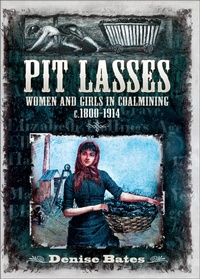
Pit Lasses
Description

" Pit Lasses adds enormously to our understanding of the role of women in coalmining as well as shedding new light on Victorian society and its values." - Beverley Guardian
Women have long been recognised as the backbone of coalmining communities, supporting their men. Less well known is the role which they played as the industry developed, working underground or at the pit head. The report of the second Children's Employment Commission caused public outrage in May 1842, revealing that half-dressed women worked underground alongside naked men. Three months later, to protect them from moral corruption, women were banned from working underground.
The Commission's report has been neglected as a historical source with the same few quotations widely used to illustrate the same headline points. And yet, across the country, around 350 women and girls described their lives and work. Together, this report and the 1841 census, produce a detailed and surprising picture of a female miner at work, at home and in her community. After 1842 women were still allowed to work above ground. Following a painful transition in the mid-1840s when some former female miners suffered severe hardship, women forged a new role at pit heads in Lancashire and Scotland, and then fought to retain it against opposition from many men.
This book examines the social, economic and political factors affecting nineteenth-century female coalminers, drawing out the largely untapped evidence within contemporary sources and challenging long-standing myths. It contains what may be the first identified photograph of a female miner who gave evidence in 1842 and reveals the future lives of some of those who gave evidence to the Royal Commission.
More details
Other editions
Additional editions
Person
Content
- Intro
- Cover Page
- Other books in the series
- Title Page
- Copyright
- Contents
- Introduction
- Chapter 1. King Coal: Women and mining 1800-1830
- Chapter 2. The Winds of Change: How mining developed in the 1830s
- Chapter 3. Knights in Shining Armour: The work of the Children's Employment Commission
- Chapter 4. The Un-Magical Mystery Tour: The places where women worked underground
- Chapter 5. All in a Day's Work: The jobs mining women carried out
- Chapter 6. T'wixt a Rock and a Hard Place?: What choice did female miners have?
- Chapter 7. Non-Domestic Goddesses: How mining women managed their homes
- Chapter 8. Not in My Back Yard: Religion, education and health
- Chapter 9. What Not to Wear: Clothes, demeanour and morality
- Chapter 10. Publish and be Damned: The impact of the Commissioners' report
- Chapter 11. What Katy Did Next: The impact of the Mines Act
- Chapter 12. The New Woman: Mining women above ground
- Plates
- Appendix 1: The Number of Female Miners in 1841
- Appendix 2: Commission Witnesses Traced to the 1841 Census Beyond Reasonable Doubt
- Appendix 3: Weights and Measures in Nineteenth Century Britain
- Glossary of Mining Terms
- Sources and Bibliography
- Index
