

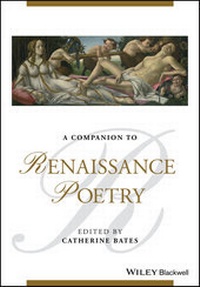
A Companion to Renaissance Poetry
Description

More details
Other editions
Additional editions
Person
Catherine Bates is Research Professor in the Department of English and Comparative Literary Studies at the University of Warwick. She is the author of: On Not Defending Poetry: Defence and Indefensibility in Sidney's Defence of Poesy; Masculinity and the Hunt: Wyatt to Spenser (for which she won the British Academy Rose Mary Crawshay Prize in 2015); Masculinity, Gender and Identity in the English Renaissance Lyric; Play in a Godless World: The Theory and Practice of Play in Shakespeare, Nietzsche and Freud; and The Rhetoric of Courtship in Elizabethan Language and Literature.
Content
Notes on Contributors ix
Preface xvii
Acknowledgments xx
Part I Contexts 1
Transitions and Translations 3
1 The Medieval Inheritance of Early Tudor Poetry 3
Seth Lerer
2 Translation and Translations 16
A. E. B. Coldiron
3 Instructive Nymphs: Andrew Marvell on Pedagogy and Puberty 31
Lynn Enterline
Religions and Reformations 50
4 Poetry and Sacrament in the English Renaissance 50
Gary Kuchar
5 "A sweetness ready penn'd"?: English Religious Poetics in the Reformation Era 63
Susannah Brietz Monta
Authorships and Authorities 78
6 Manuscript Culture: Circulation and Transmission 78
Steven W. May and Arthur F. Marotti
7 Miscellanies in Manuscript and Print 103
Jonathan Gibson
8 Renaissance Authorship: Practice versus Attribution 115
Stephen B. Dobranski
9 Female Authorship 128
Wendy Wall
10 Stakes of Hagiography: Izaak Walton and the Making of the "Religious Poet" 141
Jonathan Crewe
Defenses and Definitions 154
11 Theories and Philosophies of Poetry 154
Robert Matz
12 Tudor Verse Form: Rudeness, Artifice, and Display 166
Joseph Loewenstein
13 Genre: The Idea and Work of Literary Form 183
Patrick Cheney
Part II Forms and Genres 199
Epic and Epyllion 201
14 Edmund Spenser's The Faerie Queene 201
Gordon Teskey
15 Paradise Lost: Experimental and Unorthodox Sacred Epic 214
David Loewenstein
16 Forms of Creativity in Lucy Hutchinson's Order and Disorder 227
Shannon Miller
17 The Epyllion 239
Jim Ellis
Lyric 250
18 Petrarchism and Its Counterdiscourses: The Sonnet Tradition from Wyatt to Milton 250
Gordon Braden
19 Wyatt and Surrey: Songs and Sonnets 262
Chris Stamatakis
20 Synecdochic Structures in the Sonnet Sequences of Sidney and Spenser 276
Catherine Bates
21 "I am lunaticke": Michael Drayton, Samuel Daniel, and the Evolution of the Lyric 289
Danijela Kambaskovic?]Schwartz
22 Art and History Then: Reading Shakespeare's Sonnet 146 303
Christopher Warley
23 Metapoetry and the Subject of the Poem in Donne and Marvell 314
Barbara Correll
24 Jonson and the Cavalier Poets 325
Syrithe Pugh
Complaint and Elegy 339
25 Complaint 339
Rosalind Smith, Michelle O'Callaghan, and Sarah C. E. Ross
26 Funeral Elegy 353
Andrea Brady
Epistolary and Dialogic Forms 365
27 Letters of Address, Letters of Exchange 365
M. L. Stapleton
28 Answer Poetry and Other Verse "Conversations" 376
Cathy Shrank
Satire, Pastoral, and Popular Poetry 389
29 Verse Satire 389
Michelle O'Callaghan
30 Proper Work, Willing Waste: Pastoral and the English Poet 401
Catherine Nicholson
31 Digging into "Veritable Dunghills": Re?]appreciating
Renaissance Broadside Ballads 414
Patricia Fumerton
Religious Poetry 432
32 Female Piety and Religious Poetry 432
Femke Molekamp
33 The Psalms 446
Hannibal Hamlin
34 Donne and Herbert 459
Helen Wilcox
Part III Positions and Debates 471
35 Archipelagic Identities 473
Willy Maley
36 Chorography, Map?]Mindedness, Poetics of Place 485
Andrew Hadfield
37 Masculinity 498
Joseph Campana
38 Queer Studies 510
Stephen Guy?]Bray
39 Sensation, Passion, and Emotion 519
Douglas Trevor
40 The Body in Renaissance Poetry 531
Michael Schoenfeldt
41 Poetry and the Material Text 545
Adam Smyth
42 Science and Technology 557
Jessica Wolfe
43 Economic Criticism 570
William J. Kennedy
44 New Historicism, New Formalism, and Thy Darling in an Urn 583
Richard Strier
45 Allegory 595
Kenneth Borris
46 The Sublime 611
Patrick Cheney
Index 628
Notes on Contributors
Catherine Bates is Research Professor at the University of Warwick. She has published five monographs on Renaissance poetry and poetics, including Masculinity, Gender and Identity in the English Renaissance Lyric (2007), Masculinity and the Hunt: Wyatt to Spenser (2013)-winner of the British Academy Rose Mary Crawshay Prize, 2015-and On Not Defending Poetry: Defence and Indefensibility in Sidney's Defence of Poesy (2017). She is editor of The Cambridge Companion to the Epic (2010).
Kenneth Borris is Professor of English at McGill University, and serves on the Editorial Board of Spenser Studies. A former Canada Research Fellow and winner of the MacCaffrey Award, he has authored Visionary Spenser and the Poetics of Early Modern Platonism (2017), Allegory and Epic (2000), and Spenser's Poetics of Prophecy (1990). His four edited and co-edited books include The Sciences of Homosexuality in Early Modern Europe (2007) and Same-Sex Desire in the English Renaissance (2004).
Gordon Braden is Linden Kent Memorial Professor of English Emeritus at the University of Virginia. He is author of Renaissance Tragedy and the Senecan Tradtion (1985), The Idea of the Renaissance (1989; with William Kerrigan), and Petrarchan Love and the Continental Renaissance (1999), and co-editor (with Robert Cummings and Stuart Gillespie) of the Renaissance volume of The Oxford History of Literary Translation in English (2010).
Andrea Brady is Professor of Poetry at Queen Mary University of London, where she runs the Centre for Poetry and the Archive of the Now (www.archiveofthenow.org). She is currently writing a book on poetry and constraint across several historical periods. Scholarly works include English Funerary Elegy in the Seventeenth Century (2006). Her books of poetry are Dompteuse (2014), Cut from the Rushes (2013), Mutability (2012), and Wildfire (2010).
Joseph Campana is a poet, arts critic, and scholar of Renaissance literature and author of The Pain of Reformation: Spenser, Vulnerability, and the Ethics of Masculinity (2012), The Book of Faces (2005), Natural Selections (2012), and co-editor of Renaissance Posthumanism (2016). He received the Isabel MacCaffrey Essay Prize, the MLA's Crompton-Noll Award for LGB studies, and grants from the NEA and Bread Loaf Writers' Conference. He teaches at Rice University, where he is editor of Studies in English Literature, 1500-1900.
Patrick Cheney is Edwin Erle Sparks Professor of English and Comparative Literature at Penn State. With Catherine Bates, he is co-editor of Sixteenth-Century British Poetry, volume 4 in The Oxford History of Poetry in English, for which he serves as General Editor.
A. E. B. Coldiron, the Berry Chair in English Literature at the University of St Andrews, is author of Printers Without Borders: Translation and Textuality in the Renaissance (2015) and other books and essays on late-medieval and Renaissance literature, translation, poetics, and print culture. In 2014-15 she directed the Folger Institute's Year-Long Colloquium on Translation. She guest-edited The Translator's Voice, a special double issue of Philological Quarterly (2016), a collection of Colloquium participants' research.
Barbara Correll teaches English Renaissance literature and culture at Cornell University. She is the author of The End of Conduct: Grobianus and the Renaissance Text of the Subject (1996) and co-editor of Disgust in English Renaissance Literature (2016). She has published essays on Shakespeare, Donne, Marlowe, Spenser, Webster, Erasmus, and cinema.
Jonathan Crewe is the Leon Black Professor Emeritus of Shakespearean Studies at Dartmouth College. He has edited five Shakespeare plays and the narrative poems for the New Pelican Shakespeare. His extensive publications include three books and numerous articles on English Renaissance poetry and prose; he has also published on cultural memory, and on writing in South Africa.
Stephen B. Dobranski is Distinguished University Professor of English at Georgia State University. His publications include Milton, Authorship, and the Book Trade (1999), Readers and Authorship in Early Modern England (2005), A Variorum Commentary on the Poems of John Milton: "Samson Agonistes" (2009), and The Cambridge Introduction to Milton (2012). His most recent book is Milton's Visual Imagination: Imagery in "Paradise Lost" (2015).
Jim Ellis, Professor in the Department of English at the University of Calgary, is the author of Sexuality and Citizenship: Metamorphosis in Elizabethan Erotic Verse (2003) and Derek Jarman's Angelic Conversations (2009). His more recent work concerns poetry and performativity in the early modern period, particularly in relation to the Renaissance pleasure garden and progress entertainments.
Lynn Enterline is Nancy Perot Mulford Professor of English at Vanderbilt University. Her publications investigate the overlapping histories of rhetoric, affect, gender, and sexuality from the classical to the early modern periods. She is the author of Shakespeare's Schoolroom: Rhetoric, Discipline, Emotion (2012), The Rhetoric of the Body from Ovid to Shakespeare (2000), and The Tears of Narcissus: Melancholia and Masculinity in Early Modern Writing (1995).
Patricia Fumerton is Professor of English at the University of California, Santa Barbara, Director of UCSB's online English Broadside Ballad Archive, and author of Unsettled: The Culture of Mobility and the Working Poor in Early Modern England (2006) and Cultural Aesthetics: Renaissance Literature and the Practice of Social Ornament (1991). She has just completed a book on moving media and tactical publics in English broadside ballads, 1500-1800.
Jonathan Gibson is Senior Lecturer in English at The Open University (UK). Earlier in his career he worked as a researcher on the Perdita Project on early modern women's manuscript writings. His publications span many topics, including Ralegh, Shakespeare, Sidney, Spenser, translation, early modern letter-writing, italic script, codicology, and Elizabethan fiction. His most recent book is Elizabeth I's Foreign Correspondence (2014), co-edited with Carlo M. Bajetta and Guillaume Coatalen.
Stephen Guy-Bray is Professor of English at the University of British Columbia. He specializes in Renaissance poetry and queer theory. Forthcoming are essays on love and war in Renaissance sonnets, on Venus and Adonis, and on women and textual production. He is currently working on Renaissance inactivity.
Andrew Hadfield is Professor of English at the University of Sussex. He is the author of a number of studies of early modern literature, culture, and history, including Edmund Spenser: A Life (2012) and Shakespeare and Republicanism (2005). He is currently working on a study of lying in early modern culture and is general editor, with Joe Black, Jennifer Richards, and Cathy Shrank, of the Complete Works of Thomas Nashe, both forthcoming. He is chair of the Society for Renaissance Studies, a regular reviewer for the Irish Times and a visiting professor at the University of Granada.
Hannibal Hamlin is Professor of English at The Ohio State University, author of Psalm Culture and Early Modern English Literature (2004) and The Bible in Shakespeare (2013), and co-editor of The Sidney Psalter: The Psalms of Philip and Mary Sidney (2009) and The King James Bible after Four Hundred Years: Literary, Linguistic, and Cultural Influences (2010). He is currently editing The Cambridge Companion to Shakespeare and Religion as well as an anthology of Psalms for the MHRA Tudor & Stuart Translations.
Danijela Kambaskovic-Schwartz is Research Associate, Australian Research Council Centre of Excellence for the History of Emotion 1100-1800, formerly Assistant Professor, Shakespeare and Renaissance Studies, University of Western Australia. She was born in the former Yugoslavia, migrated to Australia in 1999, and writes in Serbian and English. She has published widely on Shakespeare, history of genres, social and religious history, history of love and courtship, early modern mental health, and religious doctrine and the history of the senses; she is an award-winning poet.
William J. Kennedy is Avalon Foundation Professor in the Humanities in the department of Comparative Literature at Cornell University. His publications include three books on European Renaissance poetry: Authorizing Petrarch (1994), The Site of Petrarchism: Early Modern National Sentiment in Italy, France, and England (2003), and Petrarchism at Work: Contextual Economies in the Age of Shakespeare (2016).
Gary Kuchar is Associate Professor of English at the University of Victoria. He is the author of Divine Subjection: The Rhetoric of Sacramental Devotion in Early Modern England (2005), The Poetry of Religious Sorrow in Early Modern England (2008), and George Herbert and the Mystery of the Word: Poetry and Scripture in Seventeenth-Century England (2017), and co-editor of...
