

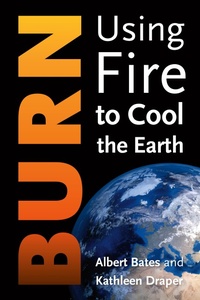
Burn
Description

An 800-CEO-READ "Editor's Choice" March 2019
How We Can Harness Carbon to Help Solve the Climate Crisis
In order to rescue ourselves from climate catastrophe, we need to radically alter how humans live on Earth. We have to go from spending carbon to banking it. We have to put back the trees, wetlands, and corals. We have to regrow the soil and turn back the desert. We have to save whales, wombats, and wolves. We have to reverse the flow of greenhouse gases and send them in exactly the opposite direction: down, not up. We have to flip the carbon cycle and run it backwards. For such a revolutionary transformation we'll need civilization 2.0.
A secret unlocked by the ancients of the Amazon for its ability to transform impoverished tropical soils into terra preta-fertile black earths-points the way. The indigenous custom of converting organic materials into long lasting carbon has enjoyed a reawakening in recent decades as the quest for more sustainable farming methods has grown. Yet the benefits of this carbonized material, now called biochar, extend far beyond the soil. Pyrolyzing carbon has the power to restore a natural balance by unmining the coal and undrilling the oil and gas. Employed to its full potential, it can run the carbon cycle in reverse and remake Earth as a garden planet.
Burn looks beyond renewable biomass or carbon capture energy systems to offer a bigger and bolder vision for the next phase of human progress, moving carbon from wasted sources:
- into soils and agricultural systems to rebalance the carbon, nitrogen, and related cycles; enhance nutrient density in food; rebuild topsoil; and condition urban and agricultural lands to withstand flooding and drought
- to cleanse water by carbon filtration and trophic cascades within the world's rivers, oceans, and wetlands
- to shift urban infrastructures such as buildings, roads, bridges, and ports, incorporating drawdown materials and components, replacing steel, concrete, polymers, and composites with biological carbon
- to drive economic reorganization by incentivizing carbon drawdown
Fully developed, this approach costs nothing-to the contrary, it can save companies money or provide new revenue streams. It contains the seeds of a new, circular economy in which energy, natural resources, and human ingenuity enter a virtuous cycle of improvement. Burn offers bold new solutions to climate change that can begin right now.
More details
Other editions
Additional editions
Persons
Kathleen Draper has been deeply involved in many areas of biochar research, communication, and outreach for the past six years. She routinely collaborates with biochar experts from around the globe as a board member of the International Biochar Initiative (IBI), moderator for IBI's biochar education webinar series, and the US Director of the Ithaka Institute for Carbon Intelligence. She has lectured on biochar in several countries and provides consulting services to companies entering the biochar industry. She is editor of the online review, The Biochar Journal.
Content
- Intro
- Praise for Burn
- Also by Albert Bates and Kathleen Draper
- Title Page
- Copyright
- Dedication
- Contents
- Introduction
- Part I. Carbon Change: From Nemesis to Ally
- 1. Charles Keeling's Curve
- 2. X-Axis Over Y
- 3. God's Own Atom
- 4. Carbon Cascades
- Part II. Carbon Construction: A Fresh Foundation
- 5. Carbon Hardscaping
- 6. Fantastic Plastic
- 7. Paper Chase
- 8. Filtration Nation
- 9. Cattle Carbs and Leafy Greenbacks
- 10. Manure Happens
- 11. Blue-Green Revolution
- Part III. Carbon Comfort: Reimagining Everyday Life
- 12. Petroleum Flip-Flop
- 13. My Tesla Runs on Banana Peels
- 14. Cooling It on Carbon
- 15. Pets, Personal Care, Pillows, Paints, and Plasters
- 16. Carbon Detox
- Part IV. Carbon Conversion: Cascades in Action
- 17. Cryptocarbon
- 18. The Cool Lab
- 19. Grassroots Solutions
- 20. Civilization 2.0
- Acknowledgments
- Appendix A. Carbon Cousins
- Appendix B. Carbonizers
- Notes
- About the Authors
