

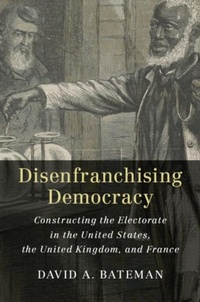
Disenfranchising Democracy
Constructing the Electorate in the United States, the United Kingdom, and France
Published on 28. September 2018
978-1-108-68452-1 (ISBN)
Description

The first wave of democratization in the United States - the removal of property and taxpaying qualifications for the right to vote - was accompanied by the disenfranchisement of African American men, with the political actors most supportive of the former also the most insistent upon the latter. The United States is not unique in this respect: other canonical cases of democratization also saw simultaneous expansions and restrictions of political rights, yet this pattern has never been fully detailed or explained. Through case studies of the USA, the UK, and France, Disenfranchising Democracy offers the first cross-national account of the relationship between democratization and disenfranchisement. It develops a political institutional perspective to explain their co-occurrence, focusing on the politics of coalition-building and the visions of political community coalitions advance in support of their goals. Bateman sheds new light on democratization, connecting it to the construction of citizenship and cultural identities.
Reviews / Votes
'This exceptionally smart, thoughtful, theoretically and empirically rigorous book breaks new ground on the politics of voting rights and disenfranchisement. Disenfranchising Democracy is critically important to understanding the politics of voting rights and civil rights, both historically and for today.' Paul Frymer, Princeton University, New Jersey 'This is an important study, theoretically innovative and empirically rigorous. Through careful attention to the history of disenfranchisement, Bateman helps us to conceptualize democracy not simply as a set of neutral mechanisms for selecting leadership, but as a deeply political process of 'people-making'. Disenfranchising Democracy helps us to understand, in precise and nuanced ways, the role of exclusions in building democratic consensus and demonstrates that the prevalent tendency to view such events as 'setbacks' obscures critical dynamics in the process of democratization itself.' Amel Ahmed, University of Massachusetts, Amherst 'Like the best work in American political development, Bateman finds a wellspring of insight into contemporary American politics buried in our past. Writing at time when voting rights are under siege, he reminds us that the electorate has been politically constructed all along, that the pattern of expansion has not been linear, and that democracy is always vulnerable to fears of diversity and its implications for some imagined community.' Stephen Skowronek, Yale University, Connecticut 'Deeply researched and beautifully written, this landmark work of scholarship presents an extremely original account of the mass franchise during the nineteenth century. For scholars of American politics, a special bonus is the demonstration that black suffrage mattered far more in antebellum party dynamics than we have previously known.' Rick Valelly, Swarthmore College, Pennsylvania 'This is a rich and important book. Bateman explains complex moments of simultaneous enrichments and disenfranchisements, placing the US in a broader nineteenth century, comparative perspective. The book makes many contributions and unearths a treasure trove of political claims-making by a variety of actors - American, British, and French.' Robert Mickey, University of Michigan 'Disenfranchising Democracy is an important contribution to the literature on democracy, in particular 19th-century America and the description of a dialectic between democratization.' S. Majstorovic, Choice 'David A. Bateman's new book explores nearly all of the crucial questions concerning democracy and inclusion that we are grappling with today ... This is an excellent book that should be read and taught by scholars of political development.' Dawn Langan Teele, Political Science QuarterlyMore details
Language
English
Place of publication
Cambridge
United Kingdom
Target group
Professional and scholarly
Illustrations
Worked examples or Exercises; 5 Tables, black and white; 1 Halftones, black and white; 15 Line drawings, black and white
File size
23,95 MB
ISBN-13
978-1-108-68452-1 (9781108684521)
Copyright in bibliographic data and cover images is held by Nielsen Book Services Limited or by the publishers or by their respective licensors: all rights reserved.
Schweitzer Classification
Other editions
Additional editions
David A. Bateman
Disenfranchising Democracy
Constructing the Electorate in the United States, the United Kingdom, and France
Book
10/2018
Cambridge University Press
€44.00
Shipment within 15-20 days
David A. Bateman
Disenfranchising Democracy
Constructing the Electorate in the United States, the United Kingdom, and France
Book
10/2018
Cambridge University Press
€135.50
No shipping information available
Person
David A. Bateman is Assistant Professor of Government at Cornell University, New York. He is co-author of Southern Nation: Congress and White Supremacy after Reconstruction (forthcoming).
Content
1. The puzzle of democratic disenfranchisement; Part I. The United States: 2. Revolutionary democracy; 3. The 'monstrous spectacle' of Jeffersonian democracy; 4 The white man's republic; Part II. The United Kingdom and France: 5. The fall of the Protestant constitution; 6. The republic through the side door; Conclusion.
