

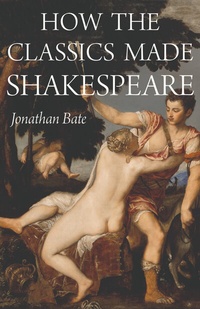
How the Classics Made Shakespeare
1st Edition
Published on 20. May 2019
384 pages
978-0-691-18563-7 (ISBN)
Description

From one of our most eminent and accessible literary critics, a groundbreaking account of how the Greek and Roman classics forged Shakespeare's imagination
Ben Jonson famously accused Shakespeare of having "small Latin and less Greek." But he was exaggerating. Shakespeare was steeped in the classics. Shaped by his grammar school education in Roman literature, history, and rhetoric, he moved to London, a city that modeled itself on ancient Rome. He worked in a theatrical profession that had inherited the conventions and forms of classical drama, and he read deeply in Ovid, Virgil, and Seneca. In a book of extraordinary range, acclaimed literary critic and biographer Jonathan Bate, one of the world's leading authorities on Shakespeare, offers groundbreaking insights into how, perhaps more than any other influence, the classics made Shakespeare the writer he became.
Revealing in new depth the influence of Cicero and Horace on Shakespeare and finding new links between him and classical traditions, ranging from myths and magic to monuments and politics, Bate offers striking new readings of a wide array of the plays and poems. At the heart of the book is an argument that Shakespeare's supreme valuation of the force of imagination was honed by the classical tradition and designed as a defense of poetry and theater in a hostile world of emergent Puritanism.
Rounded off with a fascinating account of how Shakespeare became our modern classic and has ended up playing much the same role for us as the Greek and Roman classics did for him, How the Classics Made Shakespeare combines stylistic brilliance, accessibility, and scholarship, demonstrating why Jonathan Bate is one of our most eminent and readable literary critics.
Ben Jonson famously accused Shakespeare of having "small Latin and less Greek." But he was exaggerating. Shakespeare was steeped in the classics. Shaped by his grammar school education in Roman literature, history, and rhetoric, he moved to London, a city that modeled itself on ancient Rome. He worked in a theatrical profession that had inherited the conventions and forms of classical drama, and he read deeply in Ovid, Virgil, and Seneca. In a book of extraordinary range, acclaimed literary critic and biographer Jonathan Bate, one of the world's leading authorities on Shakespeare, offers groundbreaking insights into how, perhaps more than any other influence, the classics made Shakespeare the writer he became.
Revealing in new depth the influence of Cicero and Horace on Shakespeare and finding new links between him and classical traditions, ranging from myths and magic to monuments and politics, Bate offers striking new readings of a wide array of the plays and poems. At the heart of the book is an argument that Shakespeare's supreme valuation of the force of imagination was honed by the classical tradition and designed as a defense of poetry and theater in a hostile world of emergent Puritanism.
Rounded off with a fascinating account of how Shakespeare became our modern classic and has ended up playing much the same role for us as the Greek and Roman classics did for him, How the Classics Made Shakespeare combines stylistic brilliance, accessibility, and scholarship, demonstrating why Jonathan Bate is one of our most eminent and readable literary critics.
All prices
More details
Language
English
Place of publication
Princeton, NJ
United States
Publishing group
De Gruyter
Target group
Professional and scholarly
Edition type
Digital original
Product notice
Reflowable
Illustrations
18 b/w illus.
File size
6,00 MB
ISBN-13
978-0-691-18563-7 (9780691185637)
Schweitzer Classification
Other editions
Additional editions
Jonathan Bate
How the Classics Made Shakespeare
Book
10/2020
Princeton University Press
€20.00
Shipment within 10-20 days
Jonathan Bate
How the Classics Made Shakespeare
Book
04/2019
Princeton University Press
€24.76
Shipment within 10-20 days
Person
Jonathan Bate is Foundation Professor of Environmental Humanities at Arizona State University and Senior Research Fellow at Oxford University. His many books include Soul of the Age: A Biography of the Mind of William Shakespeare. He broadcasts regularly for the BBC, is the coeditor of The RSC Shakespeare: Complete Works, and wrote an acclaimed one-man play for Simon Callow, Being Shakespeare. Twitter @profbate
Content
- Cover
- Title
- Copyright
- CONTENTS
- Dedication
- Preface and Acknowledgments
- Illustrations
- 1 The Intelligence of Antiquity
- 2 O'er-Picturing Venus
- 3 Resemblance by Example
- 4 Republica Anglorum
- 5 Tragical-Comical-Historical-Pastoral
- 6 S. P. Q. L.
- 7 But What of Cicero?
- 8 Pyrrhus's Pause
- 9 The Good Life
- 10 The Defence of Phantasms
- 11 An Infirmity Named Hereos
- 12 The Labours of Hercules
- 13 Walking Shadows
- 14 In the House of Fame
- Appendix: The Elizabethan Virgil
- Notes
- Index

