

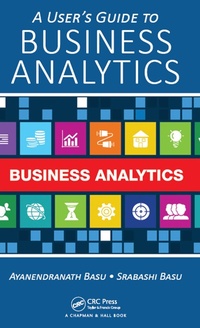
A User's Guide to Business Analytics
Published on 19. August 2016
400 pages
978-1-4665-9166-0 (ISBN)
Description

A User's Guide to Business Analytics provides a comprehensive discussion of statistical methods useful to the business analyst. Methods are developed from a fairly basic level to accommodate readers who have limited training in the theory of statistics. A substantial number of case studies and numerical illustrations using the R-software package are provided for the benefit of motivated beginners who want to get a head start in analytics as well as for experts on the job who will benefit by using this text as a reference book.
The book is comprised of 12 chapters. The first chapter focuses on business analytics, along with its emergence and application, and sets up a context for the whole book. The next three chapters introduce R and provide a comprehensive discussion on descriptive analytics, including numerical data summarization and visual analytics. Chapters five through seven discuss set theory, definitions and counting rules, probability, random variables, and probability distributions, with a number of business scenario examples. These chapters lay down the foundation for predictive analytics and model building.
Chapter eight deals with statistical inference and discusses the most common testing procedures. Chapters nine through twelve deal entirely with predictive analytics. The chapter on regression is quite extensive, dealing with model development and model complexity from a user's perspective. A short chapter on tree-based methods puts forth the main application areas succinctly. The chapter on data mining is a good introduction to the most common machine learning algorithms. The last chapter highlights the role of different time series models in analytics. In all the chapters, the authors showcase a number of examples and case studies and provide guidelines to users in the analytics field.
The book is comprised of 12 chapters. The first chapter focuses on business analytics, along with its emergence and application, and sets up a context for the whole book. The next three chapters introduce R and provide a comprehensive discussion on descriptive analytics, including numerical data summarization and visual analytics. Chapters five through seven discuss set theory, definitions and counting rules, probability, random variables, and probability distributions, with a number of business scenario examples. These chapters lay down the foundation for predictive analytics and model building.
Chapter eight deals with statistical inference and discusses the most common testing procedures. Chapters nine through twelve deal entirely with predictive analytics. The chapter on regression is quite extensive, dealing with model development and model complexity from a user's perspective. A short chapter on tree-based methods puts forth the main application areas succinctly. The chapter on data mining is a good introduction to the most common machine learning algorithms. The last chapter highlights the role of different time series models in analytics. In all the chapters, the authors showcase a number of examples and case studies and provide guidelines to users in the analytics field.
More details
Language
English
Place of publication
Philadelphia, PA
United States
Publishing group
Taylor & Francis Inc
Target group
College/higher education
Professional and scholarly
Illustrations
114 s/w Abbildungen, 63 s/w Tabellen
63 Tables, black and white; 114 Illustrations, black and white
File size
17,63 MB
ISBN-13
978-1-4665-9166-0 (9781466591660)
Copyright in bibliographic data and cover images is held by Nielsen Book Services Limited or by the publishers or by their respective licensors: all rights reserved.
Schweitzer Classification
Other editions
Additional editions
Ayanendranath Basu | Srabashi Basu
A User's Guide to Business Analytics
Book
10/2016
1st Edition
CRC Press
€202.50
Shipment within 15-20 days
Persons
Ayanendranath Basu earned his PhD in statistics from The Pennsylvania State University in 1991, under the guidance of late Professor Bruce. G. Lindsay. After spending four years at the Department of Mathematics, University of Texas at Austin, as an assistant professor, he joined the Indian Statistical Institute in 1995. Currently, Dr. Basu is a professor of the Interdisciplinary Statistical Research Unit (ISRU), ISI-Kolkata. His research interests lie mainly in the following areas: minimum distance inference, robust inference, multivariate analysis, and biostatistics.
Srabashi Basu earned her PhD in statistics from The Pennsylvania State University in 1992. After spending several years in University of Texas Health Science Center in San Antonio, she joined Indian Statistical Institute in 1995. Since 2006, Dr. Basu is working as an analytics specialist and independent consultant. She has extensive applied research publications to her credit. She also works as a corporate trainer in various areas of predictive analytics and machine learning. Dr. Basu has been an online instructor for Penn State Statistics World Campus courses since 2009. She also has developed online course materials in statistics, business analytics, R, and SAS.
Srabashi Basu earned her PhD in statistics from The Pennsylvania State University in 1992. After spending several years in University of Texas Health Science Center in San Antonio, she joined Indian Statistical Institute in 1995. Since 2006, Dr. Basu is working as an analytics specialist and independent consultant. She has extensive applied research publications to her credit. She also works as a corporate trainer in various areas of predictive analytics and machine learning. Dr. Basu has been an online instructor for Penn State Statistics World Campus courses since 2009. She also has developed online course materials in statistics, business analytics, R, and SAS.
Content
What Is Analytics? Introducing R-An Analytics Software. Reporting Data. Statistical Graphics and Visual Analytics. Probability. Random Variables and Probability Distributions. Continuous Random Variables. Statistical Inference. Regression for Predictive Model Building. Decision Trees. Data Mining and Multivariate Methods. Modeling Time Series Data for Forecasting.
