

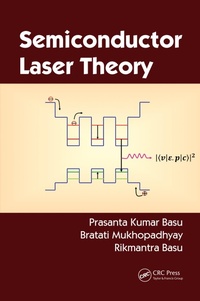
Semiconductor Laser Theory
1st Edition
Published on 17. June 2015
551 pages
978-1-4665-6192-2 (ISBN)
Description

Developed from the authors' classroom-tested material, Semiconductor Laser Theory takes a semiclassical approach to teaching the principles, structure, and applications of semiconductor lasers. Designed for graduate students in physics, electrical engineering, and materials science, the text covers many recent developments, including diode lasers using quantum wells, quantum dots, quantum cascade lasers, nitride lasers, group IV lasers, and transistor lasers.
The first half of the book presents basic concepts, such as the semiconductor physics needed to understand the operation of lasers, p-n junction theory, alloys, heterostructures, quantum nanostructures, k.p theory, waveguides, resonators, filters, and optical processes. The remainder of the book describes various lasers, including double heterostructure, quantum wire, quantum dot, quantum cascade, vertical-cavity surface-emitting, single-mode and tunable, nitride, group IV, and transistor lasers.
This textbook equips students to understand the latest progress in the research and development of semiconductor lasers, from research into the benefits of quantum wire and quantum dot lasers to the application of semiconductor lasers in fiber-optic communications. Each chapter incorporates reading lists and references for further study, numerous examples to illustrate the theory, and problems for hands-on exploration.
The first half of the book presents basic concepts, such as the semiconductor physics needed to understand the operation of lasers, p-n junction theory, alloys, heterostructures, quantum nanostructures, k.p theory, waveguides, resonators, filters, and optical processes. The remainder of the book describes various lasers, including double heterostructure, quantum wire, quantum dot, quantum cascade, vertical-cavity surface-emitting, single-mode and tunable, nitride, group IV, and transistor lasers.
This textbook equips students to understand the latest progress in the research and development of semiconductor lasers, from research into the benefits of quantum wire and quantum dot lasers to the application of semiconductor lasers in fiber-optic communications. Each chapter incorporates reading lists and references for further study, numerous examples to illustrate the theory, and problems for hands-on exploration.
Reviews / Votes
"This textbook offers a thorough treatment of basic principles and also manages to capture current trends in semiconductor laser research. ... topics are supplemented with problem sets for testing the reader's understanding, and some references to the literature. The authors' clear presentation of the material in this volume makes it eminently digestible."-Optics & Photonics News, December 2015
More details
Edition
1. Auflage
Language
English
Place of publication
Baton Rouge
United States
Publishing group
Taylor & Francis Inc
Target group
College/higher education
Illustrations
171 s/w Abbildungen, 61 s/w Tabellen
171 b/w images and 61 tables
ISBN-13
978-1-4665-6192-2 (9781466561922)
Copyright in bibliographic data and cover images is held by Nielsen Book Services Limited or by the publishers or by their respective licensors: all rights reserved.
Schweitzer Classification
Other editions
Additional editions
Prasanta Kumar Basu | Bratati Mukhopadhyay | Rikmantra Basu
Semiconductor Laser Theory
Book
06/2015
1st Edition
CRC Press
€161.50
Article not available at the moment
Persons
Prasanta Kumar Basu retired as a professor from the University of Calcutta in 2011 and is now a UGC Basic Scientific Research Faculty Fellow at the university. Dr. Basu has published roughly 120 articles in peer-reviewed journals. His research interests include low-field and hot electron transport and scattering mechanisms in semiconductors and their nanostructures, semiconductor electronic and photonic devices, and optical communication. He earned a PhD in radio physics and electronics from the University of Calcutta.
Bratati Mukhopadhyay is an assistant professor in the Institute of Radio Physics and Electronics at the University of Calcutta. Dr. Mukhopadhyay is a member of the IEEE and the current secretary of the IEEE Photonics Society, Calcutta Chapter. Her research interests include physics of semiconductor nanostructures, semiconductor devices and modeling, VLSI circuits, and photonics. She earned a PhD in radio physics and electronics from the University of Calcutta.
Rikmantra Basu is an assistant professor in the Department of Electronics and Communications Engineering at the National Institute of Technology Delhi. Dr. Basu is a member of the IEEE. His research interests include semiconductor devices, electronic circuits and devices, optoelectronics and optical communication, and nanophotonics. He earned a Ph.D. in nanotechnology from the University of Calcutta.
Bratati Mukhopadhyay is an assistant professor in the Institute of Radio Physics and Electronics at the University of Calcutta. Dr. Mukhopadhyay is a member of the IEEE and the current secretary of the IEEE Photonics Society, Calcutta Chapter. Her research interests include physics of semiconductor nanostructures, semiconductor devices and modeling, VLSI circuits, and photonics. She earned a PhD in radio physics and electronics from the University of Calcutta.
Rikmantra Basu is an assistant professor in the Department of Electronics and Communications Engineering at the National Institute of Technology Delhi. Dr. Basu is a member of the IEEE. His research interests include semiconductor devices, electronic circuits and devices, optoelectronics and optical communication, and nanophotonics. He earned a Ph.D. in nanotechnology from the University of Calcutta.
Content
Introduction to Semiconductor Lasers. Basic Theory. Heterojunctions and Quantum Structures. Band Structures. Waveguides and Resonators. Optical Processes. Models for DH Lasers. Quantum Well Lasers. Quantum Dots. Quantum Cascade Lasers. Vertical-Cavity Surface-Emitting Laser. Single-Mode and Tunable Lasers. Nitride Lasers. Group IV Lasers. Transistor Lasers. Appendices.
