

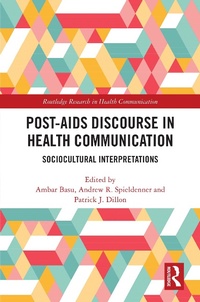
Post-AIDS Discourse in Health Communication
Sociocultural Interpretations
1st Edition
Published on 13. December 2021
278 pages
978-1-000-51061-4 (ISBN)
Description

This book examines the discourse of a "post-AIDS" culture, and the medical-discursive shift from crisis and death to survival and living. Contributions from a diverse group of international scholars interrogate and engage with the cultural, social, political, scientific, historical, global, and local consumptions of the term "post-AIDS" from the perspective of meaning-making on health, illness, and well-being.
The chapters critique and connect meanings of "post-AIDS" to topics such as neoliberalism; race, gender, and advocacy; disclosure; relationships and intimacy; stigma and structural violence; family and community; migration; work; survival; normativity; NGOs, transnational organizations; aging and end-of-life care; the politics of ART and PrEP; mental illness; campaigns; social media; and religion. Using a range of methodological tools, the scholarship herein asks how "post-AIDS" or the "End of the Epidemic" is communicated and made sense of in everyday discourse, what current meanings are circulated and consumed on and around HIV and AIDS, and provides thorough commentary and critique of a "post-AIDS" time.
This book will be an essential read for scholars and students of health communication, sociology of health and illness, medical humanities, political science, and medical anthropology, as well as for policy makers and activists.
The chapters critique and connect meanings of "post-AIDS" to topics such as neoliberalism; race, gender, and advocacy; disclosure; relationships and intimacy; stigma and structural violence; family and community; migration; work; survival; normativity; NGOs, transnational organizations; aging and end-of-life care; the politics of ART and PrEP; mental illness; campaigns; social media; and religion. Using a range of methodological tools, the scholarship herein asks how "post-AIDS" or the "End of the Epidemic" is communicated and made sense of in everyday discourse, what current meanings are circulated and consumed on and around HIV and AIDS, and provides thorough commentary and critique of a "post-AIDS" time.
This book will be an essential read for scholars and students of health communication, sociology of health and illness, medical humanities, political science, and medical anthropology, as well as for policy makers and activists.
Reviews / Votes
This book will be of great interest to all stakeholders in the HIV and AIDS response community. The authors and editors of this timely collection provide much-needed interrogation of policy discourses that frame the "end" of HIV and AIDS in the near-term as a desirable and reachable goal. No one can argue with the objective of ameliorating the HIV pandemic, but language matters. Constructs, such as a "post-AIDS" era, an "AIDS-free generation," and "ending AIDS," do violence to people with HIV, who will continue to live with the disease for decades, even if new HIV transmissions are halted by 2030 as many campaigns aspire. The experience of people living with HIV and AIDS, which includes stigma, discrimination, marginalization, and criminalization, is not sufficiently captured by discursive structures that persistently reduce the pandemic to a biomedical, rather than a relational and social, phenomenon. The engaging historical, theoretical, and empirical analyses in this book interrogate the meanings that circulate around biological science claims - that virological suppression (resulting from use of antiretroviral drugs) leads to zero new HIV transmissions which equals the "end of AIDS." They document the ways in which the persistent biomedicalizing of the HIV pandemic and its response shifts attention away from social and cultural processes that are as central to the story of AIDS - and to its ending - as is the virus itself.Judith D. Auerbach, Sociologist and Professor of Medicine, University of California, Berkeley
Phrases such as "disease control," "elimination," and "eradication" are core concepts in public health; so central, in fact, that they deserve much greater exploration. This is true in general and in efforts to "End the Epidemic" of HIV in the US and around the world. Initiatives to end the HIV epidemic (ETE) tend to focus on epidemiological, clinical, and health disparities aspects of the epidemic. Often given less attention are examinations of critical sociological, psychological, anthropologic, and social justice factors in ETE efforts. For instance, what does it mean, symbolize, and experientially feel like to be a person living with HIV in a time when the epidemic is said to be ending? Will ending the epidemic be achieved in a way that addresses long-term comprehensive health and well-being for persons living with HIV? Will these efforts serve to address societal factors in a way that actually builds HIV-related health equity? These are just a few of the types of questions explored in "Post-AIDS." This volume is highly synergistic across a variety of disciplines and examines in a wide-reaching and nuanced manner the definition of a "post-AIDS" world and the societal characteristics of that future time. "Post-AIDS" is meant to challenge our traditional notions of what it means to end an epidemic, and to greatly expand our thinking about the core public health concepts of disease elimination and eradication.
David R. Holtgrave, Dean, SUNY Empire Innovation Professor, & Distinguished Professor, School of Public Health
Post-AIDS provides a necessary and scathing critique of the "end of AIDS" discourse. It is simultaneously an examination and an indictment of the ways that "end of AIDS" rhetoric is already driving trends, policy, funding, and programmatic priorities in the U.S. and globally - at unspeakable cost to people living with HIV, especially those who are Black, Indigenous, and people of color. Biomedicalization of the HIV response has left unanswered calls for basic dignity and humanity of those who are most vulnerable, for housing and food security, healthcare access, and compassion; our lives are measured not by joy or safety but in viral loads. A "post-AIDS" vision is quite frankly, impractical, when we understand AIDS as a syndrome of interlocking oppressive syndemics - racism, homophobia, transphobia, and criminalization of pleasure - which are far from over.
In the United States alone, there are over a million people currently living with HIV. There is no "post-AIDS" for us until we are cured or dead; in an era beyond AIDS we perhaps become relegated to an inconvenience to be overlooked, rather than a danger to be policed, surveilled, and controlled.
This book is required reading for anyone who considers themselves a human rights HIV activist in the 21st century.
Naina Khanna, Co-Executive Director of Positive Women's Network, USA
More details
Series
Edition
1. Auflage
Language
English
Place of publication
London
United Kingdom
Publishing group
Taylor & Francis Ltd
Target group
Professional and scholarly
College/higher education
Illustrations
5 Tables, black and white; 9 Halftones, black and white; 9 Illustrations, black and white
ISBN-13
978-1-000-51061-4 (9781000510614)
Copyright in bibliographic data and cover images is held by Nielsen Book Services Limited or by the publishers or by their respective licensors: all rights reserved.
Schweitzer Classification
Other editions
Additional editions
Ambar Basu | Andrew R. Spieldenner | Patrick J. Dillon
Post-AIDS Discourse in Health Communication
Sociocultural Interpretations
Book
01/2024
1st Edition
Routledge
€63.50
Shipment within 10-20 days
Ambar Basu | Andrew R. Spieldenner | Patrick J. Dillon
Post-AIDS Discourse in Health Communication
Sociocultural Interpretations
Book
12/2021
1st Edition
Routledge
€205.80
Shipment within 15-20 days
Persons
Ambar Basu is Professor in the Department of Communication at the University of South Florida.
Andrew R. Spieldenner is Executive Director of MPact: Global Action for Gay Men's Health & Rights and Associate Professor in the Departments of Communication and Women, Gender & Sexuality Studies at California State University-San Marcos.
Patrick J. Dillon is Associate Professor in the School of Communication Studies at Kent State University at Stark.
Andrew R. Spieldenner is Executive Director of MPact: Global Action for Gay Men's Health & Rights and Associate Professor in the Departments of Communication and Women, Gender & Sexuality Studies at California State University-San Marcos.
Patrick J. Dillon is Associate Professor in the School of Communication Studies at Kent State University at Stark.
Content
Dreaming a Post-AIDS: An Introduction to the Discourse; Part I: Debate, Discourse, Politics; 1. Revisiting "Post-AIDS": Understanding Gay Community Responses to HIV Then and Now; 2. Biocommunicability and the Biopolitics of "Post-AIDS"; 3. Last People Standing: People Living with HIV After the 'End of the Epidemic'; 4. A Dramatization of Post-AIDs Stigma: A Pentadic Analysis of the CDC's "Let's Stop HIV Together" Campaign; 5. Indigenous HIV/AIDS in the Context of 'Post-AIDS' Discourse: A Meta-Synthesis of Qualitative Research; 6. Neoliberal Hegemony and National HIV/AIDS Policy in India; Part II: Rhetorics and Relations; 7. "I Might as Well Be Dead": Aging with HIV in the "Post-AIDS" Era; 8. African American Mothers Living with HIV in the "Post-AIDS" Era: A Meta-Ethnographic Synthesis; 9. "YOU FUCKING DESERVE HIV": Seeking PrEP information, Disciplinary Power, and Queer Technologies of the Self on /r/AskGayBros; 10. Intimacy Uncertainty and Post-AIDS Discourse: HIV and the Role It Plays as an Uninvited Third Party in Serodiscordant Relationships; 11. The Experience of Building and Testing a Visual Health Literacy Resource for HIV Prophylaxis; Afterword: On Localocentricity and "Post-AIDS"
