

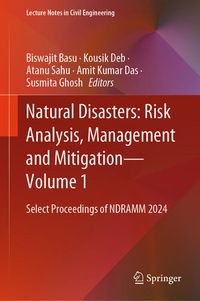
Natural Disasters: Risk Analysis, Management and Mitigation - Vol. 1
Description

This book presents select proceedings of the International Conference on Natural Disaster: Risk Analysis, Management and Mitigation (NDRAMM 2024). It discusses recent challenges in disaster risk analysis and provides solutions to mitigate and minimize the damage caused by natural disasters. The book covers diverse topics including but not limited to seismic hazard analysis and its mitigation, tsunami-induced hazard, landslide and erosion-induced disaster mitigation, liquefaction mitigation, flood risk management, urban flood modelling and planning, early warning systems and Artificial Intelligence (AI) in natural hazards engineering. This book is a valuable resource for researchers and professionals interested in disaster-resilient construction and allied fields.
More details
Other editions
Additional editions
Persons
Prof. Biswajit Basu is currently working as a Professor in the Department of Civil, Structural and Environmental Engineering at Trinity College Dublin, Ireland. He did his B.E. (Civil) from Jadavpur University, Kolkata, M.Tech. and Ph.D. from the Indian Institute of Technology (IIT), Kanpur. His major areas of research interests include active and semi-active vibration control, random vibrations, wind & earthquake engineering, offshore wind turbines, nonlinear waves, hydrodynamics and mathematical oceanography among other areas. He has published more than 200 papers in international journals. Dr. Basu received the Dr K.S. Krishnan Research Fellow Award in 2004. He was also awarded the Phil Doak Award in 2015 by the Journal of Sound and Vibration. Dr. Basu is the Associate Editor of Journal of Structural Engineering (ASCE) and he serves as an editorial board member in several international journals of repute, including Structural Control and Health Monitoring (Wiley), Journal of Multi-Body Dynamics (Institution of Mechanical Engineers, UK).
Prof. Kousik Deb is currently a Professor in the Department of Civil Engineering at IIT, Kharagpur. He obtained his B.E. from Jadavpur University, Kolkata and M. E. from Bengal Engineering College, Shibpur (D.U.) (presently IIEST Shibpur) and Ph.D. from IIT, Kanpur. His major research interests include ground improvement, geosynthetic-reinforced earth, soil-structure interaction, geotechnical earthquake engineering and soil arching. He has published 66 papers in reputed international journals. Prof. Deb received the IIT Roorkee Shamsher Prakash Research Award in 2012. Dr. Atanu Sahu is currently working as an Assistant Professor in the Department of Civil Engineering at the National Institute of Technology (NIT), Silchar. He obtained his B.E. (Civil) from Bengal Engineering and Science University Shibpur (Presently, IIEST Shibpur), M.E. (Structural Engineering) and Ph.D. from Jadavpur University, Kolkata. His major areas of research interest include passive and active vibration control, structural dynamics, vibro-acoustics, metamaterials and numerical methods of structural analysis. Dr. Sahu received the University Gold Medal in 2010 and the Council of Scientific and Industrial Research (CSIR) (Government of India) research fellowship. He has also worked at the German Aerospace Centre (DLR-Braunschweig, Germany) as a guest scientist. Dr. Sahu has published 30 papers in journals and conferences of international repute. Dr. Amit Kumar Das is currently an Assistant Professor in the Department of Civil Engineering at the NIT, Silchar. He obtained his B.E. and M. E. from Bengal Engineering and Science University, Shibpur (presently IIEST Shibpur) and his Ph.D. from IIT, Kharagpur. His major research interests include ground improvement, soil-structure interaction, dynamics of improved soil, transportation geotechniques, slope stability analysis and application of image processing in geotechnical engineering. He has published 12 technical papers in reputed international journals. Dr. Susmita Ghosh is currently an Associate Professor at the Department of Civil Engineering, NIT, Silchar. She obtained her B.E. (Civil) from North Bengal University, West Bengal and M.Tech. (Hydraulic Eng.) and Ph.D. from the IIT, Roorkee. Her major areas of research interest include water resources engineering, hydrological modelling and the application of AI, remote sensing and GIS in water resources engineering. She has published 22 papers in reputed international journals and conferences. She has guided several M.Tech. and Ph.D. students. Dr. Ghosh also has six years of experience as a project manager in the water resources section of JACOBS-CES (I) Pvt. Ltd., a consultancy and design firm. She handled hydrological analysis of several pre-feasibility and feasibility studies for various projects in her tenure at the firm.Content
Seismic hazard analysis and mitigation.- Landslide and erosion induced disaster: Analysis and Mitigation.- Flood risk management and mitigation.- ML and AI in natural hazard engineering.- Natural Hazards Triggering Technological Accidents (Natech).
