

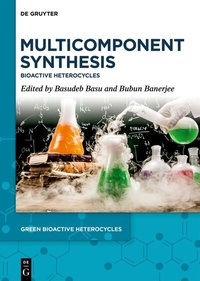
Multicomponent Synthesis
Description

Multicomponent synthesis may provide new and green routes for obtaining bioactive heterocycles. These methods produce less organic waste due to no longer removing solvent and other components between reaction steps. It can be applied to the synthesis of heterocycles with reactions such as the Biginelli reaction. This book explores the use of multi-component reactions for various heterocyclic structures with bioactivity.
More details
Other editions
Additional editions
Persons
Prof. Basudeb Basu received his PhD from Indian Association for the Cultivation of Science, Kolkata, India, working in the field of synthesis of bio-active natural products. He joined as Assistant Professor at the University of North Bengal, Darjeeling, India in 1986 and finally retired as Professor of Chemistry after serving there for more than three decades. Thereafter, Dr. Basu worked as Visiting Professor at Raiganj University, Raiganj, India for about three years and presently he is an Adjunct Professor, Cotton University, Guwahati, India. He had post-doctoral research works in the USA and Sweden working in the fields of total synthesis of a cancer growth inhibitor isolated from marine sources (USA) and suitably designed optically pure aryl bis-armed amino acids for bio-mimetic studies (Sweden). He was Visiting Professor at several Universities in Sweden, France, Taiwan and China. He has published research articles (>100), authored Book chapters (10) and four Patents (2 US and 2 EU). Dr. Basu has received accolades for his contributions, a few to mention: J. G. Goodley Memorial Award (2018), Bharatratna CNR Rao Endowment Lecture Award (2018), Elected Fellow West Bengal Academy of Science and Technology (2015), CRSI Bronze medal award (2010). His passion and commitment to diverse research areas that primarily include: organic synthesis of bio-active and drug-like small carbocycles and heterocycles, heterogeneous catalysis, graphene-based carbon nanomaterials and green chemistry.
Dr. Bubun Banerjee received his Ph.D. degree from Visva-Bharati University, Santiniketan, West Bengal, India. He has nearly nine years of experience in the field of research related to green and sustainable developments. Presently he is working as an assistant professor of chemistry at the Department of Chemistry, Akal University, Talwandi Sabo, Bathinda, Punjab, India. Dr. Banerjee published more than 100 research articles in the internationally renowned journals and authored fifteen book chapters; he also co-edited eleven books and guest edited eleven different special thematic issues of different journals.
Content
- Intro
- Preface
- Foreword
- A brief professional profile of Prof. Eric F.V. Scriven
- Contents
- List of contributing authors
- 1 Synthesis of aza-heterocycles via one-pot domino multicomponent reaction approach
- 2 One-pot three-component selective annulation strategies for the synthesis of bioactive ß-lactam, pyrrole, and pyridine scaffolds
- 3 One-pot three-component synthesis of quinolines and some other selective six-membered heterocycles with biological importance
- 4 Multicomponent synthesis of biologically prominent tetrahydrobenzoxanthenone derivatives
- 5 One-pot five/four-component synthesis of structurally diverse bioactive quinoxaline-annulated spiroheterocycles through the in situ formation of 11Hindeno[ 1,2-b]quinoxalin-11-ones
- 6 Multicomponent synthesis of biologically active quinazolinone derivatives
- 7 Recent approaches toward the synthesis of 1,2,3-triazoles using multicomponent techniques
- 8 Synthesis of various bioactive tetrazoles via one-pot multicomponent click reactions
- 9 L-Proline and its derivatives catalyzed one-pot multicomponent synthesis of biologically promising N- and O-heterocycles
- 10 Microwave-assisted solvent-free multicomponent synthesis of bioactive heterocycles
- 11 Deep eutectic mixture (DEM)-assisted multicomponent synthesis of heterocycles
- Index
