

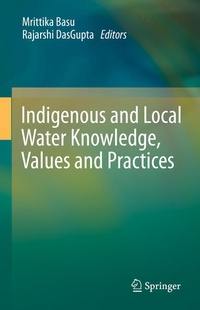
Indigenous and Local Water Knowledge, Values and Practices
Description

With increasing emphasis on the inclusion of indigenous and local knowledge into natural resource governance and conservation by international agencies like the Intergovernmental Science-Policy Platform on Biodiversity and Ecosystem Services (IPBES), the proposed book will significantly contribute to the existing knowledge base and demonstrate the importance of mainstreaming indigenous water knowledge and practices into water governance and decision making. The UN SDGs, recognizing the significance of indigenous knowledge systems, emphasized its inclusion in most aspects and principles of SDGs. Apart from direct links with SDGs like zero hunger (SDG 2), no poverty (SDG 1), and climate action (SDG 13), indigenous and local knowledge system is considered to be directly connected to clean water and sanitation (SDG 6). The book will be useful to researchers and students in the field of indigenous knowledge and education, water governance, community-level planning, and water sustainability. The book can be referred to for postgraduate courses and beyond, as well as policymakers, conservationists, non-governmental organizations, development practitioners, and local government officials.
More details
Other editions
Additional editions
Persons
Dr. Rajarshi Dasgupta is a senior policy researcher at the Institute for Global Environmental Strategies (IGES). His research interests are environmental scenario planning, spatial quantification of ecosystem services, indigenous and local knowledge systems, and community-based conservation. He served as Lead Author (LA) for the Intergovernmental Science-Policy Platform for Biodiversity and Ecosystem Services (IPBES) Asia-Pacific Regional Assessment Report as well as IPBES assessment on Sustainable Use of Wild Species (2018-22). Dr. Dasgupta authored/co-authored more than 60 peer-reviewed papers in reputed international journals on the topic related to the mapping and monitoring of ecosystem services, landscape conservation, Ecosystem and natural resource management.
Content
Chapter 1. Exploring Indigenous Water Knowledge, Values and Practices: Insights and Examples.- Chapter 2. A political-economic analysis of water, indigeneity, and capitalism in the face of climate change.- Chapter 3. Water Symbolism in Hindu Culture.- Chapter 4. Ways of Water Management in Islam: Potential Insights for Future Water Governance.- Chapter 5. Water and Shintoism: Exploring the link between spirituality and water values in Japan.- Chapter 6.Muslim Peoples and the Challenges of Water Security: A Socio-Anthropological Analysis.- Chapter 7.Indigenous water knowledge: Religious values and cultural practices.- Chapter 8.Bringing Back the Wisdom: Tradition in Urban Water Management.- Chapter 9. Interactions between Changing Climates and Land Uses: The Case of Urmia Lake, Iran.- Chapter 10. Indigenous water governance systems in a post-colonial state: Insights from Zimbabwe.- Chapter 11. Benefits of reviving indigenous water conservation practices for drought resilience in red and laterite zones of West Bengal, India.- Chapter 12. Local Knowledge on Water Use and Water-related Ecosystem Services in Lowland, Midland, and Upland Villages in Mindanao, Philippines.- Chapter 13. Indigenous knowledge, practices, and transformation of drinking water management system: Evidence from Munda community of Bangladesh.- Chapter 14.The cultural approach for community-based conservation of river basins: a case study of the Basin School Network, Taiwan.- Chapter 15. Indigenous knowledge and conservation practices for sustainable water management in lateritic Southwest Bengal, India.- Chapter 16. Importance of women's indigenous knowledge of water conservation and management in Sri Lanka.- Chapter 17. Role of ponds as a local practice in mitigating salinity intrusion threats at coastal aquifer: a case study from Sundarban Biosphere Reserve, India.- Chapter 18. The water cult and conservation in India.-Chapter 19.Concluding reflections on the indigenous and local waterknowledge, values, and practices, and lessons learned.
