

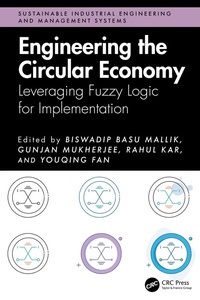
Engineering the Circular Economy
Leveraging Fuzzy Logic for Implementation
Published on 30. September 2025
266 pages
978-1-040-41114-8 (ISBN)
Description

Implementing the circular economy necessitates innovative approaches capable of managing the complexity and uncertainty inherent in the shift from linear to circular systems. Fuzzy logic, a computational approach inspired by human reasoning, provides a promising framework for navigating these complexities. With a practical approach, this book offers how fuzzy logic can be utilized to implement the circular economy.
Engineering the Circular Economy: Leveraging Fuzzy Logic for Implementation discusses the significance of incorporating fuzzy logic into circular economy strategies. This integration enables the development of adaptive models for resource management, waste reduction, and supply chain optimization. The book showcases various case studies and practical examples to demonstrate the application of fuzzy logic in implementing circular economy principles across diverse industries. Additionally, it addresses the challenges and future directions within a circular economy framework, emphasizing the importance of identifying these challenges and exploring future directions for continuous improvement in sustainability efforts. The potential of combining engineering, fuzzy logic, and the circular economy to address global sustainability challenges is highlighted, showcasing how leveraging fuzzy logic facilitates informed decision-making and the creation of innovative solutions as we work toward a more sustainable future.
With its forward-thinking approach and focus on practical applications, this book is an essential resource for practitioners, researchers, engineers, scholars, and policymakers looking to promote innovation and sustainability in today's rapidly changing economic and environmentally conscious environment.
Engineering the Circular Economy: Leveraging Fuzzy Logic for Implementation discusses the significance of incorporating fuzzy logic into circular economy strategies. This integration enables the development of adaptive models for resource management, waste reduction, and supply chain optimization. The book showcases various case studies and practical examples to demonstrate the application of fuzzy logic in implementing circular economy principles across diverse industries. Additionally, it addresses the challenges and future directions within a circular economy framework, emphasizing the importance of identifying these challenges and exploring future directions for continuous improvement in sustainability efforts. The potential of combining engineering, fuzzy logic, and the circular economy to address global sustainability challenges is highlighted, showcasing how leveraging fuzzy logic facilitates informed decision-making and the creation of innovative solutions as we work toward a more sustainable future.
With its forward-thinking approach and focus on practical applications, this book is an essential resource for practitioners, researchers, engineers, scholars, and policymakers looking to promote innovation and sustainability in today's rapidly changing economic and environmentally conscious environment.
More details
Series
Language
English
Place of publication
London
United Kingdom
Publishing group
Taylor & Francis Ltd
Target group
Professional and scholarly
College/higher education
Illustrations
36 Tables, black and white; 39 Line drawings, black and white; 5 Halftones, black and white; 44 Illustrations, black and white
File size
3,71 MB
ISBN-13
978-1-040-41114-8 (9781040411148)
Copyright in bibliographic data and cover images is held by Nielsen Book Services Limited or by the publishers or by their respective licensors: all rights reserved.
Schweitzer Classification
Other editions
Additional editions
Biswadip Basu Mallik | Gunjan Mukherjee | Rahul Kar
Engineering the Circular Economy
Leveraging Fuzzy Logic for Implementation
Book
09/2025
1st Edition
CRC Press
€146.70
Shipment within 10-20 days
Persons
Biswadip Basu Mallik, PhD, is a professor of Mathematics in the Department of Basic Science & Humanities at the Institute of Engineering & Management (School of University of Engineering and Management), Kolkata, India. With 23 years of experience in teaching and research, he has published numerous research papers and book chapters in scientific journals from esteemed international publishers such as CRC Press, Apple, Wiley, IGI Global, Springer, Nova Science, IEEE, etc. Dr. Basu Mallik has authored five undergraduate-level books on engineering mathematics, quantitative methods, and computational Intelligence. He has also published five Indian patents and edited twenty-one books. His research interests include computational fluid dynamics, mathematical modeling, optimization, and machine learning. He serves as the series editor for the book series titled Mathematics and Computer Science from Wiley-Scrivener, USA. He is the managing editor of the Journal of Mathematical Sciences & Computational Mathematics (JMSCM), USA. Additionally, Dr. Basu Mallik is editorial board member and reviewer for several scientific journals. He holds senior life membership in the Operational Research Society of India (ORSI) and life membership in the Calcutta Mathematical Society (CMS), Indian Statistical Institute (ISI), Indian Science Congress Association (ISCA), and the International Association of Engineers (IAENG).
Gunjan Mukherjee, PhD, is an associate professor in the Department of Computational Sciences, Brainware University, Kolkata, West Bengal, India. He has completed his BSc in physics (CU), MCA (IGNOU), MTech (CU) and obtained PhD degree in engineering from Jadavpur University, Kolkata, West Bengal, India. His research interest includes computer vision, machine learning, soft computing, image processing, etc. He is the life member of CSI, ISOC, and IAENG. He has published a number of papers in different journals and international conferences of repute. Dr. Mukherjee also guided many students of BTech and MCA in their project and research works. He also authored the school computer book series (class 3-10), a textbook on IT systems theory for engineering students, and a book on python technology (in press). He has also been the reviewer of many technical books and an editor of a number of books. Dr. Mukherjee has experience in different sectors of teaching for nearly 20 years.
Rahul Kar is currently working as a faculty member of Mathematics at Kalyani Mahavidyalaya, Kalyani, Nadia, West Bengal. He has completed an M.SC in PURE Mathematics and pursuing a Ph.D. in Mathematics from Bankura University. He has worked as a guest faculty of Gurunanak Institute of Technology and other 2 colleges. In total, he has 8 Years of teaching experience. He has published many research papers with the Scopus index. He also works as an editor of 4 national and international journals and a reviewer at 5 international journals. He is working as an editor of 15 mathematics/computer books. He is an annual member of the Indian Mathematical Society as well as an honorary member of Carmels Research Institute, Dakar, Senegal.
Youqing Fan, PhD, is an associate professor and chief investigator of an ARC Linkage Project on how volunteering can be better managed to become more accessible to CaLD elderly in Australia ($331,000) and a School-funded PRI project ($75,000). He is associate editorfor Journal of Business Research (ABDC A; Scimago Q1), and Employee Relations (ABDC B; Scimago Q1); and an inaugural A/editor for Journal of Tropical Futures. Youqing is the recipient of the 2023 School Citation for Research Award. His research and teaching focuses on the interaction of organizational management and sustainability, with a specific interest in understanding how managers incorporate the environmental, social, and economic aspects of sustainability goals into their organizational management practices at the workplace and along the supply chain. Dr. Fan has contributed significantly to the fields of sustainability and business management. He has published 20 papers in ABDC A* or A or Scopus Q1 journals, including papers published in major business journals such as the Journal of Business Research, International Journal of Human Resource Management, Business Strategy and the Environment, Enterprise Information Systems, Cross-Cultural and Strategic Management, Journal of Global Information Management, and Asian Businessaand Management, and in high-impact sustainability journals such as Transportation Research Part E: Logistics and Transportation Review, Journal of Environmental Management, Journal of Cleaner Production, Corporate Social Responsibility & Environmental Management and Habitat International. He has published an edited book on addressing employee mental health issues, along with several The Conversation articles. He is also a regular reviewer for Journal of Business Research, International Journal of Human Resource Management, International Journal of Hospitality Management, Academy of Management Annual Conference, International Journal of Production Research, Information and Management, Sustainable Development, and Economic and Labour Relations Review. Dr. Fan's research findings have generated social impacts beyond academia. His viewpoints appear in independent academic media such as TheConversation.com and The Fifth Estate, and the mainstream media outlets such as ABC News and Sydney Morning Herald. Dr. Fan has successfully led a School funded Priority Research Initiative Project to completion. The project examines urban employment and housing segregation. Dr. Fan has also been involved in international collaborative projects investigating the poverty reduction and migrant health inequalities in the global south. Dr. Fan has successfully supervised three PhD students to completion. As of April 2023, He has published four journal papers with PhD students.
Gunjan Mukherjee, PhD, is an associate professor in the Department of Computational Sciences, Brainware University, Kolkata, West Bengal, India. He has completed his BSc in physics (CU), MCA (IGNOU), MTech (CU) and obtained PhD degree in engineering from Jadavpur University, Kolkata, West Bengal, India. His research interest includes computer vision, machine learning, soft computing, image processing, etc. He is the life member of CSI, ISOC, and IAENG. He has published a number of papers in different journals and international conferences of repute. Dr. Mukherjee also guided many students of BTech and MCA in their project and research works. He also authored the school computer book series (class 3-10), a textbook on IT systems theory for engineering students, and a book on python technology (in press). He has also been the reviewer of many technical books and an editor of a number of books. Dr. Mukherjee has experience in different sectors of teaching for nearly 20 years.
Rahul Kar is currently working as a faculty member of Mathematics at Kalyani Mahavidyalaya, Kalyani, Nadia, West Bengal. He has completed an M.SC in PURE Mathematics and pursuing a Ph.D. in Mathematics from Bankura University. He has worked as a guest faculty of Gurunanak Institute of Technology and other 2 colleges. In total, he has 8 Years of teaching experience. He has published many research papers with the Scopus index. He also works as an editor of 4 national and international journals and a reviewer at 5 international journals. He is working as an editor of 15 mathematics/computer books. He is an annual member of the Indian Mathematical Society as well as an honorary member of Carmels Research Institute, Dakar, Senegal.
Youqing Fan, PhD, is an associate professor and chief investigator of an ARC Linkage Project on how volunteering can be better managed to become more accessible to CaLD elderly in Australia ($331,000) and a School-funded PRI project ($75,000). He is associate editorfor Journal of Business Research (ABDC A; Scimago Q1), and Employee Relations (ABDC B; Scimago Q1); and an inaugural A/editor for Journal of Tropical Futures. Youqing is the recipient of the 2023 School Citation for Research Award. His research and teaching focuses on the interaction of organizational management and sustainability, with a specific interest in understanding how managers incorporate the environmental, social, and economic aspects of sustainability goals into their organizational management practices at the workplace and along the supply chain. Dr. Fan has contributed significantly to the fields of sustainability and business management. He has published 20 papers in ABDC A* or A or Scopus Q1 journals, including papers published in major business journals such as the Journal of Business Research, International Journal of Human Resource Management, Business Strategy and the Environment, Enterprise Information Systems, Cross-Cultural and Strategic Management, Journal of Global Information Management, and Asian Businessaand Management, and in high-impact sustainability journals such as Transportation Research Part E: Logistics and Transportation Review, Journal of Environmental Management, Journal of Cleaner Production, Corporate Social Responsibility & Environmental Management and Habitat International. He has published an edited book on addressing employee mental health issues, along with several The Conversation articles. He is also a regular reviewer for Journal of Business Research, International Journal of Human Resource Management, International Journal of Hospitality Management, Academy of Management Annual Conference, International Journal of Production Research, Information and Management, Sustainable Development, and Economic and Labour Relations Review. Dr. Fan's research findings have generated social impacts beyond academia. His viewpoints appear in independent academic media such as TheConversation.com and The Fifth Estate, and the mainstream media outlets such as ABC News and Sydney Morning Herald. Dr. Fan has successfully led a School funded Priority Research Initiative Project to completion. The project examines urban employment and housing segregation. Dr. Fan has also been involved in international collaborative projects investigating the poverty reduction and migrant health inequalities in the global south. Dr. Fan has successfully supervised three PhD students to completion. As of April 2023, He has published four journal papers with PhD students.
Content
Chapter 1 Fundamentals of Fuzzy Logic: Theory and Applications Chapter 2 Applications of Fuzzy Logic in Engineering Chapter 3 Introduction to Circular Economy Chapter 4 Integration of Fuzzy Logic in Circular Economy Chapter 5 Policy Implications and Regulatory Framework Chapter 6 Organizational Strategies for Circular Economy Adoption Chapter 7 Supply Chain Optimization and Logistics Chapter 8 Circular Product Design And Development: Principles, Strategies, and Case Studies Chapter 9 Circular Business Models And Value Creation Chapter 10 Education and Workforce Development for the Circular Economy Chapter 11 Case Studies and Practical Examples in the field of Circular Economy Chapter 12 Challenges and Future Directions Chapter 13 Synthesis and Future Directions on Circular Economy Chapter 14 Analyzing the Influence of Product Quality on Consumer Perception: A Comparative Analysis in Between Rural Market of India and Developed Country Market Chapter 15 Circular Economy and Triple Bottom Line: A Case for India
