

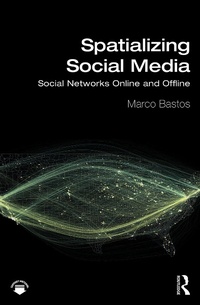
Spatializing Social Media
Social Networks Online and Offline
1st Edition
Published on 19. August 2021
200 pages
978-1-000-42563-5 (ISBN)
Description

Spatializing Social Media charts the theoretical and methodological challenges in analyzing and visualizing social media data mapped to geographic areas. It introduces the reader to concepts, theories, and methods that sit at the crossroads between spatial and social network analysis to unpack the conceptual differences between online and face-to-face social networks and the nonlinear effects triggered by social activity that overlaps online and offline.
The book is divided into four sections, with the first accounting for the differences between space (the geometrical arrangements that structure and enable forms of interaction) and place (the mechanisms through which social meanings are attached to physical locations). The second section covers the rationale of social network analysis and the ontological differences, stating that relationships, more than individual and independent attributes, are key to understanding of social behavior. The third section covers a range of case studies that successfully mapped social media activity to geographically situated areas and considers the inflection of homophilous dependencies across online and offline social networks. The fourth and last section of the book explores a range of networks and discusses methods for and approaches to plotting a social network graph onto a map, including the purpose-built R package Spatial Social Media.
The book takes a non-mathematical approach to social networks and spatial statistics suitable for postgraduate students in sociology, psychology and the social sciences.
The book is divided into four sections, with the first accounting for the differences between space (the geometrical arrangements that structure and enable forms of interaction) and place (the mechanisms through which social meanings are attached to physical locations). The second section covers the rationale of social network analysis and the ontological differences, stating that relationships, more than individual and independent attributes, are key to understanding of social behavior. The third section covers a range of case studies that successfully mapped social media activity to geographically situated areas and considers the inflection of homophilous dependencies across online and offline social networks. The fourth and last section of the book explores a range of networks and discusses methods for and approaches to plotting a social network graph onto a map, including the purpose-built R package Spatial Social Media.
The book takes a non-mathematical approach to social networks and spatial statistics suitable for postgraduate students in sociology, psychology and the social sciences.
Reviews / Votes
"Comprehensive and insightful, Spatializing Social Media provides a fascinating, in-depth analysis of the relationship between the social, spatial and virtual, and the confluence and divergence of social networks on- and offline. Essential reading for anyone interested in understanding the societal and spatial operations and impacts of social media." -- Rob Kitchin, Professor of Geography at Maynooth University, Ireland"Spatializing Social Media provides an original and highly promising framework for the analysis of social media by focusing on the spatial patterns of digital interactions. This place-based perspective is bound to deepen our understanding of the role and effects of digital media in social life. By providing his readers with instructive case studies and a ready-made analytical tool kit, Bastos has made his book into the natural origin point of a new wave of studies with and on social media." -- Andreas Jungherr, Professor for Digital Transformation and Publics at University of Jena, Germany
"By focusing on theoretically grounded suggestions about what we as researchers can actually do once we get our hands on data, the perspectives contained in this book should remain valid for a long stretch of time. Spatializing Social Media appears as more than a methods book, much like it reads as more than theoretical account." -- Anders Olaf Larsson, Professor of Media and Communication Studies at Kristiania University College, Norway
"The idea that network analysis and geographic relationships are close cousins has long been understood, but the details of laying bare these relationships are too often addressed with hand-waving. Hidden beneath the title of Bastos's new book is a thorough exploration of the ways in which networked approaches can be employed to provide a much better understanding of flows in online and offline spaces. The broad theoretical and practical approaches will provide the casual reader a sophisticated introduction to networked spaces, while leaving much to engage more experienced scholars as well." -- Alexander Halavais, Associate Professor of Critical Data Studies at Arizona State University, United States of America "Comprehensive and insightful, Spatializing Social Media provides a fascinating, in-depth analysis of the relationship between the social, spatial and virtual, and the confluence and divergence of social networks on- and offline. Essential reading for anyone interested in understanding the societal and spatial operations and impacts of social media." -- Rob Kitchin, Professor of Geography at Maynooth University, Ireland
"Spatializing Social Media provides an original and highly promising framework for the analysis of social media by focusing on the spatial patterns of digital interactions. This place-based perspective is bound to deepen our understanding of the role and effects of digital media in social life. By providing his readers with instructive case studies and a ready-made analytical tool kit, Bastos has made his book into the natural origin point of a new wave of studies with and on social media." -- Andreas Jungherr, Professor for Digital Transformation and Publics at University of Jena, Germany
"By focusing on theoretically grounded suggestions about what we as researchers can actually do once we get our hands on data, the perspectives contained in this book should remain valid for a long stretch of time. Spatializing Social Media appears as more than a methods book, much like it reads as more than theoretical account." -- Anders Olaf Larsson, Professor of Media and Communication Studies at Kristiania University College, Norway
"The idea that network analysis and geographic relationships are close cousins has long been understood, but the details of laying bare these relationships are too often addressed with hand-waving. Hidden beneath the title of Bastos's new book is a thorough exploration of the ways in which networked approaches can be employed to provide a much better understanding of flows in online and offline spaces. The broad theoretical and practical approaches will provide the casual reader a sophisticated introduction to networked spaces, while leaving much to engage more experienced scholars as well." -- Alexander Halavais, Associate Professor of Critical Data Studies at Arizona State University, United States of America
More details
Edition
1. Auflage
Language
English
Place of publication
London
United Kingdom
Publishing group
Taylor & Francis Ltd
Target group
College/higher education
Professional and scholarly
Product notice
Reflowable
Illustrations
2 Line drawings, black and white; 23 Halftones, black and white; 25 Illustrations, black and white
ISBN-13
978-1-000-42563-5 (9781000425635)
Copyright in bibliographic data and cover images is held by Nielsen Book Services Limited or by the publishers or by their respective licensors: all rights reserved.
Schweitzer Classification
Other editions
Additional editions
Book
08/2021
1st Edition
Routledge
€206.10
Shipment within 15-20 days
Book
08/2021
1st Edition
Routledge
€69.10
Shipment within 15-20 days
Person
Marco Bastos is the University College Dublin Ad Astra Fellow at the School of Information and Communication Studies and Senior Lecturer at City, University of London. His research leverages computational methods and network science to explore the intersection of communication and critical data studies.
Content
Funding
Acknowledgments
Foreword
Introduction
SECTION I
Local and digital: the dyadic interaction of social and virtual
1 Place and space
2 Face-to-face and online communities
3 From global village to identity tribes
SECTION II
Social and spatial networks: the dyadic interaction of virtual and spatial
4 Network spillover
5 Social networks
6 Spatial analysis
SECTION III
Social networks online and offline: the dyadic interaction of social and spatial
7 Spatial and social media data
8 Online-offline coordination
9 The directionality of homophily
SECTION IV
Mapping online to offline social networks: bridging geography and geodesy
10 Network layouts by geodesy and geography
11 Methods in spatial statistics for social networks
12 An R package for spatializing social media
Conclusion
Index of names
Index of subjects
Acknowledgments
Foreword
Introduction
SECTION I
Local and digital: the dyadic interaction of social and virtual
1 Place and space
2 Face-to-face and online communities
3 From global village to identity tribes
SECTION II
Social and spatial networks: the dyadic interaction of virtual and spatial
4 Network spillover
5 Social networks
6 Spatial analysis
SECTION III
Social networks online and offline: the dyadic interaction of social and spatial
7 Spatial and social media data
8 Online-offline coordination
9 The directionality of homophily
SECTION IV
Mapping online to offline social networks: bridging geography and geodesy
10 Network layouts by geodesy and geography
11 Methods in spatial statistics for social networks
12 An R package for spatializing social media
Conclusion
Index of names
Index of subjects
