

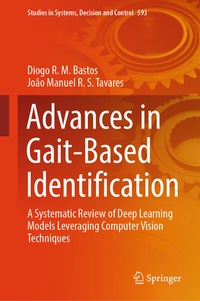
Advances in Gait-Based Identification
Description

This book provides a systematic review of gait-based person identification, categorizing studies into deep-learning and non-deep-learning approaches while analyzing key datasets and performance metrics. It explores challenges such as covariant factors, e.g., viewing angles, clothing, and accessories, and highlights advancements in real-world gait recognition systems. With a structured methodology and transparent review process, this work serves as a valuable reference for researchers and a foundation for future developments in biometric identification.
More details
Other editions
Additional editions
Persons
Diogo R. M. Bastos holds an MSc in biomedical engineering from the Faculdade de Engenharia da Universidade do Porto (FEUP). His research interests include artificial intelligence, computer vision, and gait-based biometric identification.
João Manuel R. S. Tavares is a Full Professor in the Department of Mechanical Engineering at the Faculdade de Engenharia da Universidade do Porto (FEUP) and a senior researcher at the Instituto de Ciência e Inovação em Engenharia Mecânica e Engenharia Industrial (INEGI). His research focuses on computational vision, medical imaging, biomechanics, and biomedical engineering.
Content
Introduction.- Background.- Research objectives and method.- Datasets.- Comparison of the reviewed methods.- Conclusion.
