

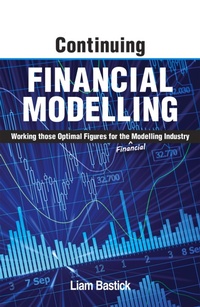
Continuing Financial Modelling
Working Those Optimal Figures for the (Financial) Modelling Industry
Published on 1. September 2020
422 pages
978-1-61547-154-6 (ISBN)
Description

Master advanced financial modeling techniques for real-world business challenges. This guide is for analysts and finance pros seeking to deepen their expertise in forecasting and valuation. It builds upon introductory concepts, exploring complex topics like: Cashflow forecasting pitfalls Inventory modeling strategies Depreciation methods Debt sculpting Rolling budgets & dynamic charting Robust valuations Refine your skills, avoid common traps, and make better decisions. Learn to construct models that drive strategic planning and improve business outcomes.
More details
Other editions
Additional editions
Liam Bastick
Continuing Financial Modelling
Working Those Optimal Figures For the (Financial) Modelling Industry
Book
01/2021
Holy Macro! Books
€51.20
Shipment within 3-4 weeks
Content
- Intro
- About the Author
- Preface
- Editor's notes
- Downloadable Resources
- Chapter 0: Not an Introduction, But a Continuation
- Chapter 1: Recap
- Chapter 1.1: Best Practice Concept
- Chapter 1.2: Time Series Analysis
- CHAPTER 1.3: Financial Statement Theory
- CHAPTER 1.4: Control Accounts
- Chapter 2: What-If? Analysis
- Chapter 2.1: Conditional Formulae
- CHAPTER 2.2: OFFSET
- CHAPTER 2.3: Scenario Analysis
- CHAPTER 2.4: Data Tables
- CHAPTER 2.5: INDEX and MATCH
- CHAPTER 2.6: Using Tornado Charts for Sensitivity Analysis
- CHAPTER 2.7: Simulations Analysis
- CHAPTER 2.8: Variance Analysis
- CHAPTER 2.9: Breakeven Analysis
- Chapter 3: Forecasting Considerations
- CHAPTER 3.1: Seasonal / Cyclical Forecasting
- CHAPTER 3.2: Revising Forecasts
- CHAPTER 3.3: Pro-Rating Forecasts Over Time
- CHAPTER 3.4: Changing Periodicities
- CHAPTER 3.5: Modelling Historical, Actual and Forecast Data
- CHAPTER 3.6: Rolling Budgets and Charts
- CHAPTER 3.7: Forecasting Maximum Cash Required
- Chapter 4: Modelling Inventory
- Chapter 5: Capital Expenditure
- Chapter 6: Debt
- CHAPTER 6.1: Debt Sculpting
- CHAPTER 6.2: Calculating Interest Rates Correctly
- CHAPTER 6.3: Useful Repayment Functions and Formulae
- Chapter 7: Valuation Considerations
- CHAPTER 7.1: Deriving the Correct Cash Flow for DCF
- CHAPTER 7.2: Considering Discount Factors
- CHAPTER 7.3: Common DCF Modelling Errors
- CHAPTER 7.4: Using the Dividend Discount Model
- CHAPTER 7.5: Irrelevant IRR
- CHAPTER 7.6: Modified Internal Rate of Return (MIRR)
- CHAPTER 7.7: Smoothing Capital Expenditure
- CHAPTER 7.8: Calculating Economic Lives
- Chapter 8: Linking Models
- Chapter 9: Life's Too Short
- CHAPTER 9.1: Section Numbering
- CHAPTER 9.2: US vs. European Dates
- CHAPTER 9.3: Sheet Referencing
- CHAPTER 9.4: Reducing File Size
- CHAPTER 9.5: Taking it to the Limit
- CHAPTER 9.6: Order of Operations
- CHAPTER 9.7: Keeping Styles Under Control
- CHAPTER 9.8: Wearing Protection
- Chapter 10: Look To The Future
- CHAPTER 10.1: Dynamic Arrays
- CHAPTER 10.2: XLOOKUP and XMATCH
- CHAPTER 10.3: LET it Be
- CHAPTER 10.4: New Data Types
- CHAPTER 10.5: STOCKHISTORY
- Resources
- Index
