

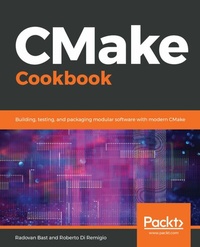
CMake Cookbook
Building, testing, and packaging modular software with modern CMake
1st Edition
Published on 3. June 2024
606 pages
978-1-78847-234-0 (ISBN)
Description

Learn CMake through a series of task-based recipes that provide you with practical, simple, and ready-to-use CMake solutions for your codeKey Features - Learn to configure, build, test, and package software written in C, C++, and Fortran
- Progress from simple to advanced tasks with examples tested on Linux, macOS, and Windows
- Manage code complexity and library dependencies with reusable CMake building blocks
Book DescriptionCMake is cross-platform, open-source software for managing the build process in a portable fashion. This book features a collection of recipes and building blocks with tips and techniques for working with CMake, CTest, CPack, and CDash. CMake Cookbook includes real-world examples in the form of recipes that cover different ways to structure, configure, build, and test small- to large-scale code projects. You will learn to use CMake's command-line tools and master modern CMake practices for configuring, building, and testing binaries and libraries. With this book, you will be able to work with external libraries and structure your own projects in a modular and reusable way. You will be well-equipped to generate native build scripts for Linux, MacOS, and Windows, simplify and refactor projects using CMake, and port projects to CMake. What you will learn - Configure, build, test, and install code projects using CMake
- Detect operating systems, processors, libraries, files, and programs for conditional compilation
- Increase the portability of your code
- Refactor a large codebase into modules with the help of CMake
- Build multi-language projects
- Know where and how to tweak CMake configuration files written by somebody else
- Package projects for distribution
- Port projects to CMake
Who this book is forIf you are a software developer keen to manage build systems using CMake or would like to understand and modify CMake code written by others, this book is for you. A basic knowledge of C++, C, or Fortran is required to understand the topics covered in this book.
- Progress from simple to advanced tasks with examples tested on Linux, macOS, and Windows
- Manage code complexity and library dependencies with reusable CMake building blocks
Book DescriptionCMake is cross-platform, open-source software for managing the build process in a portable fashion. This book features a collection of recipes and building blocks with tips and techniques for working with CMake, CTest, CPack, and CDash. CMake Cookbook includes real-world examples in the form of recipes that cover different ways to structure, configure, build, and test small- to large-scale code projects. You will learn to use CMake's command-line tools and master modern CMake practices for configuring, building, and testing binaries and libraries. With this book, you will be able to work with external libraries and structure your own projects in a modular and reusable way. You will be well-equipped to generate native build scripts for Linux, MacOS, and Windows, simplify and refactor projects using CMake, and port projects to CMake. What you will learn - Configure, build, test, and install code projects using CMake
- Detect operating systems, processors, libraries, files, and programs for conditional compilation
- Increase the portability of your code
- Refactor a large codebase into modules with the help of CMake
- Build multi-language projects
- Know where and how to tweak CMake configuration files written by somebody else
- Package projects for distribution
- Port projects to CMake
Who this book is forIf you are a software developer keen to manage build systems using CMake or would like to understand and modify CMake code written by others, this book is for you. A basic knowledge of C++, C, or Fortran is required to understand the topics covered in this book.
More details
Other editions
Additional editions
Radovan Bast | Roberto Di Remigio
CMake Cookbook
Building, testing, and packaging modular software with modern CMake
Book
09/2018
Packt Publishing
€71.50
Shipment within 3-4 weeks
Persons
Bast Radovan :
Radovan is working at the High Performance Computing Group at UiT - The Arctic University of Norway in Troms and leads the CodeRefinery project. He has a PhD in theoretical chemistry and as code developer is contributing to a number of quantum chemistry programs. He enjoys learning new programming languages and techniques, and to teach programming to students and researchers. He got in touch with CMake in 2008 and has ported a number of research codes and migrated a number of communities to CMake since.Di Remigio Roberto :
Roberto is a postdoctoral fellow in theoretical chemistry at the UiT - The Arctic University of Norway in Troms, Norway and Virginia Tech, USA. He is currently working on stochastic methods and solvation models. He is a developer of the PCMSolver library and the Psi4 open source quantum chemistry program. He contributes or has contributed to the development of popular quantum chemistry codes and libraries: DIRAC, MRCPP, DALTON, LSDALTON, XCFun, and ReSpect. He usually programs in C++ and Fortran.
Radovan is working at the High Performance Computing Group at UiT - The Arctic University of Norway in Troms and leads the CodeRefinery project. He has a PhD in theoretical chemistry and as code developer is contributing to a number of quantum chemistry programs. He enjoys learning new programming languages and techniques, and to teach programming to students and researchers. He got in touch with CMake in 2008 and has ported a number of research codes and migrated a number of communities to CMake since.Di Remigio Roberto :
Roberto is a postdoctoral fellow in theoretical chemistry at the UiT - The Arctic University of Norway in Troms, Norway and Virginia Tech, USA. He is currently working on stochastic methods and solvation models. He is a developer of the PCMSolver library and the Psi4 open source quantum chemistry program. He contributes or has contributed to the development of popular quantum chemistry codes and libraries: DIRAC, MRCPP, DALTON, LSDALTON, XCFun, and ReSpect. He usually programs in C++ and Fortran.
Content
Table of Contents - From a Simple Executable to Libraries
- Detecting the Environment
- Detecting External Libraries and Programs
- Creating and Running Tests
- Configure-time and Build-time Operations
- Generating Source Code
- Structuring Projects
- The Superbuild Pattern
- Mixed-language Projects
- Writing an Installer
- Packaging Projects
- Building Documentation
- Alternative Generators and Cross-compilation
- Testing Dashboards
- Porting a Project to CMake
- Detecting the Environment
- Detecting External Libraries and Programs
- Creating and Running Tests
- Configure-time and Build-time Operations
- Generating Source Code
- Structuring Projects
- The Superbuild Pattern
- Mixed-language Projects
- Writing an Installer
- Packaging Projects
- Building Documentation
- Alternative Generators and Cross-compilation
- Testing Dashboards
- Porting a Project to CMake
