

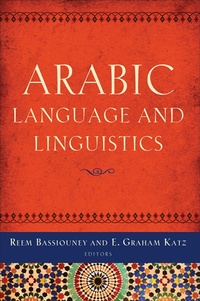
Arabic Language and Linguistics
Description

Arabic, one of the official languages of the United Nations, is spoken by more than half a billion people around the world and is of increasing importance in today's political and economic spheres. The study of the Arabic language has a long and rich history: earliest grammatical accounts date from the 8th century and include full syntactic, morphological, and phonological analyses of the vernaculars and of Classical Arabic. In recent years the academic study of Arabic has become increasingly sophisticated and broad.
This state-of-the-art volume presents the most recent research in Arabic linguistics from a theoretical point of view, including computational linguistics, syntax, semantics, and historical linguistics. It also covers sociolinguistics, applied linguistics, and discourse analysis by looking at issues such as gender, urbanization, and language ideology. Underlying themes include the changing and evolving attitudes of speakers of Arabic and theoretical approaches to linguistic variation in the Middle East.
More details
Other editions
Additional editions
Persons
Reem Bassiouney is an associate professor of Arabic linguistics at Georgetown University. She is the author of Arabic Sociolinguistics: Topics in Diglossia, Gender, Identity, and Politics.
E. Graham Katz is an assistant professor in the Department of Linguistics at Georgetown University.
Content
Preface Transliteration conventions Introduction
Part I: Theoretical and Computational Linguistics
1. Negation in Moroccan Arabic: Scope and Focus Nizha Chatar-Moumni
2. On the Syntax and Semantics of Arabic Universal Quantification Kamel A. Elsaadany and Salwa Muhammed Shams
3. Statistical and Symbolic Paradigms in Arabic Computational Linguistics Ali Farghaly
4. Raising in Standard Arabic: Backward, Forward, and None Youssef A. Haddad
5. Construct State Nominals as Semantic Predicates Sarah Ouwayda
6. On Licensing Wh-Scope: Wh-Questions in Egyptian Arabic Revisited Usama Soltan
7. The Notion of 'Complete' and 'Incomplete' Verbs in Early Arabic Grammatical Theory: Kana and Its Sisters Hana Zabarah
Part II: Sociolinguistics and Applied Linguistics
8. Women and Politeness on Egyptian Talk Shows Reem Bassiouney
9. Bonjour, ça va ? Labas ale-ik? French and Arabic in Casablanca Elena Canna
10. Nominalization in Arabic Discourse: A Genre Analysis Perspective Ahmed Fakhri
11. The Elusiveness of Luġa Wusta?or, Attempting to Catch Its ?True Nature? Gunvor Mejdell
12. Mexicans Speaking in Dârija (Moroccan Arabic): Media, Urbanization, and Language Changes in Morocco Catherine Miller
13. Critical Languages and Critical Thinking: Reframing Academic Arabic Programs Karin Christina Ryding
14. Ideology and the Standardization of Arabic Yasir Suleiman
15. The Ditransitive Dative Divide in Arabic: Grammaticality Assessments and Actuality David Wilmsen
