

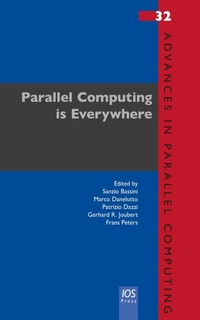
Parallel Computing is Everywhere
1st Edition
Published on 15. March 2018
852 pages
978-1-61499-843-3 (ISBN)
Description

The most powerful computers work by harnessing the combined computational power of millions of processors, and exploiting the full potential of such large-scale systems is something which becomes more difficult with each succeeding generation of parallel computers. Alternative architectures and computer paradigms are increasingly being investigated in an attempt to address these difficulties. Added to this, the pervasive presence of heterogeneous and parallel devices in consumer products such as mobile phones, tablets, personal computers and servers also demands efficient programming environments and applications aimed at small-scale parallel systems as opposed to large-scale supercomputers.
This book presents a selection of papers presented at the conference: Parallel Computing (ParCo2017), held in Bologna, Italy, on 12 to 15 September 2017. The conference included contributions about alternative approaches to achieving High Performance Computing (HPC) to potentially surpass exa- and zetascale performances, as well as papers on the application of quantum computers and FPGA processors. These developments are aimed at making available systems better capable of solving intensive computational scientific/engineering problems such as climate models, security applications and classic NP-problems, some of which cannot currently be managed by even the most powerful supercomputers available. New areas of application, such as robotics, AI and learning systems, data science, the Internet of Things (IoT), and in-car systems and autonomous vehicles were also covered.
As always, ParCo2017 attracted a large number of notable contributions covering present and future developments in parallel computing, and the book will be of interest to all those working in the field.
This book presents a selection of papers presented at the conference: Parallel Computing (ParCo2017), held in Bologna, Italy, on 12 to 15 September 2017. The conference included contributions about alternative approaches to achieving High Performance Computing (HPC) to potentially surpass exa- and zetascale performances, as well as papers on the application of quantum computers and FPGA processors. These developments are aimed at making available systems better capable of solving intensive computational scientific/engineering problems such as climate models, security applications and classic NP-problems, some of which cannot currently be managed by even the most powerful supercomputers available. New areas of application, such as robotics, AI and learning systems, data science, the Internet of Things (IoT), and in-car systems and autonomous vehicles were also covered.
As always, ParCo2017 attracted a large number of notable contributions covering present and future developments in parallel computing, and the book will be of interest to all those working in the field.
More details
Series
Language
English
Place of publication
London
Netherlands
Publishing group
IOS Press
Target group
Professional and scholarly
File size
16,75 MB
ISBN-13
978-1-61499-843-3 (9781614998433)
Copyright in bibliographic data and cover images is held by Nielsen Book Services Limited or by the publishers or by their respective licensors: all rights reserved.
Schweitzer Classification
Other editions
Additional editions

Sanzio Bassini | Gerhard R. Joubert | Frans Peters
Parallel Computing is Everywhere
Book
03/2018
1st Edition
IOS Press,US
€170.84
Article exhausted; check different version
Content
- Title Page
- Preface
- Conference Organisation
- Contents
- Invited Talks
- Smart Systems, the Fourth Industrial Revolution and New Challenges in Distributed Computing
- Main Track
- High Performance Scientific Applications
- Application of Eisenstat-SSOR Preconditioner to Realistic Stress Analysis Problems by Parallel Cache-Cache Computing
- Communication Avoiding Neumann Expansion Preconditioner for LOBPCG Method: Convergence Property of Exact Diagonalization Method for Hubbard Model
- Long Range Forces in a Performance Portable Molecular Dynamics Framework
- Porting of the DBCSR Library for Sparse Matrix-Matrix Multiplications to Intel Xeon Phi Systems
- Benchmarking a Hemodynamics Application on Intel Based HPC Systems
- Memetic Phase Retrieval and HPC for the Imaging of Matter at Atomic Resolution
- Communication Hiding Pipelined Krylov Methods. On Parallel Performance and Numerical Stability of Pipelined Conjugate Gradients
- Solving Sparse Linear Systems of Equations Using Fortran Coarrays
- Design Towards Modern High Performance Numerical LA Library Enabling Heterogeneity and Flexible Data Formats
- Spectral Acceleration of Parallel Iterative Eigensolvers for Large Scale Scientific Computing
- Scalable Block-Tridiagonal Eigensolvers in the Context of Electronic Structure Calculations
- A Parallel Scheduling Algorithm to Solve Triangular Band Systems on Multicore Machine
- Parallel Ray Tracing Algorithm for Numerical Analysis in Radiative Media Physics
- A Parallel Simulator of Quench in Superconducting Magnets
- SPUX: Scalable Particle Markov Chain Monte Carlo for Uncertainty Quantification in Stochastic Ecological Models
- A Parallel Module for Multiblock Structured Grids in JASMIN and Its Applications
- Performance Evaluation and Optimization of MagnetoHydroDynamic Simulation for Planetary Magnetosphere with Xeon Phi KNL
- Real Time and Adaptive Systems
- Optimizing Communication and Synchronization in CAF Applications
- State-Aware Concurrency Throttling
- On Architecture for the Future Petascale Computing
- Popularity-Based Caching of CMS Datasets
- Self-Scheduling for a Heterogeneous Distributed Platform
- CalCul: A Python-Based Workspace for High-Performance Parameters-Sweep in Scientific Legacy Codes
- Comparing Actor System Topologies and Parameters Using BeCoMe
- Energy/Performance Tradeoff
- A Bottleneck-Centric Tuning Policy for Optimizing Energy in Parallel Programs
- Energy Saving and Thermal Management Opportunities in a Workload-Aware MPI Runtime for a Scientific HPC Computing Node
- Optimizing a RBF Interpolation Solver for Energy on Heterogeneous Systems
- Implications of Reduced-Precision Computations in HPC: Performance, Energy and Error
- Design-Time Analysis for the READEX Tool Suite
- A Nature-Inspired, Anytime and Parallel Algorithm for Data Stream Clustering
- Accelerators
- GPU-Accelerated and Storage-Efficient Implementation of the QR Decomposition
- A Fast Implementation of a Spectral Finite Elements Method on CPU and GPU Applied to Ultrasound Propagation
- SYCL-BLAS: Combining Expression Trees and Kernel Fusion on Heterogeneous Systems
- Multi-GPU k-Nearest Neighbor Search in the Context of Data Embedding
- Strategies for Forward Modelling of Infrared Radiative Transfer on GPUs
- Deeply Heterogeneous Many-Accelerator Infrastructure for HPC Architecture Exploration
- Towards a Unified CPU-GPU Code Hybridization: A GPU Based Optimization Strategy Efficient on Other Modern Architectures
- Vectorization Strategies for Ant Colony Optimization on Intel Architectures
- Graphs and Big Data
- Using Complex-Network Properties for Efficient Graph Analysis
- Characterization of Genomic Data Using Graph Databases
- Optimal Nine Node Diffusion for Special Torus Graphs
- Load Balancing and Fault Tolerance
- Improving the Performance of Parallel SpMV Operations on NUMA Systems with Adaptive Load Balancing
- Load Balancing with p4est for Short-Range Molecular Dynamics with ESPResSo
- Dynamic Load Balancing of Monte Carlo Particle Transport Applications on HPC Clusters
- Enabling Application-Integrated Proactive Fault Tolerance
- Parallel IO in the LFRic Infrastructure
- Compiler Directives for Parallel Computing
- Task Based Parallelism with OpenMP: A Case Study with DL_POLY_4
- An Efficient SIMD Implementation of Pseudo-Verlet Lists for Neighbour Interactions in Particle-Based Codes
- Exploiting Hierarchical Parallelism in an Astrophysical Equation of State Using OpenACC and OpenMP
- On the Implementation of OpenMP and Hybrid MPI/OpenMP Parallelization Strategies for an Explicit DG Solver
- AI and Machine Learning
- Implementing Deep Neural Networks on Fresh Breeze
- A Performance Study of Machine and Deep Learning Frameworks on Cineca HPC Systems
- High Level Programming Models
- Towards Distributed Parallel Programming Support for the SPar DSL
- High-Level Parallel Implementation of Swarm Intelligence-Based Optimization Algorithms with Algorithmic Skeletons
- Distributed Event-Based Computing
- Cloud
- Adaptive Execution of Parallel Programs on Grids and Clouds
- Scientific Workflows on Clouds with Heterogeneous and Preemptible Instances
- Mini Symposia
- ParaFPGA 2017
- ParaFPGA 2017: Enlarging the Scope of Parallel Programming with FPGAs
- Bridging the Gap Between Software and Hardware Designers Using High-Level Synthesis
- Pipelined Streaming Computation of Histogram in FPGA OpenCL
- Implementation of the K-Means Algorithm on Heterogeneous Devices: A Use Case Based on an Industrial Dataset
- On Coding Techniques for Targeting FPGAs via OpenCL
- Highly Parallel Lattice QCD Wilson Dirac Operator with FPGAs
- REPARA 2017
- RePara 2017 MiniSymposium: The 3rd International Workshop on Reengineering for Parallelism in Heterogeneous Parallel Platforms
- Simultaneous Multiprocessing on a FPGA+CPU Heterogeneous System-On-Chip
- A Tool to Support FastFlow Program Design
- Higher-Level Parallelism Abstractions for Video Applications with SPar
- Towards a Software Transactional Memory for Heterogeneous CPU-GPU Processors
- Energy Aware Scientific Computing on Low Power and Heterogeneous Architectures
- MiniSymposium on Energy Aware Scientific Computing on Low Power and Heterogeneous Architectures
- Multi-Node Advanced Performance and Power Analysis with Paraver
- Energy-Efficiency Evaluation of Intel KNL for HPC Workloads
- Optimization of Finite-Differencing Kernels for Numerical Relativity Applications
- Large Scale Low Power Computing System: Status of Network Design in ExaNeSt and EuroExa Projects
- The Brain on Low Power Architectures: Efficient Simulation of Cortical Slow Waves and Asynchronous States
- The INFN COSA Project: Low-Power Computing and Storage
- Edge Computing
- MiniSymposium on Edge Computing
- Edge-as-a-Service: Towards Distributed Cloud Architectures
- Flexible Distributed Computing Across End-Devices, the Edge and the Cloud
- Power Modelling for Heterogeneous Cloud-Edge Data Centers
- Edge and Cloud Provider Cost Minimization by Exploiting Extended Voltage and Frequency Margins
- Subject Index
- Author Index
