

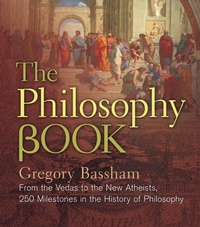
The Philosophy Book
From the Vedas to the New Atheists, 250 Milestones in the History of Philosophy
Published on 1. February 2019
528 pages
978-1-4549-3557-5 (ISBN)
Description

Philosophy explores the deepest, most fundamental questions of reality-and this accessible and entertaining chronology presents 250 milestones of the most important theories, events, and seminal publications in the field over the last 3,500 years. The brief, engaging entries cover a range of topics and cultures, from the Hindu Vedas and Plato's theory of forms to Ockham's Razor, Pascal's Wager, Hume's A Treatise of Human Nature, existentialism, feminism, Philosophical Zombies, and the Triple Theory of Ethics. Beautifully illustrated and filled with unexpected insights, The Philosophy Book will appeal to a wide spectrum of readers.
More details
Other editions
Additional editions

Gregory Bassham
The Philosophy Book
From the Vedas to the New Atheists, 250 Milestones in the History of Philosophy
Book
09/2016
Sterling
€50.95
Article exhausted; check different version
Person
Gregory Bassham is professor of philosophy at King's College in Wilkes-Barre, PA, where he specializes in the philosophy of law, critical thinking, and the connections between pop culture and philosophy. He is also coeditor of several successful books, including The Lord of the Rings and Philosophy (Open Court) and The Ultimate Harry Potter and Philosophy (Wiley), and the lead writer of Critical Thinking: A Student's Introduction (5th ed., McGraw-Hill). Bassham earned his PhD at the University of Notre Dame, and his articles and essays on philosophy are featured in numerous periodicals and books. Having taught philosophy for 25 years, he has read virtually every major work of philosophy ever written. Gregory lives in PA.
Content
- Intro
- Title Page
- Copyright
- Contents
- Introduction
- c. 1500 BCE: The Vedas
- c. 585 BCE: Birth of Western Philosophy
- c. 550 BCE: The Dao
- c. 540 BCE: Reincarnation
- c. 540 BCE: Ahimsa
- c. 530 BCE: Anthropomorphization
- c. 525 BCE: The Four Noble Truths
- c. 525 BCE: No-Self (Anatta)
- c. 500 BCE: Confucian Ethics
- c. 500 BCE: Reciprocity
- c. 500 BCE: Change Is Constant
- c. 500 BCE: The Book of Job
- c. 470 BCE: Change Is Illusory
- c. 460 BCE: Mind Organizes Nature
- c. 460 BCE: The Paradoxes of Motion
- c. 450 BCE: Survival of the Fittest
- c. 450 BCE: Protagoras and Relativism
- c. 450 BCE: The Sophists
- c. 450 BCE: Ladder of Love
- c. 430 BCE: Know Thyself
- c. 420 BCE: Atoms and the Void
- c. 420 BCE: Universal Love
- c. 400 BCE: Cynicism
- c. 400 BCE: Cyrenaic Hedonism
- c. 400 BCE: The Bhagavad Gita
- 399 BCE: The Trial and Death of Socrates
- c. 399 BCE: Socratic Dialogues
- c. 386 BCE: Plato Founds the Academy
- c. 380 BCE: The World of the Forms
- c. 380 BCE: Plato's Republic
- c. 380 BCE: Mind-Body Dualism
- c. 367 BCE: Aristotle Enrolls in the Academy
- 334 BCE: Hellenization Begins
- c. 330 BCE: The Invention of Logic
- c. 330 BCE: The Earth-Centered Universe
- c. 330 BCE: Matter and Form
- c. 330 BCE: The Four Causes
- c. 330 BCE: Nicomachean Ethics
- c. 320 BCE: Maybe Life Is a Dream
- c. 300 BCE: Ecclesiastes
- c. 300 BCE: Epicureanism
- c. 300 BCE: Stoicism
- c. 300 BCE: Innate Goodness
- 155 BCE: Carneades on Justice
- c. 55 BCE: On the Nature of Things
- 51 BCE: Universal Moral Law
- c. 30 CE: The Christian Era Begins
- c. 65: Buddhism Comes to China
- 65: The Death of Seneca
- c. 125: Epictetian Stoicism
- c. 150: Platonism and Christianity
- 180: The Philosopher-King
- c. 200: Outlines of Pyrrhonism
- c. 250: Neoplatonism
- c. 285: The Problem of Universals
- 386: Augustine's Conversion
- 415: Death of Hypatia
- 426: The City of God
- c. 460: The Last Great Greek Philosopher
- 476: The Dark Ages Begin
- c. 500: The Way of Negation
- c. 520: Origins of Chan/Zen Buddhism
- 524: The Consolations of Philosophy
- 529: Justinian Closes the Academy
- c. 630: The Rise and Spread of Islam
- c. 700: Huineng and the Platform Sutra
- c. 810: Monism
- c. 840: Islamic Philosophy Begins
- c. 865: Eriugena's Christian Neoplatonism
- c. 1015: Ibn Sina's Islamic Aristotelianism
- 1078: The Ontological Argument
- c. 1093: The Incoherence of the Philosophers
- 1121: The Birth of Scholasticism
- c. 1130: Aristotelian Revival in the West
- c. 1135: Qualified Dualism
- c. 1180: Revival of Confucianism
- c. 1185: The Commentator
- c. 1190: The Guide for the Perplexed
- c. 1220: Philosophers Join Academia
- c. 1250: The Universal Doctor
- 1259: A Franciscan Approach to Philosophy
- c. 1265: The Great Medieval Synthesis
- c. 1265: The Five Ways
- c. 1270: Natural Law
- c. 1300: Attack on the Medieval Synthesis
- c. 1300: Mystical Theology
- c. 1320: Ockham's Razor
- c. 1320: Conceptualism
- 1324: The Defender of Peace
- c. 1350: The Renaissance Begins
- 1440: The Synthesis of Opposites
- 1468: The Recovery of Platonism
- 1516: Utopia
- 1517: The Reformation Begins
- c. 1520: The Humanist Ideal
- c. 1525: The Silver Age of Scholasticism
- 1532: The Prince
- 1539: The Rights of Native Peoples
- 1543: The Birth of Modern Science
- 1580: Revival of Classical Skepticism
- 1605: The Advancement of Learning
- 1620: The Enlightenment Begins
- 1625: On the Law of War and Peace
- 1637: The Father of Modern Philosophy
- 1641: Meditations on First Philosophy
- 1651: Leviathan
- 1651: Free Will and Determinism Are Compatible
- 1670: Pascal's Wager
- 1674: Occasionalism
- 1677: Ethics
- 1689: Human Rights
- 1689: Religious Liberty
- 1689: Empiricism
- c. 1700: Preestablished Harmony
- 1713: To Be Is to Be Perceived
- 1725: The Moral Sense
- 1730: Deism
- 1736: The Analogy of Religion
- 1739: A Treatise of Human Nature
- 1739: The Problem of Induction
- 1748: An Attack on Miracles
- 1748: The Spirit of the Laws
- 1751: Morality Is Rooted in Feeling
- 1754: America's First Major Philosopher
- 1759: Candide
- c. 1760: The Birth of Romanticism
- 1762: The Social Contract
- 1762: Emile and Natural Education
- 1764: The Philosophy of Common Sense
- 1770: A Godless, Mechanistic Universe
- 1779: Hume's Dialogues
- 1781: Critique of Pure Reason
- 1785: The Categorical Imperative
- 1787: The Federalist
- 1789: Utilitarianism
- 1790: Critique of Judgment
- 1790: Forefather of Conservatism
- 1792: A Vindication of the Rights of Woman
- c. 1795: The Beginnings of German Idealism
- 1807: The Phenomenology of Spirit
- 1819: The Philosophy of Pessimism
- 1821: The Real Is the Rational
- 1830: Positivism
- 1832: Law and Morality Are Separate
- 1836: American Transcendentalism
- 1841: Idealism Is Turned Upside Down
- 1843: Existentialism
- 1843: A System of Logic
- 1846: Truth Is Subjectivity
- 1848: The Communist Manifesto
- 1854: Walden
- 1859: On Liberty
- 1859: Darwin's Origin of Species
- 1862: Social Darwinism
- 1863: Refined Utilitarianism
- c. 1865: The Rise of British Idealism
- 1867: Capital
- 1869: The Subjection of Women
- 1874: The Methods of Ethics
- 1874: Intentionality
- 1878: Origins of Pragmatism
- 1879: The New Logic
- 1882: "God Is Dead"
- 1882: Perspectivism
- 1887: The Revaluation of Values
- 1890: The Principles of Psychology
- 1897: "The Will to Believe"
- 1900: Phenomenology
- 1901: Environmental Preservationism
- 1902: The Varieties of Religious Experience
- 1903: Ethical Intuitionism
- 1903: The Analytic-Continental Split
- 1905: The Theory of Definite Descriptions
- 1907: Pragmatism
- 1907: Vitalism
- 1910: Principia Mathematica
- 1912: The Problems of Philosophy
- 1916: Progressive Education
- 1918: Logical Atomism
- 1920: Contemplation vs. Enjoyment
- c. 1920: Neo-Thomism
- 1921: The Picture Theory of Language
- 1923: I and Thou
- 1925: Instrumentalism
- 1927: Being and Time
- 1927: Religion as Wish Fulfillment
- 1929: Process Philosophy
- 1929: An Idealist View of Life
- 1930: Deontological Intuitionism
- 1932: Ordinary Language Philosophy
- 1934: The Rejection of Metaphysics
- 1936: Logical Positivism
- 1938: Nausea
- 1942: Existential Defiance
- 1943: Being and Nothingness
- 1944: Emotivism
- 1945: The Phenomenology of Perception
- 1946: Atheistic Existentialism
- 1949: The Ghost in the Machine
- 1949: The Second Sex
- 1949: Ecocentrism
- 1951: "Two Dogmas of Empiricism"
- 1952: Prescriptivism
- 1953: Philosophical Investigations
- 1953: Impossibility of a Private Language
- 1954: The New Riddle of Induction
- 1957: Intention
- 1959: Falsifiability in Science
- 1959: Descriptive Metaphysics
- 1960: The Indeterminacy of Translation
- 1960: Hermeneutics
- 1960: Functionalism
- 1961: Legal Positivism
- 1962: Scientific Revolutions
- 1962: Oxford Ordinary Language Philosophy
- 1963: The Gettier Problem
- 1966: Soul-Making Theodicy
- 1967: Deconstruction
- c. 1968: The (Re)birth of Applied Ethics
- 1968: Mind-Brain Identity Theory
- 1970: Anomalous Monism
- 1971: A Theory of Justice
- c. 1971: The Rise of Informal Logic
- 1974: Political Libertarianism
- 1974: "What Is It Like to Be a Bat?"
- 1974: Essentialism
- 1975: Animal Liberation
- 1975: Power/Knowledge
- c. 1976: Emergence of Feminist Philosophy
- 1977: Moral Anti-Realism
- 1977: Taking Rights Seriously
- 1979: The New Pragmatism
- 1979: Postmodernism
- 1979: Reliabilism
- 1980: The Chinese Room
- 1980: The Causal Theory of Reference
- 1981: The Revival of Virtue Ethics
- 1981: Critical Theory
- 1982: In a Different Voice
- 1984: Revival of Christian Philosophy
- 1984: Reasons and Persons
- 1984: The Moral Limits of the Criminal Law
- 1985: The Peculiar Institution of Morality
- 1987: Pragmatic Realism
- 1989: Religious Pluralism
- 1991: Philosophical Zombies
- 2000: The Capability Approach
- 2004: The New Atheists
- 2006: Cosmopolitanism
- 2011: The Triple Theory of Ethics
- Notes and Further Reading
- Image Credits
