

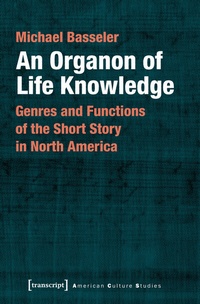
An Organon of Life Knowledge
Genres and Functions of the Short Story in North America
1st Edition
Published on 23. January 2019
276 pages
978-3-8394-4642-3 (ISBN)
Description

Can fiction teach us how to live? This study offers a fresh take on the North American short story, exploring how the genre has engaged in the construction and circulation of 'life knowledge'. Echoing the resurgence of short story scholarship in recent years, it thus contributes a genre-focused perspective to the growing field of 'literature and knowledge' studies. Drawing on stories from the late 19th century to the present by authors such as Henry James, F. Scott Fitzgerald, Eudora Welty, Junot Díaz, and Alice Munro, Michael Basseler examines how knowledge about life and how to live it is generically constituted and, vice versa, how literary genres such as the short story are embedded in broader cultural frameworks of knowledge production.
Reviews / Votes
»As it stands, An Organon of Life Knowledge is a well-balanced, theoretically well-informed and critically insightful monograph that opens new ground in the field of short story theory and criticism. We need more books like this oneto expand our knowledge of life and literature and of their mutual interaction.«More details
Other editions
Additional editions
Michael Basseler
An Organon of Life Knowledge
Genres and Functions of the Short Story in North America
Book
02/2019
1st Edition
transcript
€34.99
Shipment within 7-9 days
Person
Michael Basseler (Dr. habil.), born in 1976, works as Academic Manager at the International Graduate Centre for the Study of Culture at the University of Gießen. His research focuses on US-American literature and culture as well as literary and cultural theory, especially the study of narrative, African American literature, and the short story. His current project deals with the concept of resilience from a literary and cultural perspective.
Content
- Cover
- Contents
- Preface and Acknowledgements
- Introduction
- Part One: Life, Literature, and Knowledge: Theoretical Premises
- 1. Literature, Life Knowledge, and 'Science for Living'
- 2. The Knowledge of Literature: Positions, Debates, and Approaches
- Part Two: The Genericity of Literary Life Knowledge in the Short Story
- 4. The Short Story as an Organon of Life Knowledge: An Epistemological Approach to the Genre
- 5. Life Knowledge as Projection: The Cognitive Work of Short Stories
- 6. Life-Changing Experiences and Turning Points: The Crisis-Ridden Life Knowledge of the Short Story
- 7. The American Short Story and the Temporalization of Life in Modernity: Washington Irving's "Rip Van Winkle" and F. Scott Fitzgerald's "The Curious Case of Benjamin Button"
- Part Three: Stages of Life - Staging Life in the Short Story
- 8. Epistemological Uncertainty and Knowledge of Maturation in Stories of Initiation: Sherwood Anderson's "I Want to Know Why", Eudora Welty's "A Visit of Charity" and "A Memory", and Junot Díaz's "Ysrael
- 9. Midlife Crisis as Turning Point for the 'Mature Moderns': John Cheever's "The Country Husband"
- 10. Stories of 'Unlived' and Secret Lives: Nathaniel Hawthorne, Sherwood Anderson, Henry James, and James Thurber
- 11. Gerontophobia, Ageism, and the Wisdom of Later Life in Stories of Aging: Willa Cather's "Old Mrs. Harris" and Eudora Welty's "Old Mr. Marblehall"
- 12. Understanding Life Retrospectively in Stories of Remembered Life: Willa Cather, William Saroyan, Russell Banks, Anthony Doerr
- Coda: The Short Story as Epistemological Fiction Alice Munro's "What Do You Want to Know For?"
- Works Cited
